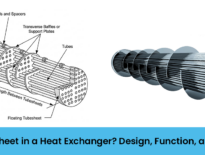
In a shell-and-tube heat exchanger, getting the shell-side fluid to actually interact with the tube bundle rather than bypassing it is the core thermal design challenge. This is addressed by the use of pipe baffles, the effect of which is to create plates or discs inside the shell to change the flow direction of the fluid through the tubes, and to provide mechanical support. With them, the fluid would flow smoothly without much turbulence, which would significantly decrease the heat exchange efficiency. A knowledge of pipe baffles is vital to understanding how to optimize the performance of an exchanger and this guide covers the various types, design principles, the role they play and how they can be applied. Solitaire Overseas provides high-quality Pipe baffles and other material which are delivered in different parts of India and all over the world.
Types of Pipe Baffles
Different types of pipe baffles are used in shell-and-tube heat exchangers depending on the required heat transfer performance, pressure drop, and operating conditions. Here’s a simplified overview of the most common types:
- Single Segmental Baffle: This is the most popular variety of Baffles heat exchanger. An annular plate having a cut part (usually 20-25%) which causes the fluid to flow in a cross-flow motion between the tubes in a zigzag manner. It is balanced for both heat transfer and pressure drop, and is suitable for most applications.
- Double Segmental Baffle: This design is a two cut design with two parallel flow paths. It results in a smaller pressure loss than a single segmental baffle, but still has reasonable heat transfer. It is widely used in condenser systems and applications where lower resistance is desired.
- Triple Segmental Baffle: In this type, fluid can pass through several pathways, which means that the pressure drop is very low with three cuts. There is a slight reduction in the heat transfer however, and a more complex fabrication process. It’s appropriate for big exchangers and gas cooling applications.
- Disk-and-Doughnut Baffle: This kind is composed of alternately solid discs and ring-shaped plates. The sequence of fluid flow around the disc and through the ring makes for a more uniform flow pattern. It is suitable for use in high flow, low fouling applications such as chemical services, refinery services, etc.
- Helical (Twisted) Baffle: The helical baffles cause the fluid to flow in a spiral, rather than a zig-zag, pattern. This not only results in low dead zones, fouling and pressure drop, but it also provides good heat transfer. These tend to have a higher initial cost, but are better for long-term efficiency and maintenance.
- Rod Baffle: Rod baffles are the baffles which contain with grid of rods, rather than rigid plates. The flow of the fluid in the tubes has a very low pressure drop, and the vibration of the tubes is reduced. Mainly used in gas-to-gas exchangers and systems with high velocity.
- Orifice Baffle: These baffles are designed with small gaps around the tubes which create jet-like flow, enhancing the local turbulence and heat transfer. They are, however, susceptible to fouling, and so are only used in clean fluid services.
- Longitudinal Baffle: This baffle is placed parallel to the tubes and divides the shell into parts for multi-pass flow. It aids to obtain counter current flow and hence, better heat transfer efficiency. It is used in designs where better temperature control is desired.
Key Baffle Design Parameters
To achieve a satisfactory balance of heat transfer, pressure drop and equipment life in a heat exchanger, a baffle design must be good. In addition to the type of baffle, these are the main parameters that determine the performance of the system under real conditions.
- Baffle Spacing: The distance between two baffles is called baffle spacing. It should not be too big or too small as per standards; usually, it is in the range of 0.3 – 0.6 times the diameter of the shell. Too-tight spacing leads to a rise in pressure drop, and cleaning will be difficult. The farther away, the more fluid will flow straight rather than across the tubes, which means there will be less heat transferred and vibrations will result.
- Baffle Cut (%): The percentage of the plate cut for the fluid to pass through is called the baffle cut. Typically falls between 15% and 45%, with 20-25% being the most frequent. A smaller cut will have better heat transfer, but will create more pressure drop, and a larger cut will create less of a pressure drop but will have less heat transfer because the fluid will bypass the cut.
- Baffle Orientation: The direction of the baffle cut is called the orientation, either horizontal or vertical. Horizontal cuts will work well for liquids, but not for drainage. Vertical cuts are more suitable for gas and two-phase systems since it will help to drain and limit fluid accumulation.
TEMA Standards for Baffle Design
The primary design standards for shell-and-tube baffles heat exchangers are written by TEMA (Tubular Exchanger Manufacturers Association) and specify important design rules for baffles. It includes three classes: Class R (heavy duty for refinery), Class B (chemical processing), and Class C (general applications).
TEMA guidelines relate to factors such as limiting baffle spacing, hole size (typically the outside diameter of the tube plus 0.8 mm), shell to baffle clearance requirements and the necessary baffle plate thickness based on the size of the shell. These rules ensure safe equipment operation, good heat transfer, and long equipment life. The latest TEMA 11th Edition (2024) includes updated design requirements, making it important for current engineering standards.
Applications of Pipe Baffles
The Pipe baffles heat exchanger come with high strength and corrosion resistance in many harsh conditions. Because of these features many industries use this material and some of the common ones are listed below.
- Oil Refineries & Petrochemicals: Pipe baffles are widely used in crude preheat trains and reactor feed or effluent exchangers. They assist in creating a more efficient transfer of heat and proper fluid flow through the tubes under high temperature and high pressure conditions.
- Power Generation: Pipe baffles are installed in cooling systems and steam condensers of power plants as well as in feedwater heaters. They improve thermal efficiency and assist tubes during continuous operation and varying loads.
- Chemical Processing: Baffles heat exchanger are used in reactor heat removal, solvent recovery systems. They are used to regulate the temperature of chemical reactions and enhance process efficiency.
- Pharmaceutical Manufacturing: Pipe baffles are utilized in sterile heat exchanger applications in pharmaceutical systems. They provide proper heat transfer and keep hygiene and contamination in check.
- Food and Beverage Industry: Pipe baffles heat exchangers are utilized in pasteurizers and product cooling systems to help keep the product and product quality uniform during processing.
- HVAC and Industrial Refrigeration: A baffle is an often-used feature in a shell-and-tube chiller. They help to optimize the cooling system’s performance and maintain a balanced distribution of cooling fluids.
- Sea and offshore zones.: Pipe baffles are used in seawater coolers and LNG processing units in marine systems. They enable the effective control of heat transfer in a corrosive and demanding environment.