+91-9619103479
or
vishal@solitaire-overseas.com
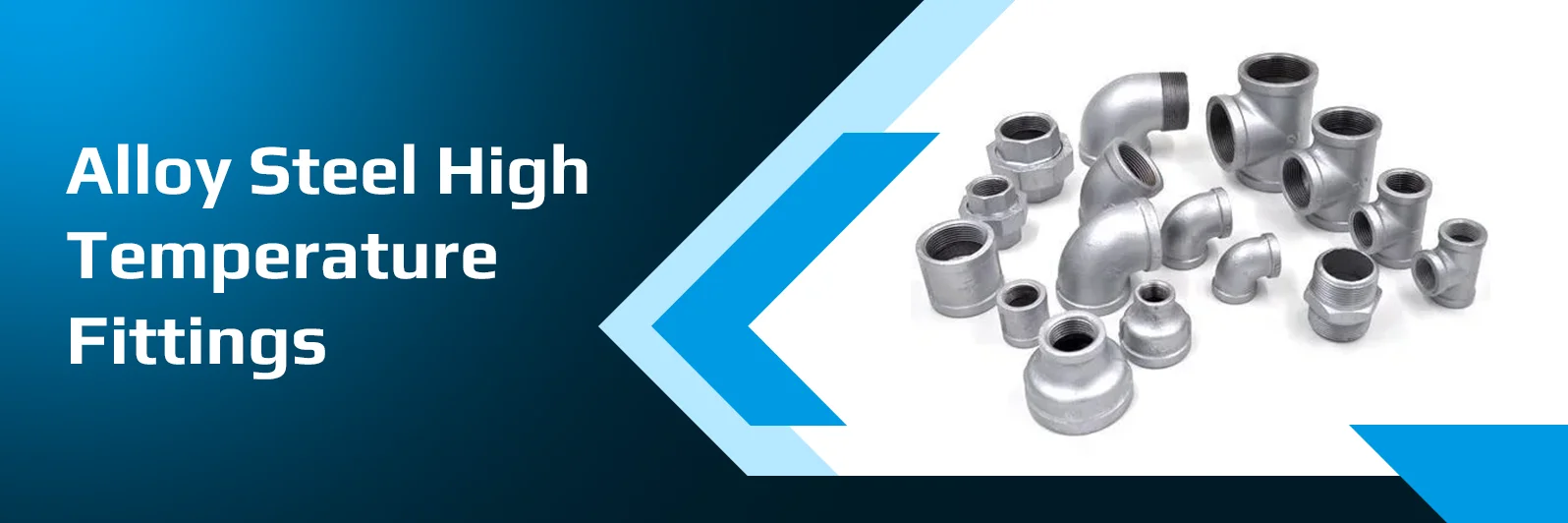
There is a temperature where P91 stops being expensive and starts being cheaper. It sits around 975 degrees F. Below it, P22 wins on first cost and there is little reason to specify anything else. Above it, P91's creep strength lets the same duty be carried in a wall roughly half as thick, and the saving in material, weight, supports and thermal fatigue life outruns the higher price per kilo. Solitaire Overseas supplies alloy steel fittings for high temperature service from India, P11 through P91, buttweld and forged, with the heat treatment records that these grades live or die by. Below: the grade ladder by temperature, why creep governs, and what P91 demands in fabrication.
At Temperature, Strength Is Not the Problem
A hot line rarely fails by overload. It fails by creep: slow, time-dependent deformation under a load the material could carry indefinitely if it were cold. Every design decision in high temperature piping follows from that. The question is not whether the fitting is strong enough today, it is whether it will still be the right shape in thirty years.
Which is why chromium and molybdenum are there.
Molybdenum raises creep strength directly. Chromium provides oxidation resistance so the metal does not scale away from the outside while it is creeping from the inside. The grades below are essentially a ladder of increasing chromium and molybdenum, and each rung buys another band of temperature.
| Grade | Chromium | Typical Service Band | Where It Is Used |
|---|---|---|---|
| P1 / WP1 | Carbon-moly, no Cr specified | Moderate | General steam service above carbon steel's limit |
| P11 / WP11 | 1.00 - 1.50% | Up to around 510 C | Superheater and reheater tubes, HP steam headers, interconnecting piping in conventional plant |
| P12 / WP12 | 0.80 - 1.25% | Similar band to P11 | General elevated temperature service |
| P22 / WP22 | 1.90 - 2.60% | Above 510 C | Main steam and hot reheat lines. Also the standard for hydrogen reformer piping, where higher Mo resists hydrogen attack |
| P5 / WP5 | 4.0 - 6.0% | High temperature refinery | Sulfidation resistance rather than pure creep strength |
| P9 / WP9 | 8.0 - 10.0% | High temperature refinery | As P5, with more chromium |
| P91 / WP91 | 8.0 - 9.5% plus V, Nb, N | Supercritical, roughly 570 to 620 C | Superheater and reheater outlet headers, main steam piping in supercritical and ultra-supercritical plant |
This is the most common material question in high temperature piping, and it has a reasonably clear answer:
| What Changes | Effect of Moving from P22 to P91 |
|---|---|
| Wall thickness | Reduced by roughly half to two thirds for the same duty |
| Component weight | Reduced by around 60 percent |
| Allowable strength | Up to 150 percent higher in the 950 to 1100 F range |
| Oxidation limit | Raised by roughly 100 F |
| Thermal fatigue life | Increased by a factor of ten or more, because thinner walls mean smaller thermal gradients |
| Support and hanger loads | Reduced, following from the weight saving |
| Fabrication difficulty | Significantly higher. See the next fold |
P91 is not a drop-in upgrade. Its properties come from a tempered martensitic microstructure that is created by heat treatment and destroyed by getting that heat treatment wrong:
All standard fitting types in the high temperature chrome-moly grades, buttweld and forged:
Product pages: elbows, tees, reducers, caps, couplings, outlet fittings, pipe bends.
Grade pipe pages: P11, P22, P91, P5, P9, P12.
| Item | Detail |
|---|---|
| Buttweld fittings | ASTM A234 WP grades to ASME B16.9 and B16.28 |
| Forged fittings | ASTM A182 F grades to ASME B16.11 |
| Grades | WP1/F1, WP5/F5, WP9/F9, WP11/F11, WP12/F12, WP22/F22, WP91/F91 |
| Heat treatment | Normalised, normalised and tempered, or quenched and tempered per grade. PWHT records supplied |
| Testing | PMI, hardness testing, mechanical testing, NDE on request |
| Certification | EN 10204 3.1 as standard, 3.2 with third-party inspection |
Industry comparisons put the economic break point at around 975 degrees F. Below that, P22 usually wins on first cost. Above it, P91's creep strength allows roughly half the wall thickness for the same duty, and the savings in material, weight, supports and thermal fatigue life outweigh the higher price. This is orientation rather than a design rule, the piping engineer's analysis under the applicable code decides it.
Its creep strength comes from a tempered martensitic microstructure with a fine dispersion of carbides and carbonitrides, and that structure is created by normalising and tempering within a narrow temperature window. Tempering outside the window leaves the material either too hard and brittle or too weak to meet its design creep strength. Hardness testing is the practical check that it was done correctly.
P22 is the standard grade for hydrogen reformer piping in refineries and ammonia plants, where its higher molybdenum content gives better resistance to high temperature hydrogen attack. For sulfidation resistance in refining, the higher chromium grades P5 and P9 are used, which is a different requirement from creep strength.
On P22 and P91 it is mandatory regardless of wall thickness. On lower alloy grades such as P11 it is required once wall thickness exceeds the threshold in the applicable code. PWHT records should form part of the documentation package on any high temperature alloy order.
Send your design temperature and pressure, grade, fitting types and sizes, and we will confirm grade suitability, heat treatment requirements, certification and lead time.