+91-9619103479
or
vishal@solitaire-overseas.com
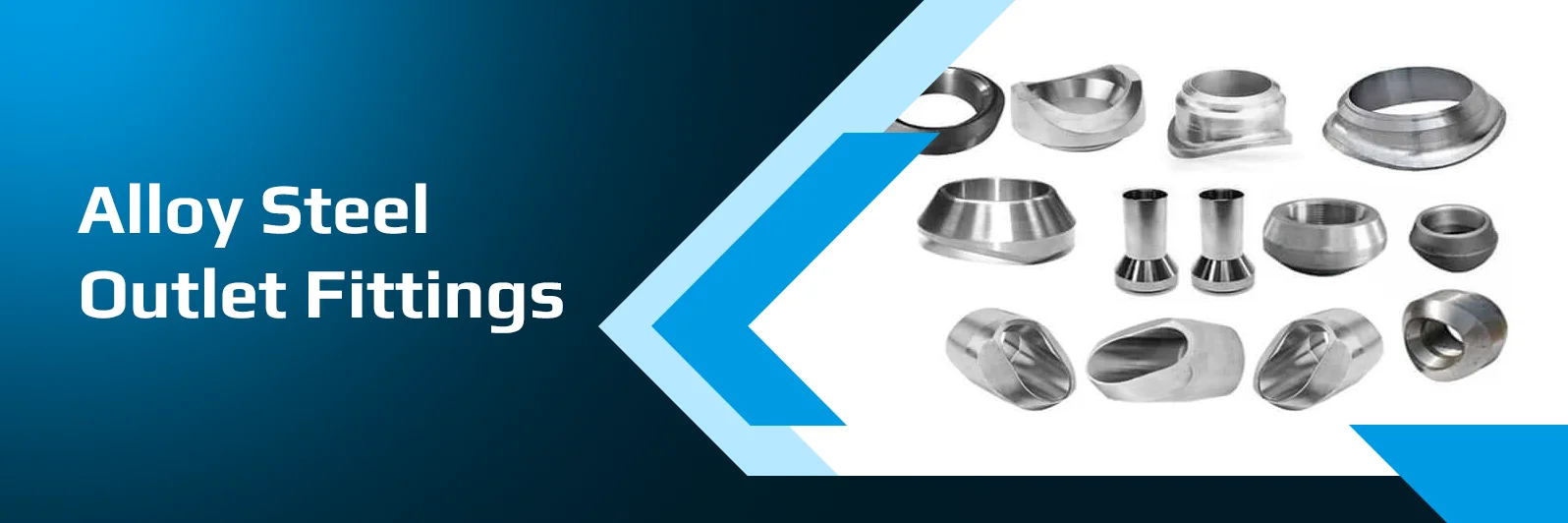
Cut a hole in a pressurised pipe and you have weakened it. The metal you removed was carrying load, and the piping code requires that load to be put back, which traditionally meant welding a reinforcing pad around the branch. A branch outlet fitting does the same job in one piece. The reinforcement is forged into the fitting as excess thickness, so it satisfies the code's requirement without a pad, without the extra welds and without the crevice a pad creates. Solitaire Overseas manufactures and exports alloy steel branch outlet fittings from India to MSS SP-97, in chrome-moly grades P1 through P91, with buttweld, socket weld and threaded outlets. Below: the fitting types, why integral reinforcement matters, and how outlets are specified.
Part of our alloy steel fittings range. See also alloy steel couplings for half couplings, the simpler branch option.
A branch outlet fitting creates a smaller take-off from a larger run pipe. It is contoured to sit against the curve of the run and is attached by a full penetration weld, with the branch pipe then connected by buttweld, socket weld or thread depending on the outlet type.
Integrally reinforced is the phrase that matters, and it is what separates these fittings from the alternatives. Piping codes require that the strength removed by cutting the branch hole is replaced. A branch outlet fitting carries that reinforcement as extra thickness machined into the forging itself, so it meets the 100 percent reinforcement requirement of ASME B31.1, B31.3, B31.4 and B31.8 without a separate reinforcing pad. One fitting, one weld, no pad, and no annular crevice where a pad would sit.
Governing standard: MSS SP-97, Integrally Reinforced Forged Branch Outlet Fittings, covering socket welding, threaded and buttwelding ends. To be used within their published ratings, these fittings are design proof tested to ASME B16.9, MSS SP-97, or ASME BPVC Section VIII Division 1 UG-101.
| Item | Detail |
|---|---|
| Design standard | MSS SP-97, Integrally Reinforced Forged Branch Outlet Fittings |
| Applicable piping codes | ASME B31.1, B31.3, B31.4, B31.8 |
| Proof testing | Design proof tested per ASME B16.9, MSS SP-97 or ASME BPVC VIII Div 1 UG-101 |
| Material standard | ASTM A182 / ASME SA182 forged alloy steel |
| Grades | F1, F5, F9, F11, F12, F22, F91 |
| Outlet types | Buttweld, socket weld, threaded, elbow, lateral, nipple, contoured |
| Mounting angle | 90 degrees perpendicular or 45 degrees lateral |
| Branch connection standards | ASME B16.25 (buttweld bevel), ASME B16.11 (socket and threaded classes) |
| Sizing | Specified as run size by branch size, both schedules stated |
| Certification | EN 10204 3.1 mill test certificate. PMI, NDE and third-party inspection on request |
Outlets are classified by how the branch pipe connects and where the fitting is mounted:
| Generic Name | Commonly Called | Branch Connection | Use |
|---|---|---|---|
| Buttweld outlet | Weldolet (trademark) | Bevelled, branch is buttwelded | The most common outlet. Full-bore branches on pressure piping |
| Socket weld outlet | Sockolet (trademark) | Counterbored socket, fillet welded | Small-bore branches, easier fit-up than buttweld |
| Threaded outlet | Thredolet (trademark) | Female NPT thread | Instrument and utility branches, no branch welding needed |
| Elbow outlet | Elbolet (trademark) | Contoured to sit on an elbow | Tapping into the back of an elbow, common for thermowells |
| Lateral outlet | Latrolet (trademark) | 45 degree branch | Angled take-offs, lower turbulence than a 90 degree branch |
| Nipple outlet | Nipolet (trademark) | Integral extended nipple | Drain and vent points, valve mounting off the run |
| Contoured buttweld outlet | Sweepolet (trademark) | Contoured, low stress intensification | Fatigue and cyclic service. Weld easily radiographed |
Forged from ASTM A182 chrome-moly material, matched to the ASTM A335 pipe grade of the run:
| A182 Grade | Matching Pipe | Chromium | Molybdenum | Typical Service |
|---|---|---|---|---|
| F1 | P1 | Not specified (carbon-moly) | 0.44 - 0.65% | Moderate temperature steam |
| F5 | P5 | 4.0 - 6.0% | 0.44 - 0.65% | Refinery hydrogen and sulphur service |
| F9 | P9 | 8.0 - 10.0% | 0.90 - 1.10% | Higher temperature refinery piping |
| F11 | P11 | 1.00 - 1.50% | 0.44 - 0.65% | The workhorse grade |
| F12 | P12 | 0.80 - 1.25% | 0.44 - 0.65% | General elevated temperature service |
| F22 | P22 | 2.00 - 2.50% | 0.87 - 1.13% | Higher temperature and pressure than F11 |
| F91 | P91 | 8.0 - 9.5% | 0.85 - 1.05% (plus V) | Modern high-temperature power plant piping |
Three ways to make a branch. They differ in how the reinforcement is provided and how much welding is involved:
| Branch Outlet Fitting | Stub-in with Reinforcing Pad | Half Coupling | |
|---|---|---|---|
| Reinforcement | Forged into the fitting | Separate pad welded around the branch | None inherent. Reinforcement must be assessed separately |
| Welds | One full penetration weld | Branch weld plus pad weld | One weld |
| Crevice risk | None | Annular gap under the pad | None |
| Inspection | Weld accessible for NDE | Pad weld harder to examine | Straightforward |
| Best for | Code-compliant branches on pressure piping | Site fabrication where outlets are unavailable | Small instrument, drain and vent tappings |
Half couplings are covered on our alloy steel couplings page, and suit small tappings where a full reinforced outlet is more than the duty requires. For pressure-retaining branches on chrome-moly lines, the outlet fitting is normally the correct choice.
Solitaire Overseas manufactures alloy steel branch outlet fittings in India and exports to power, refinery, petrochemical and pipeline projects worldwide. Orders ship with EN 10204 3.1 certification and heat-number traceability, with export documentation and third-party inspection arranged in-house. Send your run size, branch size, both schedules, grade and outlet type for a quote.
Cutting a branch hole in a pipe removes metal that was carrying load, and the piping code requires that strength to be replaced. An integrally reinforced outlet fitting carries the reinforcement as extra thickness forged into the fitting itself, so it satisfies the reinforcement requirement of ASME B31.1, B31.3, B31.4 and B31.8 without a separate welded pad. That means one weld instead of two, and no crevice under a pad.
Only the branch connection. A buttweld outlet has a bevelled end so the branch pipe is buttwelded to it, giving a full-bore connection for pressure piping. A socket weld outlet has a counterbored socket that the branch pipe sits in, fillet welded, which is easier to fit up on small bore. A threaded outlet has a female NPT thread so the branch screws in with no welding, suited to instrument and utility connections.
Yes, that is the purpose of the fitting. A stub-in branch with a welded reinforcing pad and an integrally reinforced outlet both satisfy the code requirement, but the outlet does it in one piece with a single full penetration weld, avoids the annular crevice under a pad, and gives a weld that is easier to examine. Outlets are normally preferred on pressure piping; pads persist in site fabrication where an outlet is not available.
As run size by branch size, for example 8 inch by 2 inch, with the schedule of each stated. The base of the fitting is contoured to the specific outside diameter of the run pipe, so a fitting made for one run size will not seat correctly on another. Always give both dimensions and both schedules, plus the grade and outlet type.
A branch outlet fitting is integrally reinforced and designed to satisfy the code's branch reinforcement requirement on pressure piping. A half coupling is a simple socket or threaded fitting welded to the run, with no inherent reinforcement, so reinforcement has to be assessed separately. Half couplings suit small instrument, drain and vent tappings. See our alloy steel couplings page.
Send your run size and branch size with both schedules, the grade, outlet type and mounting angle, and we will confirm availability, certification and lead time.