+91-9619103479
or
vishal@solitaire-overseas.com
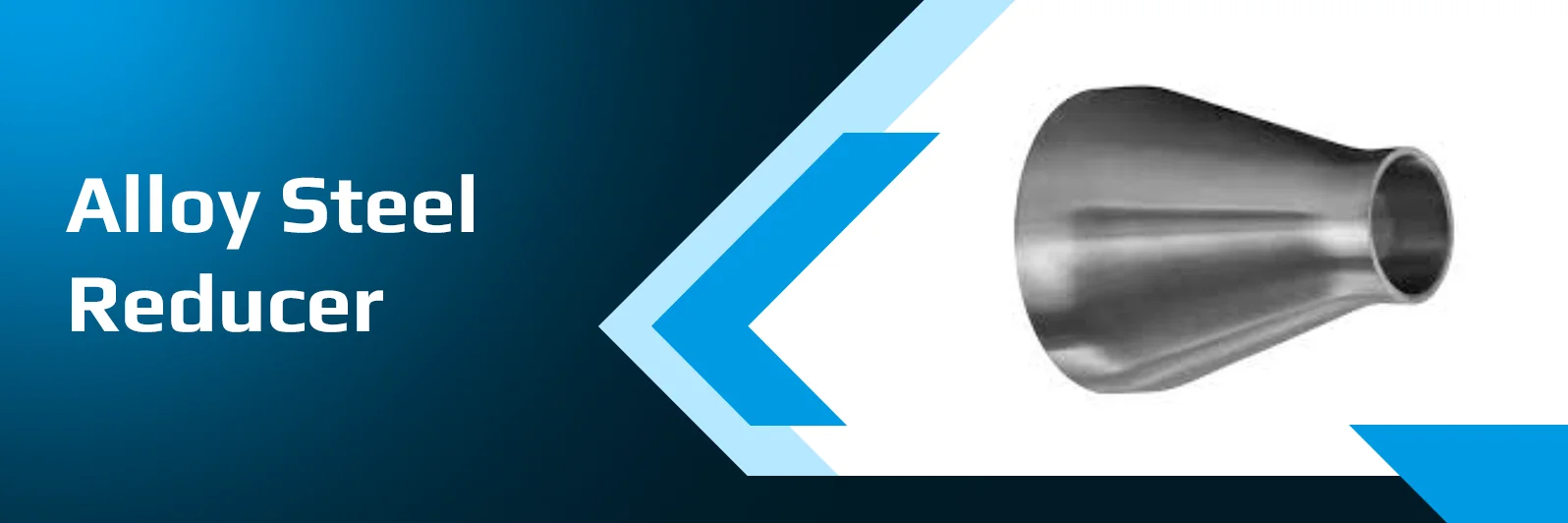
An eccentric reducer installed the wrong way up will cavitate a pump. Fit it flat side down on a horizontal suction line and vapour collects in the pocket that forms at the top, the pump loses prime, and the fault gets blamed on everything except the fitting. Flat side up is the rule on suction, flat side down where the line must drain. Solitaire Overseas manufactures and exports alloy steel reducers from India, concentric and eccentric, buttweld to ASME B16.9 in ASTM A234 WP grades. Below: which reducer goes where, the orientation rule, and full grade data.
Part of our alloy steel fittings range. For small bore reductions see alloy steel swage nipples.
A reducer is a buttweld fitting that changes pipe diameter in a run. Both ends are bevelled so the fitting welds permanently into the line, and the transition is a smooth taper rather than a step, which keeps pressure drop and turbulence down. In alloy steel it is chrome-moly, because the line is hot enough that carbon steel would creep.
Two forms, and the difference is not cosmetic. A concentric reducer keeps both ends on a common centreline. An eccentric reducer offsets them so one side of the fitting stays flat and in line with the pipe. Which one a line needs depends entirely on whether the run is vertical or horizontal, and on what would collect in the pocket a concentric fitting creates.
| Parameter | Specification |
|---|---|
| Material standard | ASTM A234 / ASME SA234 WP grades |
| Dimensional standard | ASME B16.9 |
| Grades | WP1, WP5, WP9, WP11, WP12, WP22, WP91 (state class or type) |
| Types | Concentric and eccentric |
| Size range | NPS 1/2 inch to 48 inch |
| Wall thickness | SCH 10, 20, 40/STD, 80/XS, 120, 160, XXS |
| End type | Bevelled to ASME B16.25 |
| Construction | Seamless and welded |
| Certification | EN 10204 3.1 mill test certificate. PMI, NDE and third-party inspection on request |
Both change pipe size. They are not interchangeable:
| Buttweld Reducer | Swage Nipple | |
|---|---|---|
| Standard | ASME B16.9 | MSS SP-95 |
| Manufacture | Formed or pressed from pipe or plate | Forged from bar or seamless pipe |
| Ends | Bevelled both ends for buttwelding | Male both ends. Threaded, bevelled, plain or grooved |
| Typical bore | 2 inch upward, large bore | Small bore, typically to about 4 inch |
| Length | Longer, smooth transition | Short |
| Use it when | Permanent welded transition in a main process run | Small bore, tight space, or the joint must come apart |
If the reduction is small bore or the joint needs to be dismantled, the fitting is on our alloy steel swage nipples (https://www.solitaire-overseas.com/alloy-steel-swage-nipples.html) page.
Concentric Reducers
Both ends share a common centreline and the fitting tapers evenly all the way round. This is the default in vertical runs, where the pipe centreline should stay constant and there is no top or bottom for anything to collect in. It is also used on horizontal lines where neither trapped vapour nor standing liquid is a concern.
Eccentric Reducers
The ends are offset so one side stays flat. On a horizontal run that flat side is what prevents a pocket forming. Installed flat side up, the top of the bore stays continuous so gas cannot be trapped, which is why this is the standard arrangement on pump suction lines where a vapour pocket causes cavitation. Installed flat side down, the bottom stays continuous so the line drains completely.
| Concentric | Eccentric | |
|---|---|---|
| Geometry | Common centreline, even taper | Offset centreline, one side flat |
| Use on | Vertical lines, and horizontal lines with no trapping concern | Horizontal lines where vapour or liquid would collect |
| Flat side up (FOT) | Not applicable | Prevents vapour pockets. Standard on pump suction |
| Flat side down (FOB) | Not applicable | Allows the line to drain completely |
Matched to the pipe grade it welds into, so fitting and pipe share compatible chemistry and high-temperature behaviour:
| Pipe Grade (A335) | Buttweld (A234) | Forged (A182) | Chromium | Service |
|---|---|---|---|---|
| P1 | WP1 | F1 | Not specified (carbon-moly) | Moderate temperature steam |
| P5 | WP5 | F5 | 4.0 - 6.0% | Refinery hydrogen and sulphur service |
| P9 | WP9 | F9 | 8.0 - 10.0% | Higher temperature refinery piping |
| P11 | WP11 | F11 | 1.00 - 1.50% | The workhorse grade |
| P12 | WP12 | F12 | 0.80 - 1.25% | General elevated temperature service |
| P22 | WP22 | F22 | 1.90 - 2.60% | Higher temperature and pressure than P11 |
| P91 | WP91 | F91 | 8.0 - 9.5% | Modern high-temperature power plant piping |
Most chrome-moly A234 grades are divided into classes with different mechanical properties. A purchase order naming only the grade has not fully specified the fitting:
| Grade | Classes Available | What Changes |
|---|---|---|
| WP11 | Class 1, Class 2, Class 3 | Carbon and manganese limits differ; Class 3 is the strongest |
| WP22 | Class 1, Class 3 | Class 3 carries substantially higher yield and tensile |
| WP5 / WP9 | Class 1, Class 3 | As above |
| WP12 | Class 1, Class 2 | Two classes only |
| WP91 | Type 1, Type 2 | Types rather than classes. Tempering temperature is the variable |
On horizontal runs where trapped vapour or standing liquid would cause a problem. An eccentric reducer keeps one side of the bore continuous, so installed flat side up it prevents a vapour pocket forming at the top, which is standard practice on pump suction lines. Installed flat side down it lets the line drain completely. Concentric reducers suit vertical runs and horizontal lines with no trapping concern.
Flat side up, usually marked FOT for flat on top. That keeps the top of the bore continuous so air and vapour cannot collect in a high pocket ahead of the pump. Installed the other way round, vapour accumulates, the pump loses prime and cavitates. The orientation should be stated on the isometric drawing, since the fitting itself does not indicate which way it belongs.
A reducer is a buttweld fitting to ASME B16.9, formed from pipe or plate, with bevelled ends, used for larger bore permanent welded transitions. A swage nipple is forged to MSS SP-95 with male ends, used for small bore reductions, tight spaces and joints that may need to come apart. They are different products for different scales of work.
ASTM A234 WP22. Matching the fitting grade to the pipe grade keeps chemistry and high-temperature behaviour consistent through the welded joint, and avoids creating a metallurgically weaker section in a line specified for P22 duty.
Send your large and small end sizes with schedules, grade and class, and whether concentric or eccentric, and we will confirm availability, certification and lead time.