+91-9619103479
or
vishal@solitaire-overseas.com
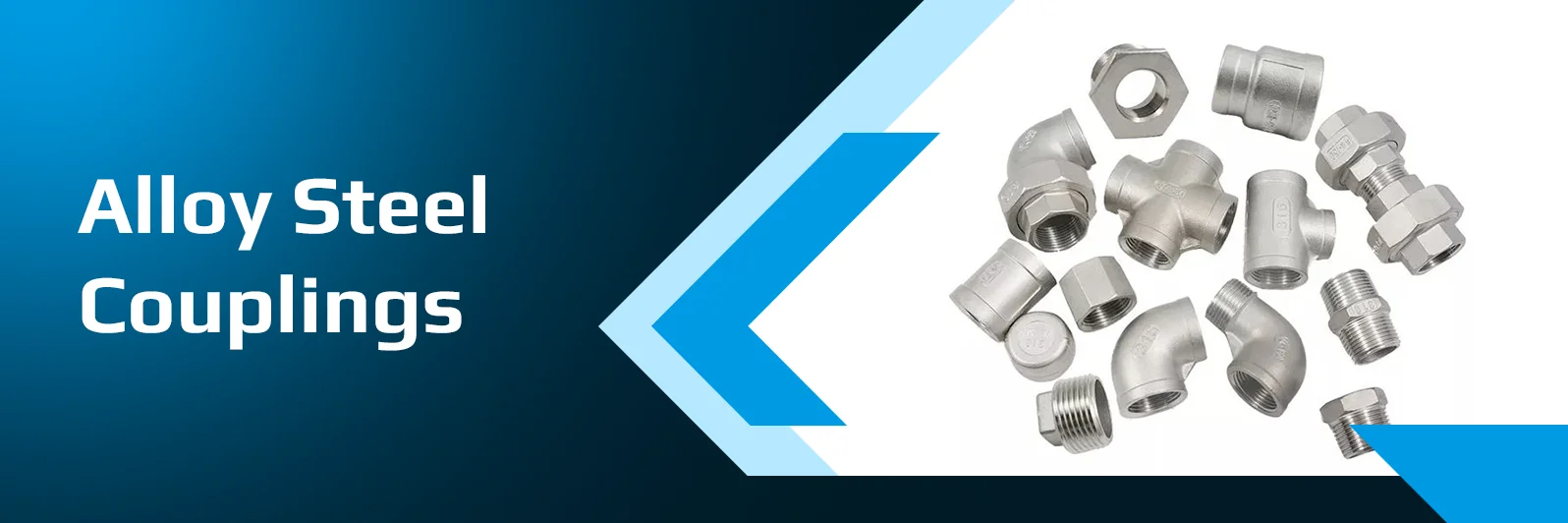
A coupling is the cheapest part in a high-pressure line. It is also the one most often specified wrong. Put an F11 coupling on P22 pipe and you have built a weak point into the system, invisible on the drawing, waiting for the first thermal cycle to find it. Solitaire Overseas manufactures and exports alloy steel couplings from India in ASTM A182 chrome-moly grades, forged to ASME B16.11 with socket weld or threaded ends. Full, half and reducing. Class 2000 through 9000, sizes 1/8 inch to 4 inch. Below: the grade table, the pressure classes, and how to match the coupling to the pipe it joins.
Part of our alloy steel fittings range. See also alloy steel pipes and alloy steel flanges.
A coupling is a short forged fitting that joins two lengths of pipe in a straight run. In alloy steel it is made from chrome-moly forgings to ASTM A182 and dimensioned to ASME B16.11, the standard for forged socket weld and threaded fittings. That places it in a different family from the buttweld elbows and tees on our main fittings page, which follow ASME B16.9.
The distinction matters commercially. Buttweld fittings are welded into the line with a full-penetration weld and suit larger bores. Forged couplings are small-bore work, 4 inch and below, joined either by fillet-welding the pipe into a socket or by screwing it into a thread. They carry far higher pressure ratings for their size, which is why they dominate steam, hydraulic and instrument piping in power plants and refineries.
| Item | Detail |
|---|---|
| Material standard | ASTM A182 / ASME SA182 forged alloy steel |
| Dimensional standard | ASME B16.11 (also BS 3799 on request) |
| Grades | F1, F5, F9, F11, F12, F22, F91 |
| Types | Full coupling, reducing coupling, half coupling |
| End connections | Socket weld, threaded NPT (BSP on request) |
| Size range | 1/8 inch to 4 inch NPS (DN 6 to DN 100) |
| Pressure classes | Socket weld 3000, 6000, 9000 · Threaded 2000, 3000, 6000 |
| Certification | EN 10204 3.1 mill test certificate, PMI and third-party inspection on request |
| Type | Configuration | What It Does | Typical Use |
|---|---|---|---|
| Full Coupling | Socket or thread at both ends | Joins two pipes of the same bore in a straight run | The default coupling. Straight pipe-to-pipe joins in small-bore lines |
| Reducing Coupling | Two different bore sizes | Joins pipes of different diameters without a separate reducer | Step-downs in instrument and drain lines |
| Half Coupling | Socket or thread at one end only | Welded onto a pipe run to create a branch or takeoff | Instrument tappings, drains, vents, pressure gauge points |
Half couplings do a different job from the other two: they are not a pipe-to-pipe joint at all but a branch connection welded onto the outside of a running pipe. Because that is a distinct product with distinct search intent, it has its own page. See Alloy Steel Half Couplings.
We supply couplings in the ASTM A182 chrome-moly grades. Each is the forged counterpart of the matching ASTM A335 pipe grade, and the two must be matched:
| A182 Grade | Matching Pipe | Chromium | Molybdenum | Typical Service |
|---|---|---|---|---|
| F1 | P1 | Not specified (carbon-moly) | 0.44 - 0.65% | Moderate temperature steam lines |
| F5 | P5 | 4.0 - 6.0% | 0.44 - 0.65% | Refinery hydrogen and sulphur service |
| F9 | P9 | 8.0 - 10.0% | 0.90 - 1.10% | Higher temperature refinery piping |
| F11 | P11 | 1.00 - 1.50% | 0.44 - 0.65% | The workhorse grade. Steam and process piping |
| F12 | P12 | 0.80 - 1.25% | 0.44 - 0.65% | General elevated temperature service |
| F22 | P22 | 2.00 - 2.50% | 0.87 - 1.13% | Higher temperature and pressure than F11 |
| F91 | P91 | 8.0 - 9.5% | 0.85 - 1.05% (plus V) | Modern high-temperature power plant piping |
ASME B16.11 rates forged couplings by class, and the class differs by end type. This trips up buyers more often than any other detail:
| End Type | Available Classes | Correlates To Pipe Schedule |
|---|---|---|
| Socket Weld | Class 3000, 6000, 9000 | 3000 = Sch 80/XS · 6000 = Sch 160 · 9000 = XXS |
| Threaded (NPT) | Class 2000, 3000, 6000 | Threaded runs one class lower at the top end. There is no Class 9000 threaded coupling |
Size range: 1/8 inch to 4 inch NPS (DN 6 to DN 100). Above 4 inch, forged couplings are not the right fitting, the line moves to buttweld fittings under ASME B16.9. See our alloy steel fittings page for the buttweld range.
Both end types are available in every grade we supply, and the choice is a service decision rather than a preference.
The most expensive mistake in forged fittings procurement is a grade mismatch. An F11 coupling installed on P22 pipe creates a section with lower chromium and molybdenum than the line it sits in, so the joint becomes the weakest point in a run that was designed to be uniform. Nothing on the outside shows it. The failure appears later, as creep or oxidation at the fitting, in a line the drawings say is P22 throughout.
Solitaire Overseas manufactures alloy steel couplings in India and exports to power, refinery and petrochemical projects worldwide. Orders ship with EN 10204 3.1 certification and heat-number traceability, with export documentation and third-party inspection arranged in-house. Send your grade, class, end type, size and quantity for a quote.
A full coupling has a socket or thread at both ends and joins two pipes in a straight run. A half coupling is open at one end only and is welded onto the outside of a running pipe to create a branch, typically for an instrument tapping, drain or vent. They are different products for different jobs. See our Alloy Steel Half Couplings page.
Socket weld couplings are made in Class 3000, 6000 and 9000. Threaded couplings are made in Class 2000, 3000 and 6000, so there is no Class 9000 threaded coupling. As a guide, Class 3000 correlates with Schedule 80/XS pipe, Class 6000 with Schedule 160, and Class 9000 with XXS.
No, not without engineering approval. F11 carries roughly 1 to 1.5 percent chromium against P22's 2 to 2.5 percent, so the fitting would be a metallurgically weaker point in a line designed for P22 duty. Always match the fitting grade to the pipe grade unless a dissimilar-metal joint has been specifically designed and a suitable weld procedure qualified.
ASME B16.11 covers forged fittings from 1/8 inch to 4 inch NPS. Above 4 inch, the line moves to buttweld fittings under ASME B16.9, which our alloy steel fittings (https://www.solitaire-overseas.com/alloy-steel-fittings.html) range covers.
Yes. EN 10204 3.1 mill test certificates accompany every order, covering chemical composition and mechanical properties with heat-number traceability. PMI verification and 3.2 certification with third-party inspection are available on request.
Send your grade, pressure class, end type, size and quantity, or your drawing for non-standard couplings, and we will confirm availability, certification and lead time.