+91-9619103479
or
vishal@solitaire-overseas.com
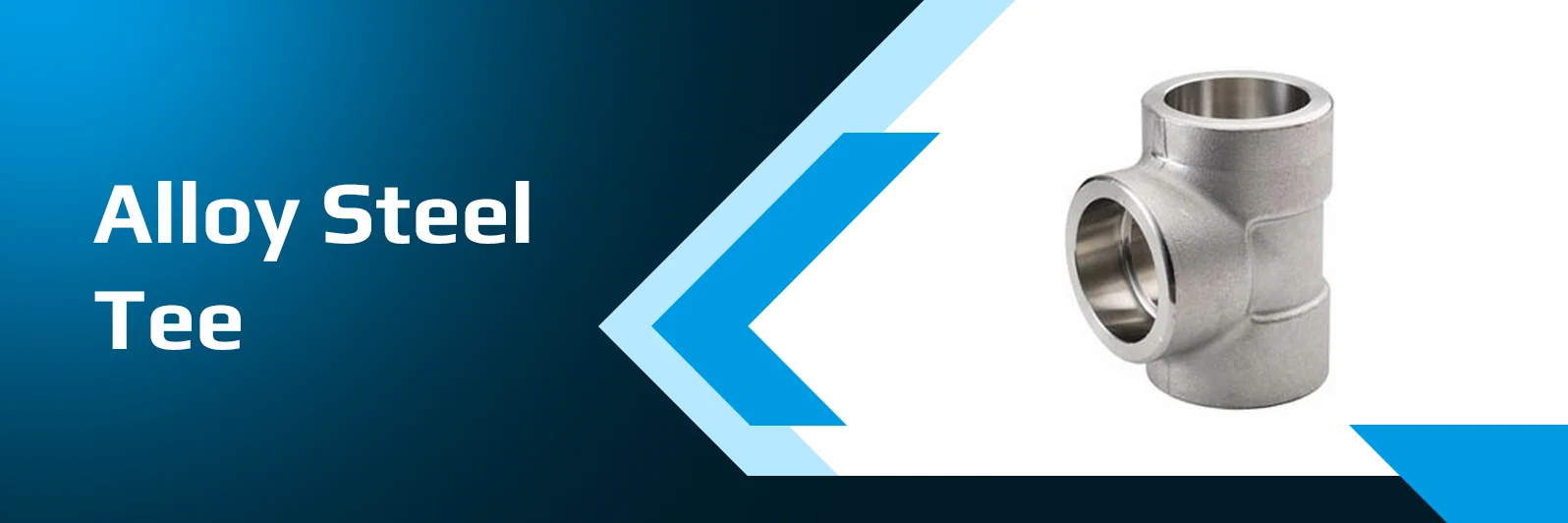
A tee is not always the right way to make a branch. Piping engineers use a rule of thumb: if the branch is half the run diameter or larger, a reducing tee is the sensible fitting. Below that ratio it stops being sensible. The tee gets expensive, stress concentration at the junction rises, and a reinforced branch outlet does the same job better and cheaper, which is why a 16 inch line with a 2 inch take-off should not be a tee at all. Solitaire Overseas manufactures and exports alloy steel tees from India, equal and reducing, buttweld to ASME B16.9 in ASTM A234 WP grades and forged to ASME B16.11 in A182 F grades. Below: the sizing convention, the branch ratio rule, and barred tees for pigged lines.
Part of our alloy steel fittings range. See also alloy steel elbows and alloy steel outlet fittings.
A tee is a three-way fitting that creates a 90 degree branch from a main run. The run passes straight through and the branch leaves perpendicular, so the fitting splits or combines flow at a junction. In alloy steel the material is chrome-moly, chosen because the line runs hot enough that carbon steel would creep.
Two product families. Large bore tees are wrought fittings to ASTM A234 WP grades, dimensioned by ASME B16.9. Small bore tees are forged to ASTM A182 F grades and dimensioned by ASME B16.11, with socket weld or threaded ends. Both are covered here, since most lines need both.
Equal Tee (Straight Tee)
All three openings the same nominal size. The standard fitting for splitting flow where the branch carries the same duty as the run. Quoted as a single size.
Reducing Tee
The branch is smaller than the run, so the fitting reduces and branches in one piece. That is a real advantage over an equal tee plus a separate reducer: fewer welds, less length, and better flow into the branch with less turbulence.
Barred Tee (Pigging Tee)
An equal tee with restriction bars welded across the inside of the branch opening. The bars stop a pipeline pig from nosing into the branch as it passes, while leaving the branch bore effectively clear for flow. Barred tees are specified on any line that will be pigged for cleaning or inline inspection. Note that barred reducing tees do not exist, because a pig could not pass a reduced branch in the first place, so barring is only relevant on an equal tee.
Tees are designated by three numbers, and the order matters. The first two are the run, the third is the branch:
| Designation | Meaning | Type |
|---|---|---|
| 8 x 8 x 8 | Run 8 inch, branch 8 inch | Equal tee. Often written simply as “8 inch tee” |
| 8 x 8 x 4 | Run 8 inch, branch 4 inch | Reducing tee |
| 6 x 6 x 2 | Run 6 inch, branch 2 inch | Reducing tee, but check the ratio rule in Fold 4 |
Two things that trip buyers up. First, an equal tee is usually quoted as a single size, so “an 8 inch tee” means 8 x 8 x 8. Second, the branch is always the LAST figure, so 8 x 4 x 4 is not a valid tee designation, it is a transposition error. State all three numbers plus the schedule of each and there is no ambiguity.
When the branch is much smaller than the run, a reducing tee stops being the right answer. The working rule:
| Branch to Run Ratio | Recommended Fitting | Why |
|---|---|---|
| 0.5 or greater (e.g. 8 x 8 x 4) | Reducing tee | Standard item, good flow, readily available |
| Below 0.5 (e.g. 16 x 16 x 2) | Reinforced branch outlet fitting | Cheaper, lower stress concentration at the junction, and the tee may not even be manufactured at that ratio |
There is a manufacturing limit as well as an economic one. Reducing tees are generally produced down to a branch about one size below half the run diameter. A 16 x 16 x 6 tee is a standard item; a 16 x 16 x 2 is not manufactured at all. Below that threshold the branch has to be made with an outlet fitting, which is covered on our alloy steel outlet fittings (https://www.solitaire-overseas.com/alloy-steel-outlet-fittings.html) page.
A tee is matched to the pipe grade it welds into, so fitting and pipe share compatible chemistry and high-temperature behaviour:
| Pipe Grade (A335) | Buttweld Tee (A234) | Forged Tee (A182) | Chromium | Service |
|---|---|---|---|---|
| P1 | WP1 | F1 | Not specified (carbon-moly) | Moderate temperature steam |
| P5 | WP5 | F5 | 4.0 - 6.0% | Refinery hydrogen and sulphur service |
| P9 | WP9 | F9 | 8.0 - 10.0% | Higher temperature refinery piping |
| P11 | WP11 | F11 | 1.00 - 1.50% | The workhorse grade |
| P12 | WP12 | F12 | 0.80 - 1.25% | General elevated temperature service |
| P22 | WP22 | F22 | 1.90 - 2.60% | Higher temperature and pressure than P11 |
| P91 | WP91 | F91 | 8.0 - 9.5% | Modern high-temperature power plant piping |
As with elbows, most chrome-moly A234 grades are divided into classes with different mechanical properties. A purchase order saying only “WP11 tee” has not fully specified the fitting:
| Grade | Classes Available | What Changes |
|---|---|---|
| WP11 | Class 1, Class 2, Class 3 | Carbon and manganese limits differ; Class 3 is the strongest |
| WP22 | Class 1, Class 3 | Class 3 carries substantially higher yield and tensile |
| WP5 / WP9 | Class 1, Class 3 | As above |
| WP12 | Class 1, Class 2 | Two classes only |
| WP91 | Type 1, Type 2 | Types rather than classes. Tempering temperature is the variable |
| Parameter | Specification |
|---|---|
| Material standard | ASTM A234 / ASME SA234 WP grades (buttweld); ASTM A182 / SA182 F grades (forged) |
| Dimensional standard | ASME B16.9 (buttweld), ASME B16.11 (forged socket weld and threaded) |
| Grades | WP1, WP5, WP9, WP11, WP12, WP22, WP91 (with class or type); F1, F5, F9, F11, F12, F22, F91 |
| Types | Equal tee, reducing tee, barred tee |
| Size range | NPS 1/8 inch to 48 inch across both product families |
| Wall thickness | SCH 10, 20, 40/STD, 80/XS, 120, 160, XXS |
| End type | Bevelled to ASME B16.25 (buttweld), socket weld or threaded NPT (forged) |
| Construction | Seamless and welded |
| Certification | EN 10204 3.1 mill test certificate. PMI, NDE and third-party inspection on request |
| Grade | Carbon | Manganese | Chromium | Molybdenum | Silicon |
|---|---|---|---|---|---|
| WP11 CL1 | 0.05 - 0.15 | 0.30 - 0.60 | 1.00 - 1.50 | 0.44 - 0.65 | 0.50 - 1.00 |
| WP11 CL2 / CL3 | 0.05 - 0.20 | 0.30 - 0.80 | 1.00 - 1.50 | 0.44 - 0.65 | 0.50 - 1.00 |
| WP22 CL1 / CL3 | 0.05 - 0.15 | 0.30 - 0.60 | 1.90 - 2.60 | 0.87 - 1.13 | 0.50 max |
| WP5 CL1 / CL3 | 0.15 max | 0.30 - 0.60 | 4.0 - 6.0 | 0.44 - 0.65 | 0.50 max |
| WP9 CL1 / CL3 | 0.15 max | 0.30 - 0.60 | 8.0 - 10.0 | 0.90 - 1.10 | 1.00 max |
| WP91 | 0.08 - 0.12 | 0.30 - 0.60 | 8.0 - 9.5 | 0.85 - 1.05 | 0.20 - 0.50 |
| Grade and Class | Tensile min | Yield min | Elongation min |
|---|---|---|---|
| WP1 | 380 MPa (55 ksi) | 205 MPa (30 ksi) | 22% |
| WP11 Class 1 | 415 MPa (60 ksi) | 205 MPa (30 ksi) | 22% |
| WP11 Class 2 | 485 MPa (70 ksi) | 275 MPa (40 ksi) | 22% |
| WP11 Class 3 | 520 MPa (75 ksi) | 310 MPa (45 ksi) | 22% |
| WP22 Class 1 | 415 MPa (60 ksi) | 205 MPa (30 ksi) | 22% |
| WP22 Class 3 | 520 MPa (75 ksi) | 310 MPa (45 ksi) | 22% |
| WP5 / WP9 Class 1 | 415 MPa (60 ksi) | 205 MPa (30 ksi) | 22% |
| WP5 / WP9 Class 3 | 520 MPa (75 ksi) | 310 MPa (45 ksi) | 22% |
| WP91 | 585 MPa (85 ksi) | 415 MPa (60 ksi) | 20% |
Tees are dimensioned by two measurements: C, the centre-to-end along the run, and M, the centre-to-end on the branch. On an equal tee C and M are the same. On a reducing tee C stays at the run dimension while M reduces with the branch. These figures are grade independent, so they match the carbon steel tables:
| NPS (equal tee) | OD (mm) | C, centre-to-end run (mm) | M, centre-to-end branch (mm) |
|---|---|---|---|
| 1/2 | 21.3 | 25 | 25 |
| 1 | 33.4 | 38 | 38 |
| 2 | 60.3 | 64 | 64 |
| 3 | 88.9 | 86 | 86 |
| 4 | 114.3 | 105 | 105 |
| 6 | 168.3 | 143 | 143 |
| 8 | 219.1 | 178 | 178 |
| 10 | 273.1 | 216 | 216 |
| 12 | 323.9 | 254 | 254 |
| 16 | 406.4 | 305 | 305 |
| 20 | 508.0 | 381 | 381 |
| 24 | 610.0 | 432 | 432 |
Solitaire Overseas manufactures alloy steel tees in India and exports to power, refinery and petrochemical projects worldwide. Orders ship with EN 10204 3.1 certification, heat treatment records and heat-number traceability, with export documentation and third-party inspection arranged in-house. Send your run and branch sizes, schedules, grade and class for a quote.
As run by run by branch. An 8 x 8 x 4 tee has an 8 inch run and a 4 inch branch. The first two figures are always the run and the third is always the branch, so 8 x 4 x 4 is a transposition error rather than a valid designation. An equal tee is usually quoted as a single size, so “an 8 inch tee” means 8 x 8 x 8.
When the branch is less than about half the run diameter. Below that ratio a reducing tee becomes expensive, carries a higher stress concentration at the junction, and may not be manufactured at all, a 16 x 16 x 2 tee does not exist as a standard item. A reinforced branch outlet does the job better and cheaper. See our alloy steel outlet fittings (https://www.solitaire-overseas.com/alloy-steel-outlet-fittings.html) page.
A barred tee is an equal tee with restriction bars welded across the inside of the branch opening. The bars prevent a pipeline pig from entering the branch as it travels along the run, while leaving the branch effectively clear for flow. They are specified on any line that will be pigged. Barred reducing tees do not exist, because a pig could not pass a reduced branch anyway.
The classes differ in carbon and manganese limits and in heat treatment, producing different mechanical properties from what looks like the same grade. Class 1 has the lowest specified strength and Class 3 the highest. Always state grade and class together on the purchase order, since a fitting supplied to the wrong class is a lower-strength component in the pressure boundary.
ASTM A234 WP22 for buttweld tees, or ASTM A182 F22 for small bore forged tees. Matching the fitting grade to the pipe grade keeps chemistry and high-temperature behaviour consistent through the welded joint.
Usually yes, where the ratio allows it. A reducing tee branches and reduces in one fitting, so there are fewer welds, less installed length and a smoother flow path into the branch with less turbulence. A separate equal tee and reducer adds a joint and takes more space, and is normally only used when the reducing tee size combination is unavailable.
Send your run and branch sizes with schedules, grade and class, and whether barred tees are required, and we will confirm availability, certification and lead time.