+91-9619103479
or
vishal@solitaire-overseas.com
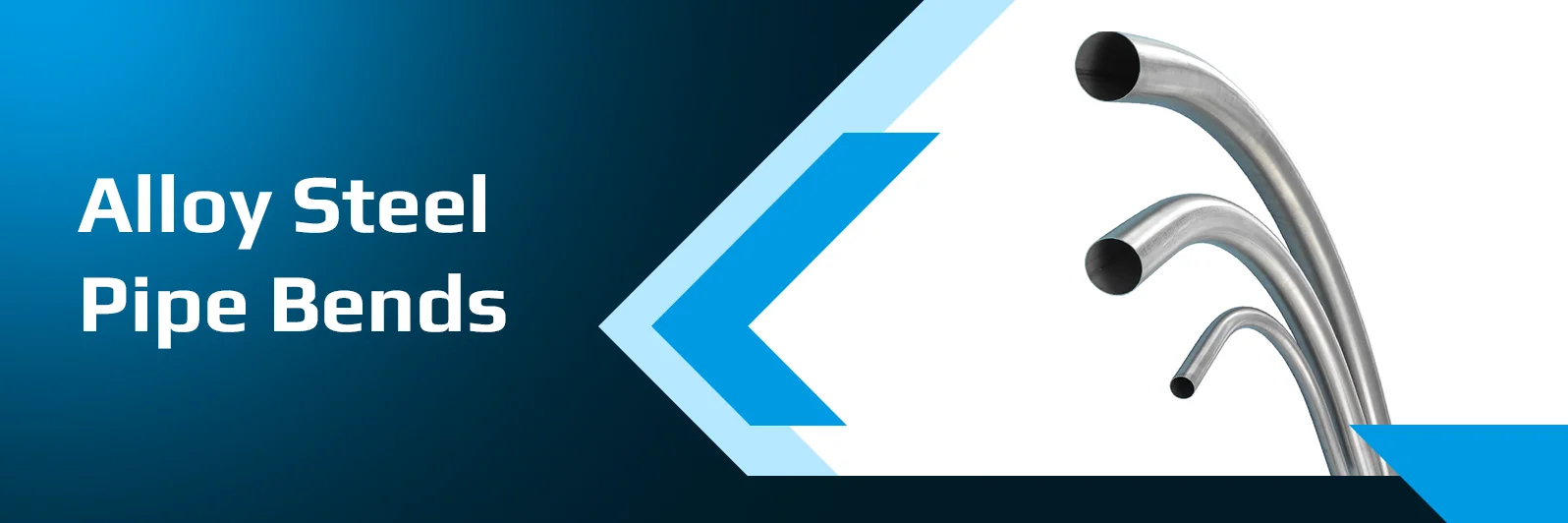
ASME B16.49 does not cover power or process piping. The standard everyone quotes for induction bends says so in its own scope: it is written for transportation and distribution pipelines under B31.4 and B31.8, in carbon steel with controlled chemistry, and it explicitly excludes the process and power applications where chrome-moly actually gets used. So a P22 bend for a refinery is engineered to the piping code instead. B31.1 or B31.3, material to A234 or A335. Solitaire Overseas manufactures and exports alloy steel pipe bends from India, induction, return and mitre, in chrome-moly grades from P1 through P91. Below: the three bend types, the standards that genuinely apply to each, and how to choose between them.
Part of our alloy steel fittings range. Made from our alloy steel pipes.
| Item | Detail |
|---|---|
| Bend types | Induction (hot), return (180 degree), mitre (fabricated) |
| Standards | ASME B16.49 (pipelines), B16.9 (180 degree returns), engineered to B31.1 / B31.3 for process and power |
| Material | ASTM A335 seamless alloy pipe or ASTM A234 WP wrought fittings |
| Grades | P1/WP1, P5/WP5, P9/WP9, P11/WP11, P12/WP12, P22/WP22, P91/WP91 |
| Bend radius | 3D, 5D, 6D, 8D, 10D or custom |
| Bend angle | Any angle to drawing. 15, 30, 45, 60, 90 degrees and custom |
| Tangents | With or without tangent lengths, specify on order |
| Weld ends | Bevelled to ASME B16.25 |
| Heat treatment | Normalised, normalised and tempered, or quenched and tempered as the grade requires |
| Certification | EN 10204 3.1 mill test certificate. PMI, NDE and third-party inspection on request |
Three types cover the range, and they sit under three different standards. That is the single most useful thing to understand before ordering:
| Type | How It Is Made | Governing Standard | Typical Use |
|---|---|---|---|
| Induction Bend | Pipe heated by an induction coil and formed under controlled conditions | ASME B16.49 for pipelines. For power and process, engineered to B31.1 or B31.3 | Large bore, long radius, high pressure. The premium option |
| Return Bend | 180 degree turn, long or short radius | ASME B16.9 (tables for 180 degree returns) | Heater coils, heat exchangers, reversing a run in tight space |
| Mitre Bend | Straight pipe segments cut at an angle and welded together | Fabricated. ASME B31.3 imposes pressure limits, see Fold 5 | Large bore, low pressure. Where a formed bend is uneconomic |
Induction Bends
The pipe passes through an induction coil that heats a narrow band to forming temperature while the bend is formed and then cooled. Because only a narrow band is hot at any moment, the bend keeps its shape and ovality is controlled. Radii of 3D, 5D, 6D and 10D are standard, and any angle can be produced.
The wall thinning point buyers need to know: the outside of the bend, the extrados, thins during forming. The tighter the radius, the more it thins. Pipe for induction bending is routinely ordered with extra wall thickness so the finished extrados still meets the design minimum. If you specify a 5D bend in 12.7 mm wall without allowing for this, the bend may not meet the wall requirement after forming. Send the design minimum wall and we will confirm the starting pipe schedule needed.
Return Bends
A 180 degree bend that reverses the direction of a run. Long radius and short radius patterns are both standard, and dimensions follow the 180 degree return tables in ASME B16.9. Return bends are the building block of heater coils and serpentine heat exchanger passes, where the flow has to fold back on itself repeatedly in a confined space.
Mitre Bends
Not formed at all. A mitre bend is fabricated by cutting straight pipe at an angle and welding the segments together, so the change of direction happens in a series of steps rather than a smooth curve. That makes it economical in large diameters where forming equipment is impractical, but it comes with a genuine code limitation covered in the next fold.
Bends are formed from ASTM A335 seamless alloy pipe or supplied as A234 WP wrought fittings, in the chrome-moly grades:
| Pipe Grade (A335) | Fitting Grade (A234) | Chromium | Molybdenum | Typical Service |
|---|---|---|---|---|
| P1 | WP1 | Not specified (carbon-moly) | 0.44 - 0.65% | Moderate temperature steam |
| P5 | WP5 | 4.0 - 6.0% | 0.44 - 0.65% | Refinery hydrogen and sulphur service |
| P9 | WP9 | 8.0 - 10.0% | 0.90 - 1.10% | Higher temperature refinery piping |
| P11 | WP11 | 1.00 - 1.50% | 0.44 - 0.65% | The workhorse grade |
| P12 | WP12 | 0.80 - 1.25% | 0.44 - 0.65% | General elevated temperature service |
| P22 | WP22 | 2.00 - 2.50% | 0.87 - 1.13% | Higher temperature and pressure than P11 |
| P91 | WP91 | 8.0 - 9.5% | 0.85 - 1.05% (plus V) | Modern high-temperature power plant piping |
HEAT TREATMENT AFTER BENDING IS NOT OPTIONAL: Induction bending puts the material through a thermal cycle, so post-bend heat treatment is required to restore properties. This matters most on P91, where an incorrect or missed tempering step leaves the bend outside specification and hardness testing is the check that catches it. Specify the heat treatment condition on the order.
The words get used interchangeably and they should not be. All elbows are bends; not all bends are elbows.
| Elbow | Bend | |
|---|---|---|
| Radius | 1D (short radius) or 1.5D (long radius) | 3D, 5D, 6D, 10D or custom |
| Angle | Standard 45, 90 or 180 degrees only | Any angle. 15, 30, 45, 60, 90 or custom |
| Supply | Prefabricated, off the shelf | Made to order for the route |
| Standard | ASME B16.9 | B16.49 (pipelines) or engineered to the piping code |
| Flow | Tighter turn, higher pressure drop and erosion | Gentler turn, lower pressure drop, pigging friendly |
| Use it when | Space is tight and the angle is standard | The route needs a specific angle or gentle radius |
Radius is expressed as a multiple of nominal diameter. A 5D bend on 8 inch pipe has a centreline radius of 40 inches. The number is a trade-off:
| Radius | Centreline Radius | Trade-Off |
|---|---|---|
| 3D | 3 x nominal diameter | Tightest standard bend. More extrados thinning, higher pressure drop, more erosion at the bend |
| 5D | 5 x nominal diameter | The common compromise. Widely used on process and power lines |
| 6D to 10D | 6 to 10 x nominal diameter | Gentlest flow path, lowest pressure drop, pigging friendly. Takes the most space |
Choose the tightest radius the space demands and the loosest the process allows. Erosive service, slurry lines and pigged lines all argue for a larger radius; congested plant argues for a smaller one.
A mitre bend is welded from cut segments, so it is not a listed fitting in the way a B16.9 elbow is. ASME B31.3 places specific limits on mitre bends, with the allowable pressure depending on the angle of each cut and the number of cuts making up the bend. Fewer, larger cuts mean a sharper transition and a lower allowable pressure; more cuts approximate a smooth curve and permit more.
In practice this means a mitre bend is a design decision, not a catalogue selection. The piping engineer calculates the allowable pressure for the specific geometry against the code. It is why mitre bends belong in large-bore, lower-pressure duty such as ducting, water and utility lines, and why they are rarely the right answer in high-pressure chrome-moly service, which is precisely where induction bending earns its cost.
Solitaire Overseas manufactures alloy steel pipe bends in India and exports to power, refinery, petrochemical and pipeline projects worldwide. Orders ship with EN 10204 3.1 certification, heat treatment records and heat-number traceability, with export documentation and third-party inspection arranged in-house. Send your size, wall, grade, radius, angle and design conditions for a quote.
An elbow is a prefabricated fitting to ASME B16.9 in a standard 45, 90 or 180 degree angle with a 1D or 1.5D radius. A bend is made to order with a larger radius, typically 3D to 10D, and can be produced at any angle the route requires. Elbows suit tight spaces and standard angles; bends suit gentler flow paths, custom angles and pigged lines.
No, not directly. B16.49 covers induction bends for transportation and distribution pipelines under B31.4, B31.8 and B31.11, and it is written around carbon steel with controlled chemistry. Its scope explicitly excludes process and power piping. Chrome-moly bends for refinery and power service are engineered to the applicable piping code, B31.1 or B31.3, with material to ASTM A234 WP grades or A335.
The centreline radius is five times the nominal pipe diameter. On 8 inch pipe a 5D bend has a 40 inch centreline radius. A larger multiple gives a gentler turn with lower pressure drop, less erosion and easier pigging, at the cost of more space. 3D is the tightest standard bend; 5D is the common compromise.
The extrados, the outside of the curve, is stretched as the bend is formed, and stretching reduces wall thickness. The tighter the radius the more it thins. Pipe for induction bending is therefore often ordered with extra wall so the finished extrados still meets the design minimum. Send the design minimum wall and the starting schedule can be calculated.
They are limited. ASME B31.3 restricts mitre bends, with allowable pressure depending on the cut angle and number of segments, so a mitre bend is a design calculation rather than a catalogue item. In practice mitre bends suit large-bore lower-pressure duty, while induction bending is the appropriate choice for high-pressure chrome-moly service.
Send your pipe size, wall thickness, grade, bend radius, angle, tangent lengths and design conditions, and we will confirm the starting schedule, heat treatment and lead time.