+91-9619103479
or
vishal@solitaire-overseas.com
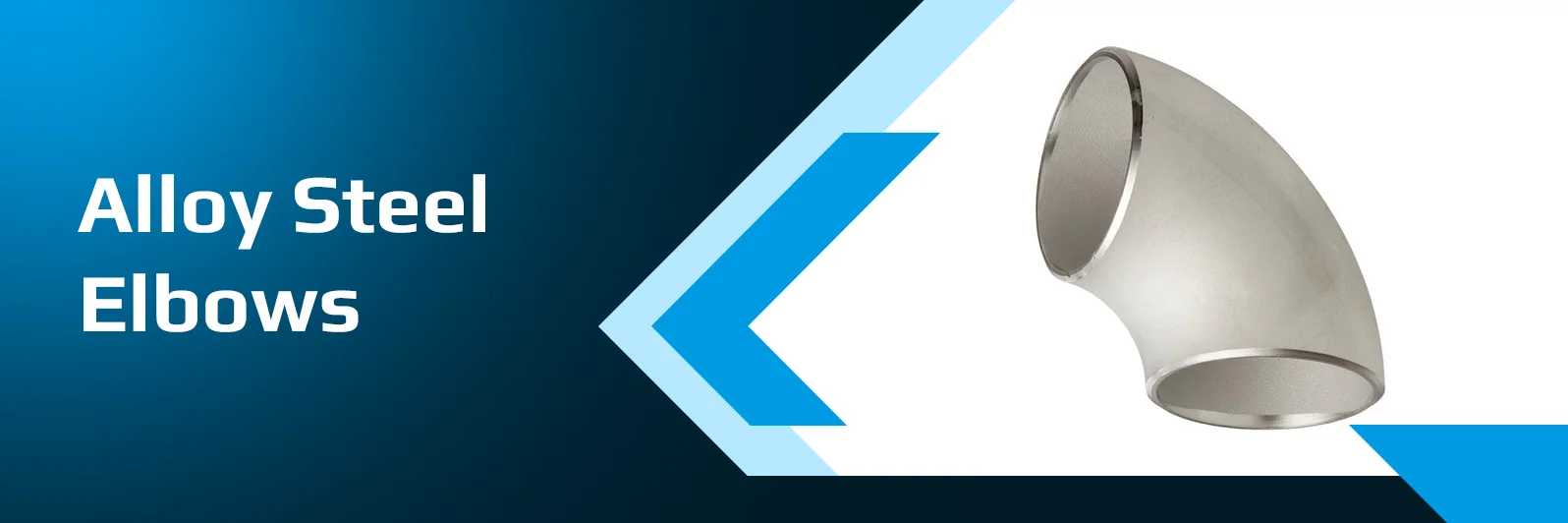
WP11 is not one material. It is three. ASTM A234 splits the chrome-moly elbow grades into classes with genuinely different mechanical properties, so a Class 1 WP11 elbow and a Class 3 WP11 elbow carry different yield strengths despite sharing a grade name. Leave the class off the purchase order and you are letting the mill decide which one turns up. Solitaire Overseas manufactures and exports alloy steel elbows from India, large bore buttweld to ASME B16.9 and B16.28 in ASTM A234 WP grades, small bore forged to ASME B16.11 in ASTM A182 F grades, 45, 90 and 180 degrees, long and short radius. Below: the grade correlation table, the class system, and full dimensional data.
Part of our alloy steel fittings range. For gentler direction changes at custom radius, see alloy steel pipe bends.
An elbow changes the direction of a pipe run, most often through 90 or 45 degrees, with 180 degree returns used where a line folds back on itself in heater coils and exchanger passes. In alloy steel the elbow is chrome-moly, chosen because the line runs hot: chromium and molybdenum hold strength and resist oxidation at temperatures where carbon steel would creep.
Two product families, one page. Large bore elbows are wrought fittings to ASTM A234 WP grades, dimensioned by ASME B16.9 for long radius and ASME B16.28 for short radius and returns. Small bore elbows are forged to ASTM A182 F grades and dimensioned by ASME B16.11, with socket weld or threaded ends. Both are covered here, because a single line usually needs both.
| Parameter | Specification |
|---|---|
| Material standard | ASTM A234 / ASME SA234 WP grades (buttweld); ASTM A182 / SA182 F grades (forged) |
| Dimensional standard | ASME B16.9 (buttweld LR), ASME B16.28 (short radius and 180 degree returns), ASME B16.11 (forged socket weld and threaded) |
| Grades | WP1, WP5, WP9, WP11, WP12, WP22, WP91 (with class or type); F1, F5, F9, F11, F12, F22, F91 |
| Size range | NPS 1/8 inch to 48 inch across both product families |
| Bend angle | 45 degrees, 90 degrees, 180 degree return |
| Radius type | Long radius (1.5D) and short radius (1.0D) |
| Wall thickness | SCH 10, 20, 40/STD, 80/XS, 120, 160, XXS |
| End type | Bevelled to ASME B16.25 (buttweld), socket weld or threaded NPT (forged) |
| Construction | Seamless and welded |
| Certification | EN 10204 3.1 mill test certificate. PMI, NDE and third-party inspection on request |
An elbow is matched to the pipe grade it welds into, so fitting and pipe share compatible chemistry and behave the same way at temperature. These are the standard chrome-moly pairings:
| Pipe Grade (A335) | Buttweld Elbow (A234) | Forged Elbow (A182) | Chromium | Service |
|---|---|---|---|---|
| P1 | WP1 | F1 | Not specified (carbon-moly) | Moderate temperature steam |
| P5 | WP5 | F5 | 4.0 - 6.0% | Refinery hydrogen and sulphur service |
| P9 | WP9 | F9 | 8.0 - 10.0% | Higher temperature refinery piping |
| P11 | WP11 | F11 | 1.00 - 1.50% | The workhorse grade |
| P12 | WP12 | F12 | 0.80 - 1.25% | General elevated temperature service |
| P22 | WP22 | F22 | 1.90 - 2.60% | Higher temperature and pressure than P11 |
| P91 | WP91 | F91 | 8.0 - 9.5% | Modern high-temperature power plant piping |
Most chrome-moly A234 grades are divided into classes. The chemistry differs slightly and the heat treatment differs more, and the result is materially different strength from what looks like the same grade:
| Grade | Classes Available | What Changes |
|---|---|---|
| WP11 | Class 1, Class 2, Class 3 | Carbon and manganese limits differ; Class 3 is the strongest of the three |
| WP22 | Class 1, Class 3 | Class 3 carries substantially higher yield and tensile than Class 1 |
| WP5 | Class 1, Class 3 | As above |
| WP9 | Class 1, Class 3 | As above |
| WP12 | Class 1, Class 2 | Two classes only |
| WP91 | Type 1, Type 2 | Types rather than classes. Tempering temperature is the variable |
| Grade | Carbon | Manganese | Chromium | Molybdenum | Silicon |
|---|---|---|---|---|---|
| WP11 CL1 | 0.05 - 0.15 | 0.30 - 0.60 | 1.00 - 1.50 | 0.44 - 0.65 | 0.50 - 1.00 |
| WP11 CL2 / CL3 | 0.05 - 0.20 | 0.30 - 0.80 | 1.00 - 1.50 | 0.44 - 0.65 | 0.50 - 1.00 |
| WP22 CL1 / CL3 | 0.05 - 0.15 | 0.30 - 0.60 | 1.90 - 2.60 | 0.87 - 1.13 | 0.50 max |
| WP5 CL1 / CL3 | 0.15 max | 0.30 - 0.60 | 4.0 - 6.0 | 0.44 - 0.65 | 0.50 max |
| WP9 CL1 / CL3 | 0.15 max | 0.30 - 0.60 | 8.0 - 10.0 | 0.90 - 1.10 | 1.00 max |
| WP91 | 0.08 - 0.12 | 0.30 - 0.60 | 8.0 - 9.5 | 0.85 - 1.05 | 0.20 - 0.50 |
Minimum values. Note how much the class changes the answer within a single grade:
| Grade and Class | Tensile Strength min | Yield Strength min | Elongation min |
|---|---|---|---|
| WP1 | 380 MPa (55 ksi) | 205 MPa (30 ksi) | 22% |
| WP11 Class 1 | 415 MPa (60 ksi) | 205 MPa (30 ksi) | 22% |
| WP11 Class 2 | 485 MPa (70 ksi) | 275 MPa (40 ksi) | 22% |
| WP11 Class 3 | 520 MPa (75 ksi) | 310 MPa (45 ksi) | 22% |
| WP22 Class 1 | 415 MPa (60 ksi) | 205 MPa (30 ksi) | 22% |
| WP22 Class 3 | 520 MPa (75 ksi) | 310 MPa (45 ksi) | 22% |
| WP5 / WP9 Class 1 | 415 MPa (60 ksi) | 205 MPa (30 ksi) | 22% |
| WP5 / WP9 Class 3 | 520 MPa (75 ksi) | 310 MPa (45 ksi) | 22% |
| WP91 | 585 MPa (85 ksi) | 415 MPa (60 ksi) | 20% |
Centre-to-end dimensions for 90 and 45 degree long radius buttweld elbows. These are standardised ASME B16.9 figures and apply across grades for a given size, so they are the same as for carbon steel:
| NPS | OD (mm) | 90 deg LR centre-to-end (mm) | 45 deg LR centre-to-end (mm) |
|---|---|---|---|
| 1/2 | 21.3 | 38 | 16 |
| 3/4 | 26.7 | 38 | 19 |
| 1 | 33.4 | 38 | 22 |
| 1 1/2 | 48.3 | 57 | 29 |
| 2 | 60.3 | 76 | 35 |
| 3 | 88.9 | 114 | 51 |
| 4 | 114.3 | 152 | 64 |
| 6 | 168.3 | 229 | 95 |
| 8 | 219.1 | 305 | 127 |
| 10 | 273.1 | 381 | 159 |
| 12 | 323.9 | 457 | 190 |
| 16 | 406.4 | 610 | 254 |
| 20 | 508.0 | 762 | 318 |
| 24 | 610.0 | 914 | 381 |
| Feature | Long Radius (LR) | Short Radius (SR) |
|---|---|---|
| Centreline radius | 1.5 x NPS | 1.0 x NPS |
| Pressure drop | Lower | Higher |
| Space required | More | Less |
| Erosion at the bend | Less | More, flow turns harder |
| Dimensional standard | ASME B16.9 | ASME B16.28 |
| Typical use | Normal process and high-velocity service | Congested layouts, skids and packages |
| Availability | Standard, most widely stocked | Available, less common |
Where even a long radius elbow turns too sharply, the answer is a formed bend at 3D, 5D or larger. See our alloy steel pipe bends page, which covers the difference between an elbow and a bend in detail.
Solitaire Overseas manufactures alloy steel elbows in India and exports to power, refinery and petrochemical projects worldwide. Orders ship with EN 10204 3.1 certification, heat treatment records and heat-number traceability, with export documentation and third-party inspection arranged in-house. Send your size, schedule, grade and class, bend angle and radius for a quote.
The classes differ in carbon and manganese limits and, more importantly, in heat treatment, which produces different mechanical properties. Class 1 has the lowest specified strength and Class 3 the highest, with Class 2 in between. Because they share the grade name, a purchase order stating only “WP11” does not fully specify the fitting. Always state grade and class together.
A long radius elbow has a centreline radius of 1.5 times the nominal pipe diameter, giving a gentler turn with lower pressure drop and less erosion. A short radius elbow has a centreline radius equal to the pipe diameter, taking less space but turning the flow harder. Long radius is dimensioned by ASME B16.9 and is the standard choice; short radius follows ASME B16.28 and suits congested layouts.
ASTM A234 WP22 for buttweld elbows, or ASTM A182 F22 for small bore forged elbows. Matching the fitting grade to the pipe grade keeps chemistry and high-temperature behaviour consistent through the joint. Mixing grades creates a dissimilar-metal weld that needs a qualified procedure and is best avoided unless it has been engineered deliberately.
An elbow is a prefabricated fitting in a standard 45, 90 or 180 degree angle at 1D or 1.5D radius, made to ASME B16.9, B16.28 or B16.11. A bend is formed to a custom radius, typically 3D to 10D, and can be produced at any angle. Elbows suit standard angles and tight spaces; bends suit gentler flow paths and pigged lines. See our alloy steel pipe bends page.
Both are produced under ASTM A234. Seamless construction is generally preferred for smaller bores and higher-integrity service, while larger sizes are commonly made from welded pipe or plate. Specify your requirement, since some project specifications mandate seamless throughout on chrome-moly lines.
Buttweld long radius elbows follow ASME B16.9. Short radius elbows and 180 degree returns follow ASME B16.28. Small bore forged socket weld and threaded elbows follow ASME B16.11. The dimensions are grade independent, so an alloy steel elbow has the same centre-to-end dimension as a carbon steel elbow of the same size and pattern.
Send your size, schedule, grade and class, bend angle and radius pattern, and we will confirm availability, certification and lead time.