+91-9619103479
or
vishal@solitaire-overseas.com
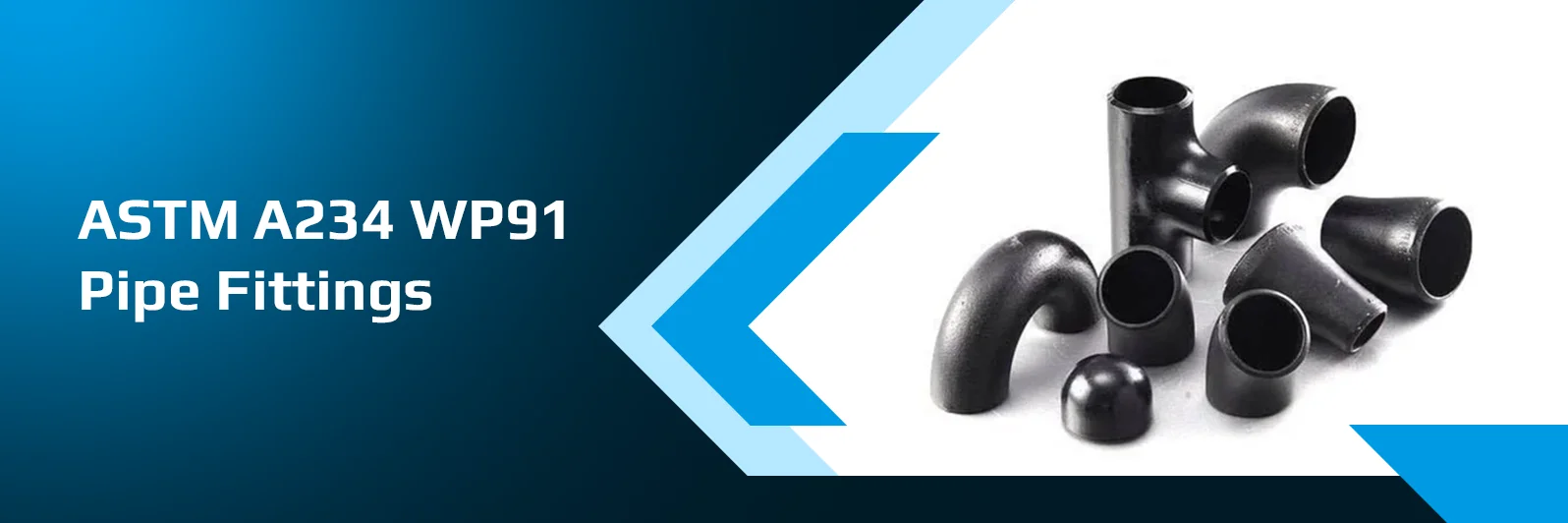
Weld WP91 with the wrong consumable and the joint is scrap. ASTM A234 does something unusual for this grade. It names the permitted welding processes and filler metals outright, and caps nickel plus manganese in the consumable at one percent, and that is not guidance from a fabrication handbook, it is written into the material standard itself. Everything about WP91 is like that. Solitaire Overseas manufactures and exports A234 WP91 buttweld fittings from India for supercritical service, with PMI on every heat and hardness records. Below: what the standard mandates, why the tempering window is narrow, and where WP91 belongs.
WP91 is the only grade in A234 where the standard reaches into the welding shop. These are specification requirements, not good practice:
| Requirement | Detail |
|---|---|
| Permitted welding processes and consumables | SMAW with A5.5 E90XX-B9; SAW with A5.23 EB9 plus flux; GTAW with A5.28 ER90S-B9; FCAW with A5.29 E91T1-B9 |
| Consumable chemistry limit | Nickel plus manganese content of all welding consumables must not exceed 1.0% |
| NDE timing | Examination of welds must be performed after forming, not before |
| Minimum tempering temperature | 730 C (1350 F), the highest of any A234 grade |
| Normalising range | Approximately 1040 to 1080 C |
Why the Ni plus Mn cap matters. Nickel and manganese lower the temperature at which the weld metal transforms. Push that transformation temperature too low and the post-weld heat treatment, which has to sit below it, gets squeezed into an impossibly narrow band or cannot temper the weld properly at all. Capping Ni plus Mn at one percent is what keeps a workable PWHT window available. It is a subtle requirement with a very unsubtle failure mode.
| Element | Range |
|---|---|
| Carbon | 0.08 - 0.12% |
| Manganese | 0.30 - 0.60% |
| Silicon | 0.20 - 0.50% |
| Chromium | 8.0 - 9.5% |
| Molybdenum | 0.85 - 1.05% |
| Vanadium | 0.18 - 0.25% |
| Niobium (columbium) | 0.06 - 0.10% |
| Nitrogen | 0.03 - 0.07% |
| Nickel | 0.40% max |
| Aluminium | 0.02% max |
THESE ARE THE ELEMENTS THAT MATTER: Vanadium, niobium and nitrogen are the reason WP91 outperforms WP22. They form the stable MX carbonitrides that pin the microstructure against creep. Any supplier who cannot produce heat-specific PMI covering these three is not demonstrating that the grade will perform.
WP91 under ASTM A234 is the buttweld fitting to ASME B16.9. F91 under ASTM A182 is the forged fitting to ASME B16.11 with socket weld or threaded ends. Supercritical steam systems use both, WP91 through the main run and F91 at small bore connections.
Type 1 and Type 2. Unlike the lower grades, WP91 is divided into types rather than classes, distinguished by tempering. Note that the general A234 requirement to hardness test two pieces per batch is applied differently to WP91 Type 1 and Type 2, so confirm the testing regime with the order rather than assuming the standard batch rule applies.
Available as elbows, tees, reducers, caps, stub end and pipe bends.
| Item | Detail |
|---|---|
| Standard | ASTM A234 / ASME SA234 WP91 |
| Dimensional | ASME B16.9, ASME B16.28 |
| Types | Type 1, Type 2 |
| Size range | NPS 1/2 inch to 48 inch |
| Wall thickness | SCH 10 through XXS |
| Heat treatment | Normalised approximately 1040 to 1080 C, tempered minimum 730 C. PWHT mandatory |
| Testing | PMI every heat, hardness testing, NDE after forming |
| Matching pipe | ASTM A335 P91 |
| Certification | EN 10204 3.1 with heat treatment records. 3.2 with third-party inspection |
Matching pipe: ASTM A335 P91 pipes.
WP91's creep strength does not come from its chemistry alone. It comes from a tempered martensitic microstructure carrying a fine dispersion of carbides and carbonitrides, and that structure is created by normalising and then tempering within a narrow band. Temper too low and the material stays hard and brittle. Temper too high and the precipitates coarsen and the creep strength the design depends on is simply gone, without any change visible on a tensile test.
The economic comparison against WP22 is covered on our high temperature fittings page, along with the roughly 975 degrees F break point.
Yes, and it is unusual for a material standard to do so. A234 names the permitted processes and consumables for WP91: SMAW with A5.5 E90XX-B9, SAW with A5.23 EB9 plus flux, GTAW with A5.28 ER90S-B9, and FCAW with A5.29 E91T1-B9. It also limits nickel plus manganese in the consumable to one percent, because higher levels lower the weld metal transformation temperature and squeeze the post-weld heat treatment window.
Because the creep strength comes from the microstructure, not just the chemistry. WP91 relies on tempered martensite carrying a fine dispersion of carbides and carbonitrides. Tempering too low leaves the material hard and brittle; tempering too high coarsens the precipitates and removes the creep strength the design depends on, without necessarily failing a tensile test. Hardness testing is the practical check that it was done right.
WP91 is used in supercritical and ultra-supercritical steam service, typically around 570 to 620 degrees C at 170 to 230 bar. Separately, ASTM A234 sets a minimum tempering temperature of 730 degrees C during manufacture, the highest of any grade in the standard, which is a production requirement rather than a service limit.
Because vanadium, niobium and nitrogen are what give the grade its creep strength, forming stable carbonitrides that pin the microstructure. A deviation in those elements during steelmaking can dramatically reduce long-term creep performance while ordinary tensile and hardness testing still passes. Heat-specific PMI is the only reliable check.
Send your fitting type, size, schedule, type and the design conditions, and we will confirm availability, heat treatment and testing regime, certification and lead time. WP91 orders should state the PMI, hardness and PWHT documentation required.