+91-9619103479
or
vishal@solitaire-overseas.com
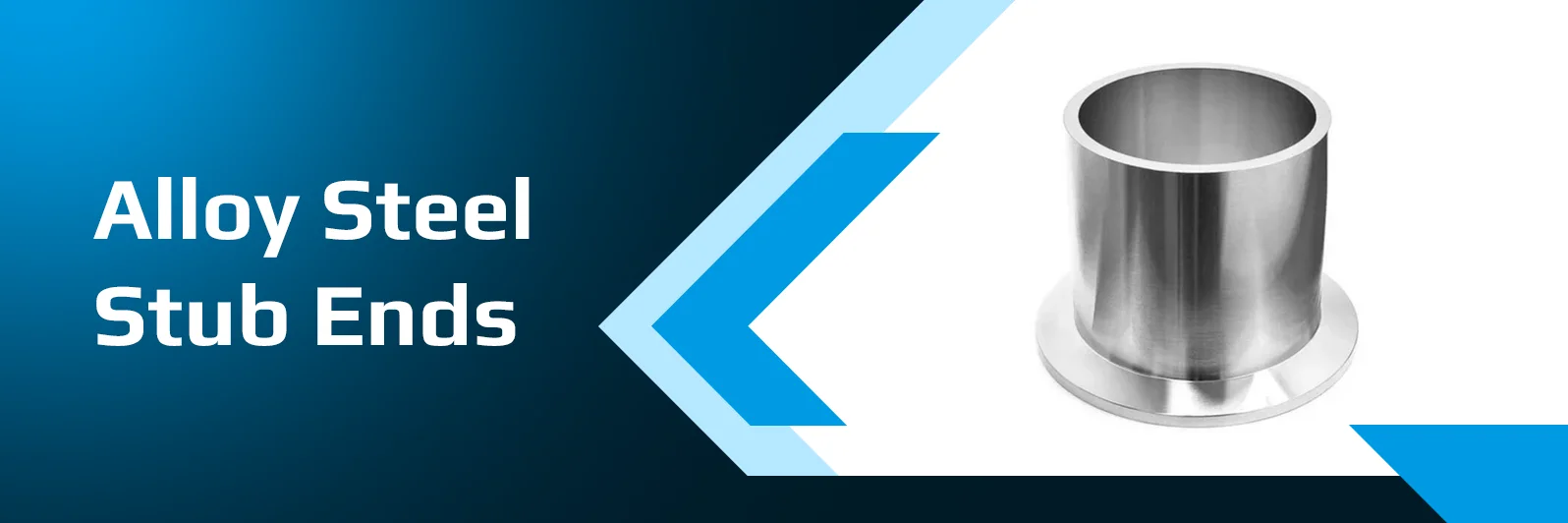
The backing flange never touches the process fluid. That single fact is why stub ends exist, and why they save money on expensive alloy lines: the stub end is P91 or P22 because it is in contact with the medium, while the loose flange behind it can be ordinary carbon steel. On a large bore chrome-moly line that difference is significant. Add the fact that a loose flange rotates freely for bolt hole alignment, and the case for a lap joint gets stronger still. Solitaire Overseas manufactures and exports alloy steel stub ends from India to ASME B16.9 and MSS SP-43, Type A, B and C, in ASTM A234 WP grades. Below: the three types, the flange pairing rule, and where a stub end is the wrong choice.
Part of our alloy steel fittings range. See also alloy steel flanges.
A stub end is a short buttweld fitting with a flared lap at one end. It welds into the pipe run like any other buttweld fitting, and a loose backing flange slips over the pipe behind the lap. When the joint is bolted up, the gasket seats against the face of the lap and the flange simply provides the clamping force. The flange is never in the flow path.
Two advantages follow from that arrangement. First, cost: because the backing flange does not contact the medium, it can be a cheaper material than the line. On a chrome-moly system that means an alloy stub end with a carbon steel flange. Second, alignment: the loose flange rotates freely on the pipe, so bolt holes can be lined up on site without rotating the whole spool. On large bore work that saves real fitting time.
Lap joints are traditionally used in lower pressure and less critical service, and there is a reason. The gasket seats on a comparatively thin flared lap rather than on the substantial face of a welding neck flange, so the joint is less tolerant of high pressure, severe thermal cycling and heavy bending loads. Where the line is high pressure, high temperature and safety critical, a welding neck flange remains the stronger detail.
The types differ in lap thickness and face diameter, which determines which backing flange they suit. Choosing the wrong type can leave the fitting incompatible with the flange on site:
| Type | Lap Thickness | Pairs With | Notes |
|---|---|---|---|
| Type A | Equal to or greater than the pipe wall | Standard lap joint flanges | The industry norm. Machined radius on the back so the flange mates flush over the fitting |
| Type B | About 75 percent of the connecting pipe wall | Standard slip-on flanges used as backing flanges | Different face diameter from Type A, check flange compatibility |
| Type C | Fabricated from pipe | Both lap joint and slip-on backing flanges | The flexible option where flange type is not fixed |
Long and short patterns. Stub ends are also made in two lengths: the long pattern, sometimes called the ANSI or ASA pattern, and the short pattern, the MSS pattern. The long pattern gives more clearance between the lap face and the weld, which is what avoids the flange-over-weld problem noted above. State the type and the pattern together when ordering.
STANDARDS NOTE: ASME B16.9 covers stub end dimensions and tolerances. MSS SP-43 covers lighter wall corrosion-resistant stub ends and is substantially the same as B16.9 from NPS 1/2 to 24, except for the outside diameter at the bevel. State which standard the project requires.
Matched to the pipe grade it welds into, so fitting and pipe share compatible chemistry and high-temperature behaviour:
| Pipe Grade (A335) | Buttweld (A234) | Forged (A182) | Chromium | Service |
|---|---|---|---|---|
| P1 | WP1 | F1 | Not specified (carbon-moly) | Moderate temperature steam |
| P5 | WP5 | F5 | 4.0 - 6.0% | Refinery hydrogen and sulphur service |
| P9 | WP9 | F9 | 8.0 - 10.0% | Higher temperature refinery piping |
| P11 | WP11 | F11 | 1.00 - 1.50% | The workhorse grade |
| P12 | WP12 | F12 | 0.80 - 1.25% | General elevated temperature service |
| P22 | WP22 | F22 | 1.90 - 2.60% | Higher temperature and pressure than P11 |
| P91 | WP91 | F91 | 8.0 - 9.5% | Modern high-temperature power plant piping |
Most chrome-moly A234 grades are divided into classes with different mechanical properties. A purchase order naming only the grade has not fully specified the fitting:
| Grade | Classes Available | What Changes |
|---|---|---|
| WP11 | Class 1, Class 2, Class 3 | Carbon and manganese limits differ; Class 3 is the strongest |
| WP22 | Class 1, Class 3 | Class 3 carries substantially higher yield and tensile |
| WP5 / WP9 | Class 1, Class 3 | As above |
| WP12 | Class 1, Class 2 | Two classes only |
| WP91 | Type 1, Type 2 | Types rather than classes. Tempering temperature is the variable |
| Parameter | Specification |
|---|---|
| Material standard | ASTM A234 / ASME SA234 WP grades |
| Dimensional standard | ASME B16.9. MSS SP-43 for lighter wall patterns |
| Grades | WP1, WP5, WP9, WP11, WP12, WP22, WP91 (state class or type) |
| Types | Type A, Type B, Type C |
| Patterns | Long (ANSI/ASA) and short (MSS) |
| Size range | NPS 1/2 inch to 24 inch typical, larger to order |
| End type | Bevelled to ASME B16.25 at the weld end, flared lap at the flange end |
| Gasket face finish | Per ASME B16.5 for raised face flanges |
| Certification | EN 10204 3.1 mill test certificate. PMI, NDE and third-party inspection on request |
Two reasons. Cost: the backing flange never contacts the process fluid, so on an alloy line it can be ordinary carbon steel while only the stub end is chrome-moly, which is a significant saving on large bore. Convenience: the loose flange rotates freely so bolt holes align without turning the spool, and the joint is easy to break and remake. For high pressure and safety critical service, a welding neck flange is still the stronger detail.
Lap thickness and face diameter, which determines the backing flange they suit. Type A has a lap at least as thick as the pipe wall and pairs with standard lap joint flanges. Type B has a thinner lap, about 75 percent of the pipe wall, and suits slip-on flanges used as backing flanges. Type C is fabricated from pipe and works with both. Selecting the wrong type can leave the fitting incompatible with the flange on site.
No, and that is the main commercial reason to use a lap joint. The flange sits behind the lap and never touches the process fluid, so it can be a cheaper material. On a chrome-moly line an alloy stub end is commonly paired with a carbon steel backing flange, provided the flange material is suitable for the design temperature and the bolting loads.
Length. The long pattern, sometimes called ANSI or ASA, gives more distance between the lap face and the weld. The short pattern, the MSS pattern, is more compact. Long pattern matters where a larger backing flange would otherwise sit over the weld, which happens with higher class flanges. State type and pattern together when ordering.
Send your size, schedule, grade and class, plus the stub end type, pattern and the backing flange class, and we will confirm availability and lead time.