+91-9619103479
or
vishal@solitaire-overseas.com
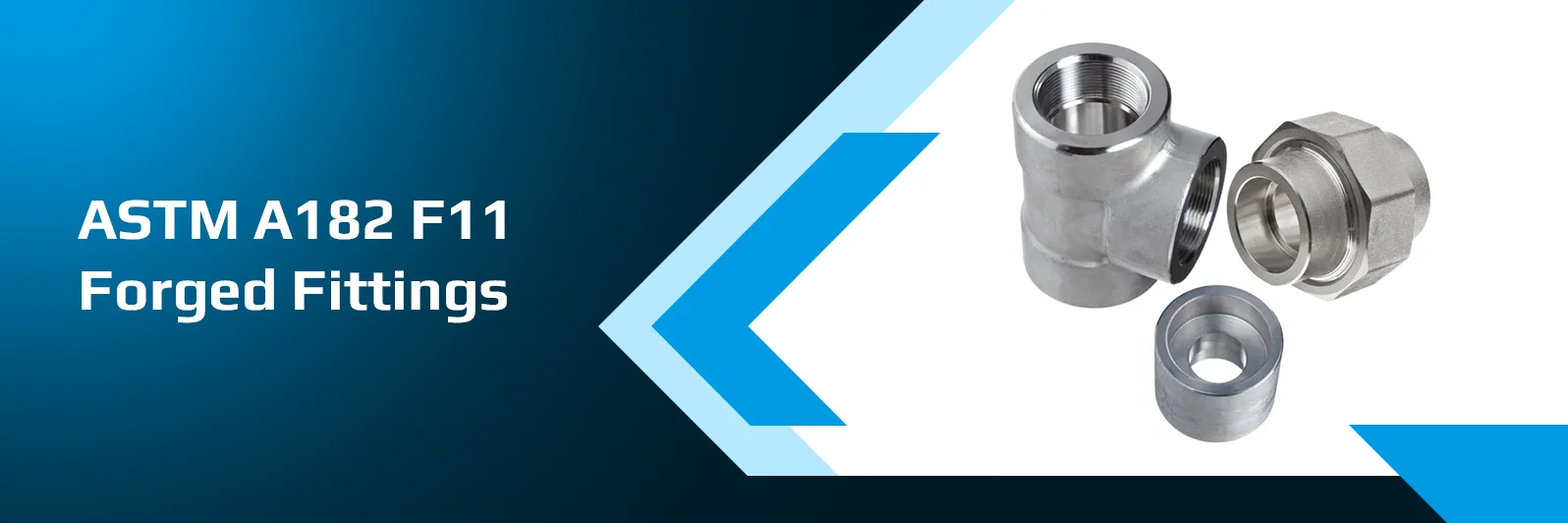
An F11 fitting can carry two different class numbers at once. ASTM A182 divides F11 into Class 1, 2 and 3 by heat treatment and strength, while ASME B16.11 separately rates the same fitting Class 3000, 6000 or 9000 by pressure, so a purchase order might legitimately read F11 Class 2, Class 6000, and anyone reading it quickly will assume one of those is a typo. It is not. Solitaire Overseas manufactures and exports A182 F11 forged fittings from India, socket weld and threaded, 1/8 inch to 4 inch. Below: the two class systems, and what forged buys that buttweld cannot.
Below about 4 inch, forged fittings replace buttweld for good engineering reasons rather than convenience:
The buttweld form of the same alloy is covered on our ASTM A234 WP11 fittings page.
This trips up buyers and expediters regularly, because both numbers are called a class and both appear on the same line of a purchase order:
| A182 Material Class | ASME B16.11 Pressure Class | |
|---|---|---|
| Set by | ASTM A182, the material specification | ASME B16.11, the dimensional standard |
| Values | Class 1, Class 2, Class 3 | Class 2000, 3000, 6000, 9000 |
| Determined by | Heat treatment and resulting mechanical properties | Wall thickness and end type |
| Tells you | How strong the metal is | How much pressure the fitting body can hold |
| Example | F11 Class 2 | Class 6000 socket weld |
A complete specification names both. “ASTM A182 F11 Class 2 socket weld coupling, Class 6000, 1 inch” is fully specified. “F11 coupling, 1 inch, Class 6000” leaves the material class open and lets the supplier decide which strength you get. Buttweld fittings do not have this problem because they carry no pressure class at all, they simply match the pipe schedule, which is one practical reason the two product families are quoted differently.
| Socket Weld | Threaded | |
|---|---|---|
| Joint | Pipe into machined socket, fillet welded | Pipe screwed into NPT thread |
| Max class | Class 9000 | Class 6000 |
| Permanence | Permanent | Dismantlable |
| Vibration | Holds well, but see the fatigue note | Threads can loosen over time |
| Best for | Steam and process lines, permanent small bore | Instrument connections, utility lines, maintenance points |
ASME B16.11 Pressure Classes
Separate from the A182 material class, the fitting carries a pressure class that depends on the end type:
| End Type | Available Classes | Correlates To Pipe Schedule |
|---|---|---|
| Socket Weld | Class 3000, 6000, 9000 | 3000 = Sch 80/XS · 6000 = Sch 160 · 9000 = XXS |
| Threaded (NPT) | Class 2000, 3000, 6000 | Threaded runs one class lower at the top end. There is no Class 9000 threaded fitting |
Size range: 1/8 inch to 4 inch NPS. Above 4 inch the line moves to buttweld fittings under ASME B16.9.
| Element | Range |
|---|---|
| Carbon | 0.05 - 0.15% |
| Manganese | 0.30 - 0.60% |
| Phosphorus | 0.030% max |
| Sulfur | 0.030% max |
| Silicon | 0.50 - 1.00% |
| Chromium | 1.00 - 1.50% |
| Molybdenum | 0.44 - 0.65% |
| Material Class | Tensile min | Yield min | Notes |
|---|---|---|---|
| Class 1 | 415 MPa (60 ksi) | 205 MPa (30 ksi) | Lowest strength condition |
| Class 2 | 485 MPa (70 ksi) | 275 MPa (40 ksi) | The common condition |
| Class 3 | 520 MPa (75 ksi) | 310 MPa (45 ksi) | Highest strength |
Supplied as couplings, unions, plugs, bushings, street elbows and swage nipples, plus forged elbows and tees.
| Item | Detail |
|---|---|
| Material standard | ASTM A182 / ASME SA182 F11 |
| Dimensional | ASME B16.11 |
| Material classes | Class 1, Class 2, Class 3 |
| Pressure classes | SW 3000/6000/9000, Threaded 2000/3000/6000 |
| Size range | 1/8 inch to 4 inch NPS |
| Ends | Socket weld, threaded NPT |
| Matching pipe | ASTM A335 P11 |
| Certification | EN 10204 3.1. PMI and hardness on request |
Matching pipe: ASTM A335 P11 pipes.
Because two different standards apply. ASTM A182 assigns a material class, Class 1, 2 or 3, based on heat treatment and the resulting mechanical properties. ASME B16.11 separately assigns a pressure class, Class 2000 to 9000, based on wall thickness and end type. A fully specified order names both, for example F11 Class 2 socket weld coupling, Class 6000.
Product form. F11 under ASTM A182 is the forged fitting, dimensioned by ASME B16.11, with socket weld or threaded ends, made from 1/8 inch to 4 inch. WP11 under ASTM A234 is the buttweld fitting, dimensioned by ASME B16.9, welded into the run with a full penetration weld and used from about 2 inch upward. Same 1.25Cr-0.5Mo alloy, different products. See our WP11 fittings page.
Socket weld for permanent small bore connections on steam and process lines, and where the design pressure requires Class 9000, since threaded fittings stop at Class 6000. Threaded where the joint needs to come apart for maintenance or where no welding is wanted, typically instrument and utility connections. Note that socket welds can suffer fatigue cracking in high cycle service, so check the piping class on vibrating lines.
Send your fitting type, size, END TYPE, material class and pressure class, and we will confirm availability, certification and lead time. If either class is missing from your specification, tell us the design conditions and we will flag it.