+91-9619103479
or
vishal@solitaire-overseas.com
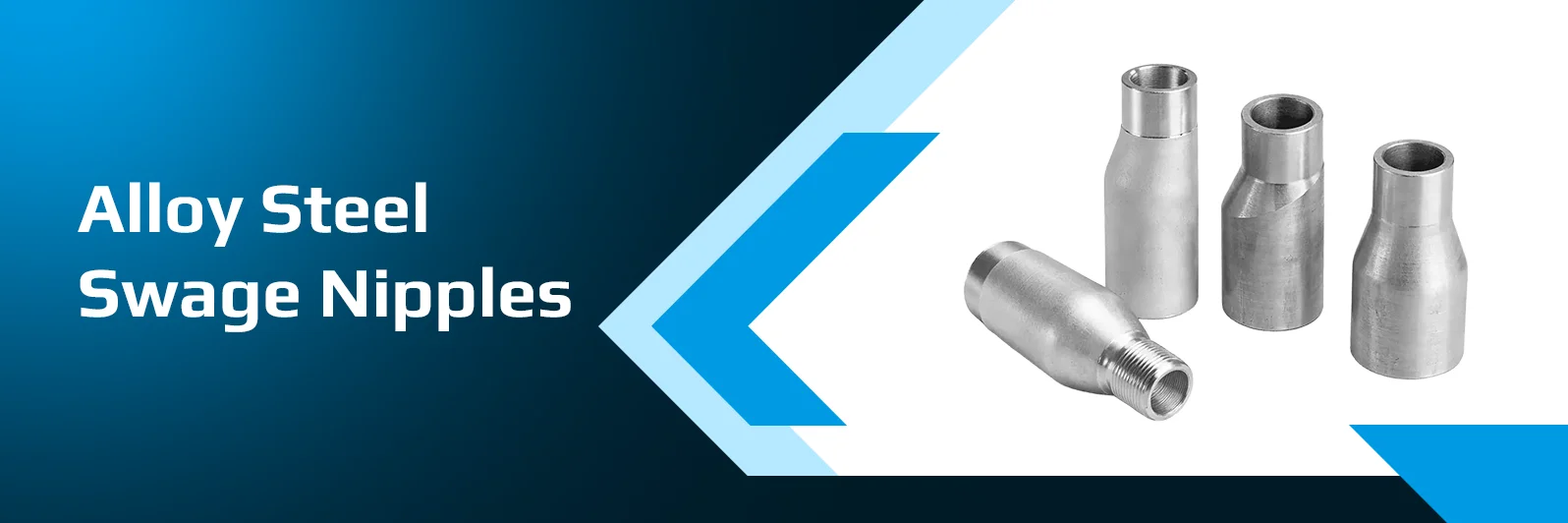
Order a swage nipple without stating the end code and you will get the wrong part. Every time. A swage nipple is made with threaded, bevelled, plain or grooved ends in any combination, and the two ends are usually different, so BBE, TBE and TOE describe genuinely different fittings from the same size and grade. Solitaire Overseas manufactures and exports alloy steel swage nipples from India to MSS SP-95, in ASTM A182 chrome-moly grades F1 through F91, concentric and eccentric, sizes 1/2 inch to 12 inch. Below: the end codes decoded, when eccentric beats concentric, and the grade table.
Part of our alloy steel fittings range. See also alloy steel couplings and alloy steel pipes.
A swage nipple is a short forged fitting that steps a pipe run from one diameter down to another. Both ends are male, which is the defining feature: instead of receiving pipe into a socket, the nipple itself is welded or screwed into the adjoining components. That makes it the standard way to change size in small-bore piping, where a full buttweld reducer would be impractical.
Governing standard: MSS SP-95, which covers dimensions, finish, tolerances, marking and material for swaged nipples and bull plugs. It includes both concentric and eccentric forms, and permits ends that are threaded, bevelled, square cut, grooved, or any combination of these. Threaded ends follow ASME B1.20.1 and bevelled ends follow ASME B16.25.
| Item | Detail |
|---|---|
| Design standard | MSS SP-95 (BS 3799 on request) |
| Material standard | ASTM A182 / ASME SA182 forged alloy steel |
| Grades | F1, F5, F9, F11, F12, F22, F91 |
| Types | Concentric and eccentric |
| Size range | 1/2 inch to 12 inch NPS. Eccentric range may be narrower, confirm on enquiry |
| Wall thickness | STD / Sch 40, XS / Sch 80, Sch 160, XXS |
| End finishes | Threaded (ASME B1.20.1), bevelled (ASME B16.25), plain / square cut, grooved, or combinations |
| Thread types | NPT standard. BSPT and BSPP on request |
| Certification | EN 10204 3.1 mill test certificate. PMI and third-party inspection on request |
Both change pipe size, so buyers use the words interchangeably. They are not interchangeable products:
| Swage Nipple | Buttweld Reducer | |
|---|---|---|
| Standard | MSS SP-95 | ASME B16.9 |
| Manufacture | Forged from bar or seamless pipe | Formed or pressed from plate or pipe |
| Ends | Male both ends. Threaded, bevelled, plain or grooved | Bevelled both ends for buttwelding |
| Length | Short | Longer transition |
| Typical bore | Small bore, up to about 4 inch in most service | Larger bore, 2 inch upward |
| Best for | Size changes in tight space, high pressure, and lines that come apart for maintenance | Permanent welded transitions in main process runs |
If the line is large bore and permanently welded, the fitting you want is a reducer, covered in our alloy steel fittings buttweld range. If the change is small bore, tight on space, or needs to be dismantled, the swage nipple is the correct fitting.
The two forms differ by one thing: whether the small end sits on the same centreline as the large end. That single geometric difference decides which one a line needs, and getting it wrong causes real operating problems.
Concentric Swage Nipples
Both ends share a common centreline, so the fitting tapers evenly all the way round. This is the default choice, used wherever the pipe centreline should stay constant: vertical runs, and horizontal runs where nothing needs to drain or vent along the wall of the pipe.
Eccentric Swage Nipples
The two ends are offset so one side of the fitting stays flat and in line. That flat side is the whole point. On a horizontal run, a concentric fitting creates a pocket at the top where vapour collects, or a dip at the bottom where liquid sits. An eccentric nipple installed flat side up keeps the top of the bore continuous so gas cannot be trapped, which matters on pump suction lines where a vapour pocket causes cavitation. Installed flat side down, it keeps the bottom continuous so the line drains fully.
| Concentric | Eccentric | |
|---|---|---|
| Geometry | Common centreline, even taper | Offset centreline, one side flat |
| Use on | Vertical lines, and horizontal lines with no drainage or venting concern | Horizontal lines where trapped vapour or liquid is a problem |
| Flat side up (FOT) | Not applicable | Prevents vapour pockets. Standard on pump suction lines |
| Flat side down (FOB) | Not applicable | Allows complete drainage of the line |
| Availability | Full size range | Usually a slightly narrower size range, confirm on enquiry |
Swage nipples are ordered by end configuration, and the trade uses a shorthand that is rarely explained anywhere. The large end and small end can be finished differently, which is why the codes come in pairs:
| Code | Meaning | Notes |
|---|---|---|
| BBE | Bevel Both Ends | For buttwelding into the line at both ends |
| TBE | Thread Both Ends | Screwed both ends, common on instrument and utility lines |
| PBE | Plain Both Ends | Square cut, for socket welding |
| GBE | Grooved Both Ends | For grooved mechanical couplings |
| TOE | Thread One End | The other end bevelled or plain. State which |
| BOE / POE | Bevel One End / Plain One End | Mixed end configurations |
| TLE / TSE | Thread Large End / Thread Small End | Specifies WHICH end carries the thread |
| BLE / BSE | Bevel Large End / Bevel Small End | Specifies which end is bevelled |
| PLE / PSE | Plain Large End / Plain Small End | Specifies which end is square cut |
| TXB, PXG, BXT | Combinations | Thread by bevel, plain by groove, bevel by thread |
Supplied in the ASTM A182 chrome-moly forged grades, each matched to its ASTM A335 pipe counterpart:
| A182 Grade | Matching Pipe | Chromium | Molybdenum | Typical Service |
|---|---|---|---|---|
| F1 | P1 | Not specified (carbon-moly) | 0.44 - 0.65% | Moderate temperature steam |
| F5 | P5 | 4.0 - 6.0% | 0.44 - 0.65% | Refinery hydrogen and sulphur service |
| F9 | P9 | 8.0 - 10.0% | 0.90 - 1.10% | Higher temperature refinery piping |
| F11 | P11 | 1.00 - 1.50% | 0.44 - 0.65% | The workhorse grade |
| F12 | P12 | 0.80 - 1.25% | 0.44 - 0.65% | General elevated temperature service |
| F22 | P22 | 2.00 - 2.50% | 0.87 - 1.13% | Higher temperature and pressure than F11 |
| F91 | P91 | 8.0 - 9.5% | 0.85 - 1.05% (plus V) | Modern high-temperature power plant piping |
Solitaire Overseas manufactures alloy steel swage nipples in India and exports to power, refinery and petrochemical projects worldwide. Orders ship with EN 10204 3.1 certification and heat-number traceability, with export documentation and third-party inspection arranged in-house. Send your size combination, grade, schedule and end code for a quote.
A concentric swage nipple keeps both ends on the same centreline and tapers evenly. An eccentric nipple offsets the ends so one side stays flat. That flat side prevents a vapour pocket forming at the top of a horizontal line, or allows the line to drain fully if installed flat side down. Concentric is the default; eccentric is specified where trapped gas or liquid would cause a problem, most commonly on pump suction lines.
They are end codes. BBE is bevel both ends, TBE is thread both ends, TOE is thread one end. Because the large and small ends can be finished differently, codes such as TLE (thread large end) and BSE (bevel small end) specify which end carries which finish. Always state the end code when ordering, since the same size and grade is made in several configurations.
MSS SP-95 covers dimensions, finish, tolerances, marking and material for swaged nipples and bull plugs, including both concentric and eccentric forms. Threaded ends follow ASME B1.20.1 and bevelled ends follow ASME B16.25. The material itself is supplied to ASTM A182 for alloy steel grades.
Use a swage nipple for small-bore size changes, tight spaces, high pressure, or lines that need to be dismantled. Use a buttweld reducer for larger bore permanent welded transitions in main process runs. See our alloy steel fittings (https://www.solitaire-overseas.com/alloy-steel-fittings.html) page for the buttweld reducer range.
Not without engineering approval. F11 carries roughly 1 to 1.5 percent chromium against P22's 2 to 2.5 percent, so the fitting becomes the weakest section in a line specified for P22 duty. Match the fitting grade to the pipe grade unless a dissimilar-metal joint has been designed and a weld procedure qualified.
Send your size combination (large end by small end), grade, schedule, end code and quantity, and we will confirm availability, certification and lead time.