+91-9619103479
or
vishal@solitaire-overseas.com
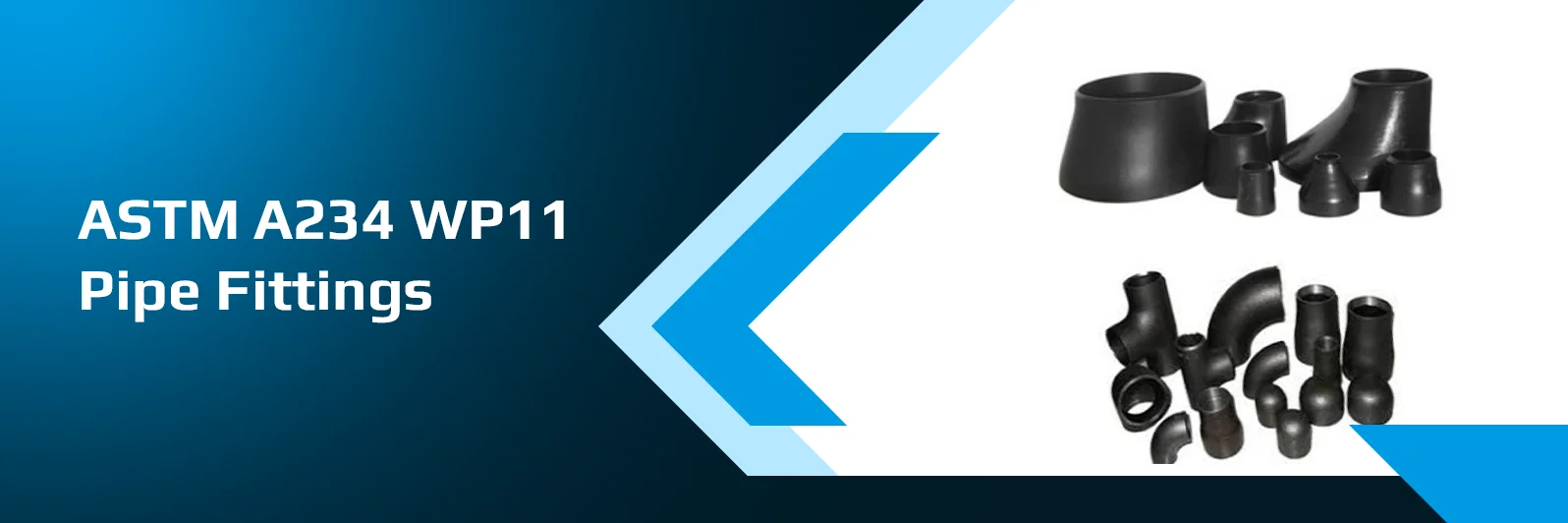
WP11 is the only grade in ASTM A234 that comes in three classes. Class 1, Class 2, Class 3. They share a name and a chemistry band but not a strength, because the heat treatment differs and the mechanical properties follow it, which makes WP11 the grade most often ordered incompletely. A purchase order reading only A234 WP11 lets the mill decide which of the three you get. Solitaire Overseas manufactures and exports A234 WP11 buttweld pipe fittings from India, all three classes, elbows through caps, to ASME B16.9 and B16.28. Below: what separates the classes, where WP11 sits on the temperature ladder, and the full chemistry.
Same alloy, two different products. WP11 under ASTM A234 is the buttweld form, dimensioned by ASME B16.9 and B16.28, welded into the line with a full penetration weld, used from about 2 inch upward. F11 under ASTM A182 is the forged form, dimensioned by ASME B16.11, with socket weld or threaded ends, used at 4 inch and below. A line typically uses both: WP11 through the main run, F11 at the small bore connections.
The classes differ in carbon and manganese limits and, decisively, in heat treatment. The result is three materially different strengths under one grade name:
| Class | Carbon | Manganese | Tensile min | Yield min |
|---|---|---|---|---|
| Class 1 | 0.05 - 0.15% | 0.30 - 0.60% | 415 MPa (60 ksi) | 205 MPa (30 ksi) |
| Class 2 | 0.05 - 0.20% | 0.30 - 0.80% | 485 MPa (70 ksi) | 275 MPa (40 ksi) |
| Class 3 | 0.05 - 0.20% | 0.30 - 0.80% | 520 MPa (75 ksi) | 310 MPa (45 ksi) |
Between Class 1 and Class 3 the yield strength rises by roughly half. A Class 1 fitting installed in a line designed around Class 3 properties is a weaker component in the pressure boundary, and nothing on the outside of the fitting reveals it. State the class on the purchase order. If the line specification is silent, ask the piping engineer rather than accepting whatever is in stock.
| Element | Range |
|---|---|
| Carbon | 0.05 - 0.15% (Cl 1), 0.05 - 0.20% (Cl 2 and 3) |
| Manganese | 0.30 - 0.60% (Cl 1), 0.30 - 0.80% (Cl 2 and 3) |
| Phosphorus | 0.030% max |
| Sulfur | 0.030% max |
| Silicon | 0.50 - 1.00% |
| Chromium | 1.00 - 1.50% |
| Molybdenum | 0.44 - 0.65% |
Note the silicon. WP11 carries 0.50 to 1.00 percent silicon, notably higher than WP22 or WP91. It is one of the quick ways to tell the grades apart on a mill certificate.
WP11 is the volume workhorse of conventional power generation, used up to around 510 degrees C:
Above about 510 degrees C the grade hands over to WP22. That transition is covered on our high temperature fittings page.
Carbon and manganese limits differ slightly, but the decisive difference is heat treatment, which produces three different strength levels under one grade name. Class 1 has the lowest specified minimum tensile and yield, Class 3 the highest, with roughly a fifty percent difference in yield strength between them. Because the grade name is the same, a purchase order stating only WP11 does not fully specify the fitting.
WP11 is generally used up to around 510 degrees C in power plant service. Above that, WP22 takes over for main steam and hot reheat duty. Note separately that ASTM A234 sets a minimum tempering temperature of 620 degrees C for WP11 during manufacture, which is a production requirement rather than a service limit.
Same alloy, different product form. WP11 under ASTM A234 is the buttweld fitting, dimensioned by ASME B16.9, welded into the line with a full penetration weld and used from about 2 inch upward. F11 under ASTM A182 is the forged fitting, dimensioned by ASME B16.11, with socket weld or threaded ends, used at 4 inch and below.
ASTM A335 P11. Matching the fitting grade to the pipe grade keeps chemistry and high-temperature behaviour consistent through the welded joint. Mixing grades creates a dissimilar-metal weld that requires a qualified procedure and is best avoided unless engineered deliberately.
Send your fitting type, size, schedule and CLASS, and we will confirm availability, certification and lead time. If the class is not stated on your specification, tell us the design conditions and we will flag it before quoting.