+91-9619103479
or
vishal@solitaire-overseas.com
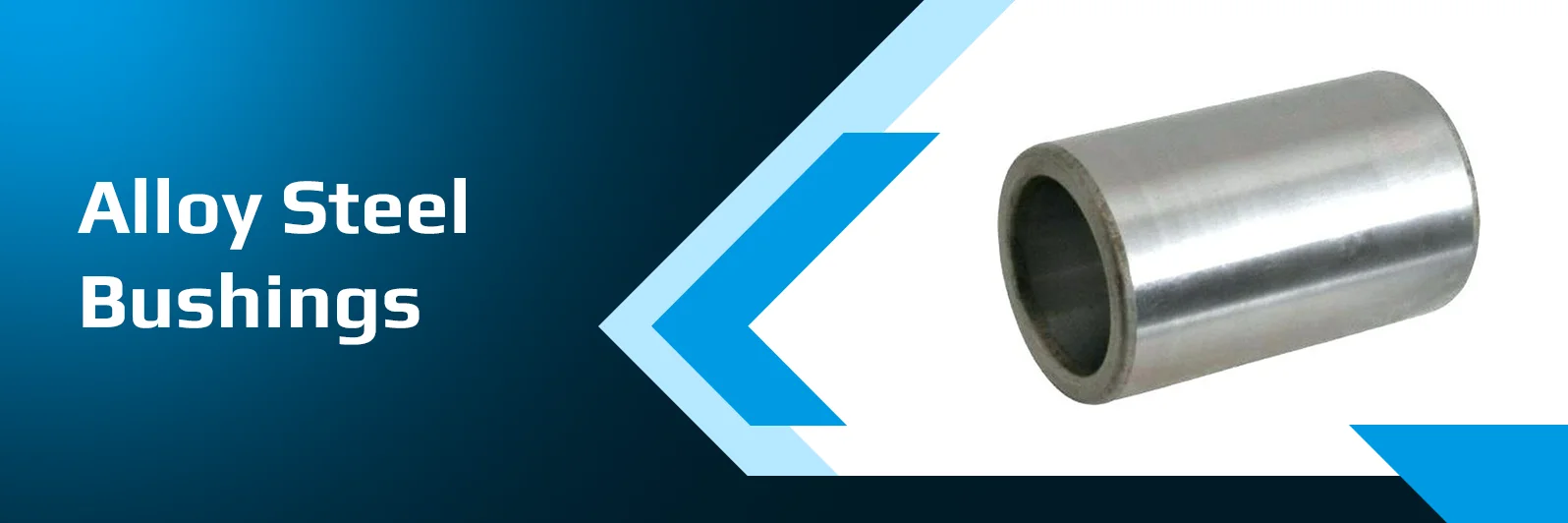
Bushings are the exception in ASME B16.11. Every other forged fitting carries a pressure class and must be permanently marked with its grade. Bushings and plugs carry neither. The standard does not designate them by class and does not require them to be marked at all, which puts the burden of proving what grade you actually received onto certification and material verification rather than a stamp you can read. Solitaire Overseas manufactures and exports alloy steel bushings from India in ASTM A182 chrome-moly grades, threaded to ASME B16.11, hex head and flush, 1/4 inch to 4 inch. Below: the two types, the load warning the standard carries, and how a bushing differs from a reducing coupling.
Part of our alloy steel fittings range. See also alloy steel couplings and alloy steel swage nipples.
A bushing is a threaded reducing fitting with male threads on the outside and female threads on the inside. The outside screws into a larger female connection; the smaller pipe screws into the bore. The result is a size reduction inside the footprint of the existing fitting, which makes the bushing the most compact way to reduce a threaded line.
Bushings are forged fittings covered by ASME B16.11, the same standard as forged couplings, elbows and tees, with material supplied to ASTM A182 for alloy steel grades. Threads follow ASME B1.20.1 (NPT). Two forms are made: hex head and flush.
| Item | Detail |
|---|---|
| Dimensional standard | ASME B16.11 |
| Material standard | ASTM A182 / ASME SA182 forged alloy steel |
| Grades | F1, F5, F9, F11, F12, F22, F91 |
| Types | Hex head bushing, flush bushing |
| Thread standard | ASME B1.20.1 (NPT). BSPT and BSPP on request |
| Size range | 1/4 inch to 4 inch NPS (6 mm to 100 mm) |
| Class designation | Not assigned by ASME B16.11 for bushings, see Fold 6 |
| Marking | Not required by the standard. Available on request |
| Certification | EN 10204 3.1 mill test certificate. PMI and third-party inspection on request |
Supplied in ASTM A182 chrome-moly forged grades, each matched to its ASTM A335 pipe counterpart:
| A182 Grade | Matching Pipe | Chromium | Molybdenum | Typical Service |
|---|---|---|---|---|
| F1 | P1 | Not specified (carbon-moly) | 0.44 - 0.65% | Moderate temperature steam |
| F5 | P5 | 4.0 - 6.0% | 0.44 - 0.65% | Refinery hydrogen and sulphur service |
| F9 | P9 | 8.0 - 10.0% | 0.90 - 1.10% | Higher temperature refinery piping |
| F11 | P11 | 1.00 - 1.50% | 0.44 - 0.65% | The workhorse grade |
| F12 | P12 | 0.80 - 1.25% | 0.44 - 0.65% | General elevated temperature service |
| F22 | P22 | 2.00 - 2.50% | 0.87 - 1.13% | Higher temperature and pressure than F11 |
| F91 | P91 | 8.0 - 9.5% | 0.85 - 1.05% (plus V) | Modern high-temperature power plant piping |
All three reduce line size, and buyers use the words loosely. They are not interchangeable, and the difference is in the threads:
| Bushing | Reducing Coupling | Swage Nipple | |
|---|---|---|---|
| Threads | Male outside, female inside | Female both ends | Male both ends |
| How it fits | Screws INTO an existing female fitting | Both pipes screw INTO it | Screws into two female fittings |
| Space taken | Least. Sits inside the existing fitting | Adds a fitting length | Adds a nipple length |
| Standard | ASME B16.11 | ASME B16.11 | MSS SP-95 |
| Use it when | Reducing at an existing female port, space is tight | Joining two pipes of different size in a run | Reducing with welded or mixed ends, or longer transition |
See alloy steel couplings for reducing couplings, and alloy steel swage nipples for the male-ended reducing option.
Hex Head Bushings
The common form, and the one most buyers mean when they say bushing. A hexagonal collar at the large end gives wrench flats, so the bushing can be tightened to a controlled torque with an ordinary spanner. That makes installation straightforward and repeatable, which is why hex head is the default across almost all threaded piping.
Flush Bushings
No external head. The bushing seats flush with the face of the fitting it screws into, so nothing protrudes. Use it where clearance is tight or where a projecting hex would foul adjacent equipment or insulation. The trade-off is installation: with no external flats, a flush bushing is turned with an internal wrench engaging the bore, which is slower and gives less torque control.
| Type | Head | Installed With | Choose It When |
|---|---|---|---|
| Hex Head Bushing | Hexagonal collar, external wrench flats | Standard spanner | The default. Clear access and controlled torque needed |
| Flush Bushing | None, seats flush with the fitting face | Internal wrench in the bore | Clearance is tight or a projecting head would foul something |
ASME B16.11 carries a cautionary note that is worth stating plainly: a hex bushing making a one-size reduction should not be used in services where it may be subject to harmful loads and forces other than internal pressure. A bushing is designed to contain pressure, not to carry bending, vibration or external mechanical load.
In practice that rules out a few common misuses. Do not hang unsupported weight off a bushed connection, do not use one where thermal movement will put a bending moment on the joint, and think carefully before using one in high-vibration service. Where those loads exist, a reducing coupling or a welded reducer distributes them better. This is one of the few places where the cheapest fitting is genuinely the wrong fitting.
Solitaire Overseas manufactures alloy steel bushings in India and exports to power, refinery and petrochemical projects worldwide. Orders ship with EN 10204 3.1 certification and heat-number traceability, with export documentation and third-party inspection arranged in-house. Send your size combination, grade, head type and quantity for a quote.
A hex bushing has a hexagonal collar at the large end giving external wrench flats, so it can be tightened with a standard spanner to a controlled torque. A flush bushing has no external head and seats level with the face of the fitting it enters, which suits tight clearances but requires an internal wrench to install. Hex head is the default; flush is specified where a projecting head would foul adjacent equipment.
ASME B16.11 does not assign a class designation to bushings or plugs, unlike couplings, elbows and tees which are rated Class 2000 to 9000. Bushings are commonly quoted as suitable for service in the Class 6000 range, but the rating should be confirmed against the current edition of the standard and the specific design conditions of the line.
Not necessarily. ASME B16.11 does not require bushings and plugs to be permanently marked, which means the grade cannot always be read off the fitting. On alloy steel work this is a real traceability gap, so rely on the mill test certificate and Positive Material Identification, and specify marking explicitly if you need it on the part.
ASME B16.11 cautions that hex bushings making a one-size reduction should not be used where they may be subject to harmful loads and forces other than internal pressure. Avoid them where the joint will carry bending, unsupported weight, thermal movement or significant vibration. In those conditions a reducing coupling or a welded reducer distributes the load better.
A bushing has male threads outside and female threads inside, so it screws into an existing female fitting and reduces within that footprint. A reducing coupling is female at both ends and joins two pipes of different diameter in a run. The bushing takes less space; the coupling handles load better. See our alloy steel couplings
Send your size combination (outside thread by bore), grade, head type and quantity, and we will confirm availability, certification and lead time.