+91-9619103479
or
vishal@solitaire-overseas.com
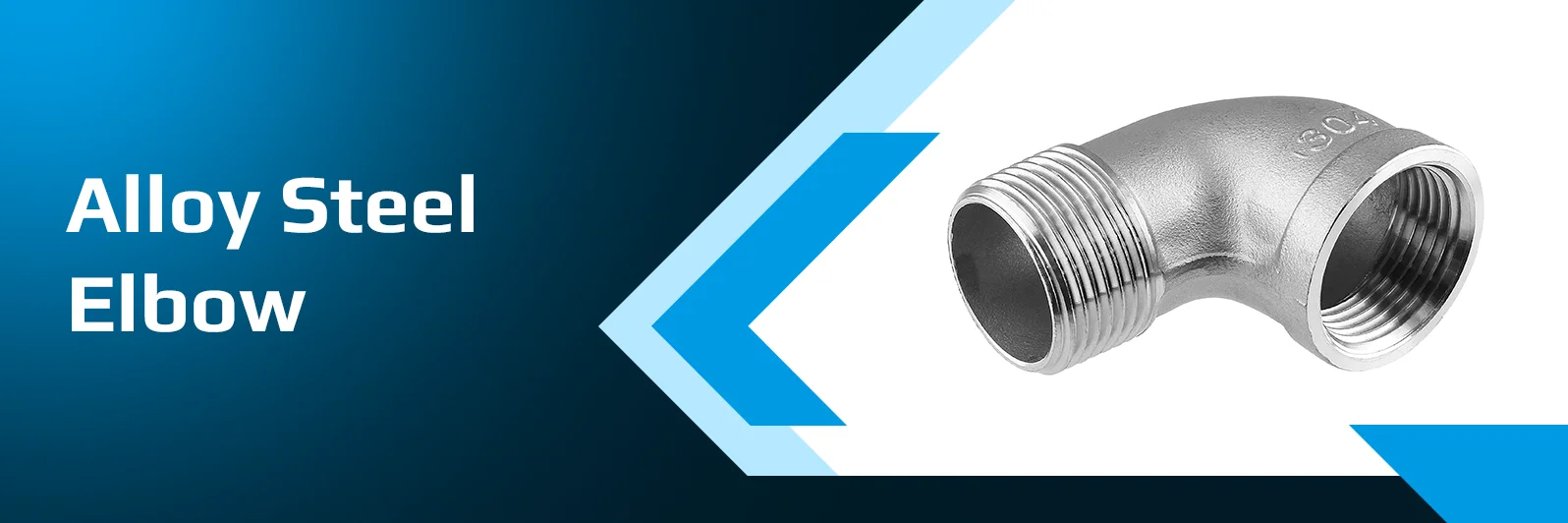
A street elbow saves you a nipple. It carries a male thread on one end and a female on the other, so it screws straight into the next fitting with nothing in between, where a standard elbow would need a short nipple to bridge the gap. One part instead of two. One joint instead of two, which also means one fewer place to leak. Solitaire Overseas manufactures and exports alloy steel street elbows from India, 45 and 90 degree, forged to ASME B16.11 in ASTM A182 chrome-moly grades, sizes 1/8 inch to 4 inch. Below: where a street elbow earns its place and how it differs from a standard forged elbow.
Part of our alloy steel fittings range. For the full elbow range including buttweld and long radius patterns, see alloy steel elbows.
A street elbow is a forged elbow with one male threaded end and one female threaded end. Every other threaded elbow has the same connection at both ends, female on a standard elbow, so joining it to another fitting needs a short nipple in between. The street elbow's male end removes that nipple entirely by screwing directly into the adjacent fitting.
| Standard Forged Elbow | Street Elbow | |
|---|---|---|
| Ends | Female both ends (or socket both ends) | One male, one female |
| Joining to another fitting | Needs a nipple in between | Screws in directly |
| Parts in the joint | Two, elbow plus nipple | One |
| Threaded joints | Two | One |
| Space taken | More, the nipple adds length | Minimum |
| Use it when | General direction change in a run | Two fittings must meet with no room between them |
| Parameter | Specification |
|---|---|
| Dimensional standard | ASME B16.11 (BS 3799 on request) |
| Material standard | ASTM A182 / ASME SA182 forged alloy steel |
| Grades | F1, F5, F9, F11, F12, F22, F91 |
| Angles | 45 degree and 90 degree |
| End configuration | Male x female. Socket weld variants on request |
| Thread standard | ASME B1.20.1 (NPT). BSPT and BSPP on request |
| Size range | 1/8 inch to 4 inch NPS |
| Pressure classes | Threaded 2000, 3000, 6000 · Socket weld 3000, 6000, 9000 |
| Certification | EN 10204 3.1 mill test certificate. PMI and third-party inspection on request |
ASME B16.11 rates forged fittings by class, and the class available depends on the end type:
| End Type | Available Classes | Correlates To Pipe Schedule |
|---|---|---|
| Socket Weld | Class 3000, 6000, 9000 | 3000 = Sch 80/XS · 6000 = Sch 160 · 9000 = XXS |
| Threaded (NPT) | Class 2000, 3000, 6000 | Threaded runs one class lower at the top end. There is no Class 9000 threaded fitting |
Size range: 1/8 inch to 4 inch NPS. Above 4 inch the line moves to buttweld fittings under ASME B16.9.
Forged from ASTM A182 chrome-moly material, matched to the ASTM A335 pipe grade of the line:
| A182 Grade | Matching Pipe | Chromium | Molybdenum | Typical Service |
|---|---|---|---|---|
| F1 | P1 | Not specified (carbon-moly) | 0.44 - 0.65% | Moderate temperature steam |
| F5 | P5 | 4.0 - 6.0% | 0.44 - 0.65% | Refinery hydrogen and sulphur service |
| F9 | P9 | 8.0 - 10.0% | 0.90 - 1.10% | Higher temperature refinery piping |
| F11 | P11 | 1.00 - 1.50% | 0.44 - 0.65% | The workhorse grade |
| F12 | P12 | 0.80 - 1.25% | 0.44 - 0.65% | General elevated temperature service |
| F22 | P22 | 2.00 - 2.50% | 0.87 - 1.13% | Higher temperature and pressure than F11 |
| F91 | P91 | 8.0 - 9.5% | 0.85 - 1.05% (plus V) | Modern high-temperature power plant piping |
A street elbow has one male threaded end and one female, so it screws directly into another fitting without a nipple in between. That saves a part, saves a threaded joint and therefore a potential leak path, and saves installed length. It is the fitting to use where two fittings must meet with no room between them, which is common on instrument hook-ups and congested skids.
End configuration. A standard threaded elbow is female at both ends, so connecting it to another fitting requires a short nipple. A street elbow is male at one end and female at the other, so it threads straight into the adjacent fitting. Everything else, the angle options and the material grades, is the same. See our alloy steel elbows page for the full range.
Yes. Both 45 and 90 degree street elbows are made, though 90 degree is far more commonly stocked. A 45 degree gives a gentler turn with lower pressure drop, and two 45s often route better than a single 90 where the geometry allows it.
Threaded street elbows follow ASME B16.11 classes 2000, 3000 and 6000. Where a socket weld variant is supplied, classes 3000, 6000 and 9000 apply, since socket weld fittings run one class higher at the top end. As a guide, Class 3000 correlates with Schedule 80/XS pipe and Class 6000 with Schedule 160.
Send your size, angle, grade, class and thread type, and we will confirm availability, certification and lead time.