+91-9619103479
or
vishal@solitaire-overseas.com
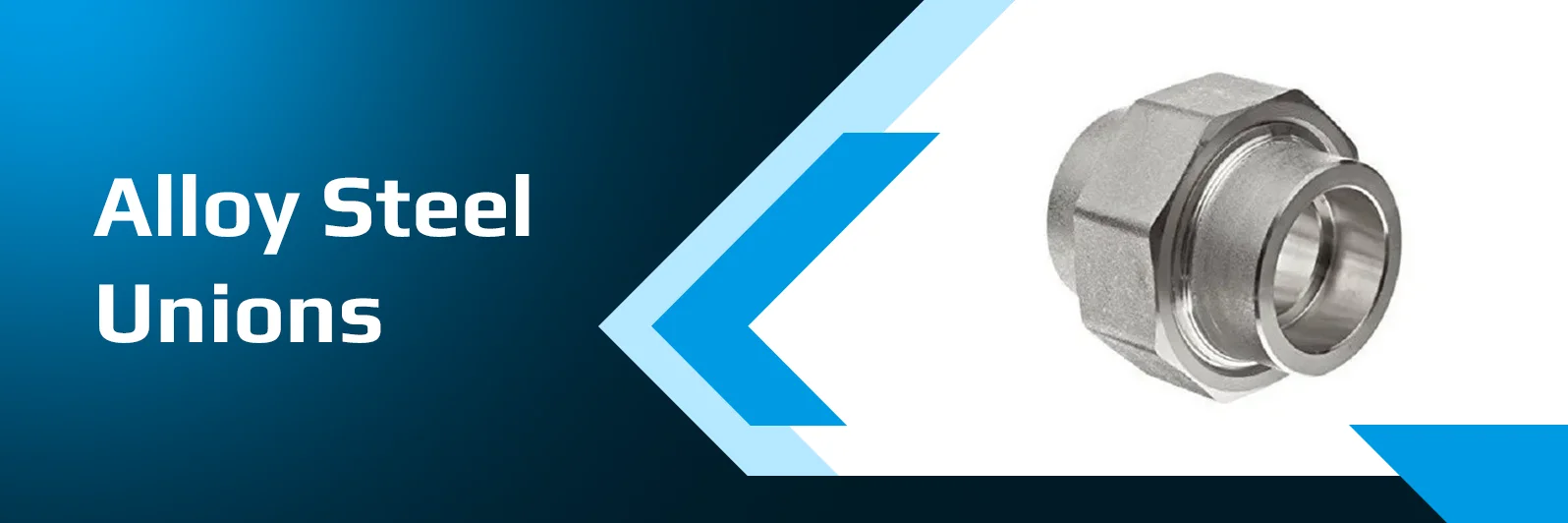
Every union is a planned leak path. That sounds like a criticism and it is not, it is the entire design intent: a union exists so a joint can be broken and remade without cutting pipe, which is exactly what you want at a control valve that comes out for overhaul every turnaround. The price is a mechanical seal instead of a weld, so unions belong where access matters and nowhere else. Solitaire Overseas manufactures and exports alloy steel unions from India, three piece with metal to metal seats, threaded and socket weld to ASME B16.11 in ASTM A182 chrome-moly grades. Below: how the seat works, where unions belong, and where they do not.
Part of our alloy steel fittings range. For permanent joints see alloy steel couplings.
A union is a three-piece fitting: a male end, a female end, and a nut that draws them together. Each end connects to its pipe by thread or socket weld, and the nut is the only part that has to be undone to break the joint. Turn the nut off and the two halves separate in place, with no cutting, no grinding and no hot work.
The seal is metal to metal. The two halves carry precision-machined seating faces, usually a taper or cone against a matching profile. Tightening the nut presses those faces together and the contact itself forms the seal, with no gasket in most designs. That gives a joint that can be broken and remade repeatedly, and it is why the seat faces matter: a scored, dented or dirty seat will not seal however hard the nut is pulled up.
Both join two pipes in a straight run. The difference is whether you ever intend to take the joint apart:
| Union | Coupling | |
|---|---|---|
| Construction | Three pieces: two halves and a nut | One piece |
| Dismantling | Undo the nut, halves separate in place | Cut the pipe or grind out the weld |
| Seal | Metal-to-metal machined seat | Weld or thread |
| Cost | Higher | Lower |
| Use it when | The joint must come apart for maintenance | The joint is permanent |
Permanent joints are covered on our alloy steel couplings (https://www.solitaire-overseas.com/alloy-steel-couplings.html) page.
| Type | End Connection | Notes |
|---|---|---|
| Threaded union | NPT female both ends | Fastest to install, no welding. Suits maintenance and utility lines |
| Socket weld union | Socket both ends | Welded to the pipe but still demountable at the nut. Higher classes available |
| Male x female union | One male, one female end | Screws directly into an adjacent fitting on one side |
| Reducing union | Different bore each side | Joins two sizes and stays demountable |
ASME B16.11 rates forged fittings by class, and the class available depends on the end type:
| End Type | Available Classes | Correlates To Pipe Schedule |
|---|---|---|
| Socket Weld | Class 3000, 6000, 9000 | 3000 = Sch 80/XS · 6000 = Sch 160 · 9000 = XXS |
| Threaded (NPT) | Class 2000, 3000, 6000 | Threaded runs one class lower at the top end. There is no Class 9000 threaded fitting |
Size range: 1/8 inch to 4 inch NPS. Above 4 inch the line moves to buttweld fittings under ASME B16.9.
Forged from ASTM A182 chrome-moly material, matched to the ASTM A335 pipe grade of the line:
| A182 Grade | Matching Pipe | Chromium | Molybdenum | Typical Service |
|---|---|---|---|---|
| F1 | P1 | Not specified (carbon-moly) | 0.44 - 0.65% | Moderate temperature steam |
| F5 | P5 | 4.0 - 6.0% | 0.44 - 0.65% | Refinery hydrogen and sulphur service |
| F9 | P9 | 8.0 - 10.0% | 0.90 - 1.10% | Higher temperature refinery piping |
| F11 | P11 | 1.00 - 1.50% | 0.44 - 0.65% | The workhorse grade |
| F12 | P12 | 0.80 - 1.25% | 0.44 - 0.65% | General elevated temperature service |
| F22 | P22 | 2.00 - 2.50% | 0.87 - 1.13% | Higher temperature and pressure than F11 |
| F91 | P91 | 8.0 - 9.5% | 0.85 - 1.05% (plus V) | Modern high-temperature power plant piping |
| Parameter | Specification |
|---|---|
| Dimensional standard | ASME B16.11 (BS 3799 on request) |
| Material standard | ASTM A182 / ASME SA182 forged alloy steel |
| Grades | F1, F5, F9, F11, F12, F22, F91 |
| Construction | Three piece: male end, female end, nut |
| Seal | Metal-to-metal machined seat |
| End connections | Threaded NPT, socket weld, or male x female |
| Size range | 1/8 inch to 4 inch NPS |
| Pressure classes | Socket weld 3000, 6000, 9000 · Threaded 2000, 3000, 6000 |
| Certification | EN 10204 3.1 mill test certificate. PMI and third-party inspection on request |
A coupling is a single piece that joins two pipes permanently, and taking the joint apart means cutting the pipe or grinding out the weld. A union is three pieces, two halves and a nut, so undoing the nut separates the halves in place with no hot work. Use a coupling where the joint is permanent and a union where equipment has to come out.
The two halves carry precision-machined seating faces, typically a taper or cone against a matching profile. Tightening the nut presses those faces together and the metal-to-metal contact forms the seal. Because the seal depends on those faces, a scored, dented or dirty seat will leak no matter how hard the nut is tightened, and usually means replacing the fitting.
They are rated for it, with socket weld unions available in Class 3000, 6000 and 9000 under ASME B16.11. But many project specifications require welded joints throughout on high-integrity or hazardous service, precisely because a mechanical seal is a potential leak path. Check the piping class before specifying a union on such a line.
Anywhere it cannot be reached. A union is a maintenance item and a mechanical seal, so burying one behind insulation, inside a wall or in an inaccessible run defeats its purpose and leaves a joint that cannot be inspected or re-made. Install unions where a technician can get a spanner on the nut.
Send your size, grade, class and end type, threaded or socket weld, and we will confirm availability, certification and lead time.