+91-9619103479
or
vishal@solitaire-overseas.com
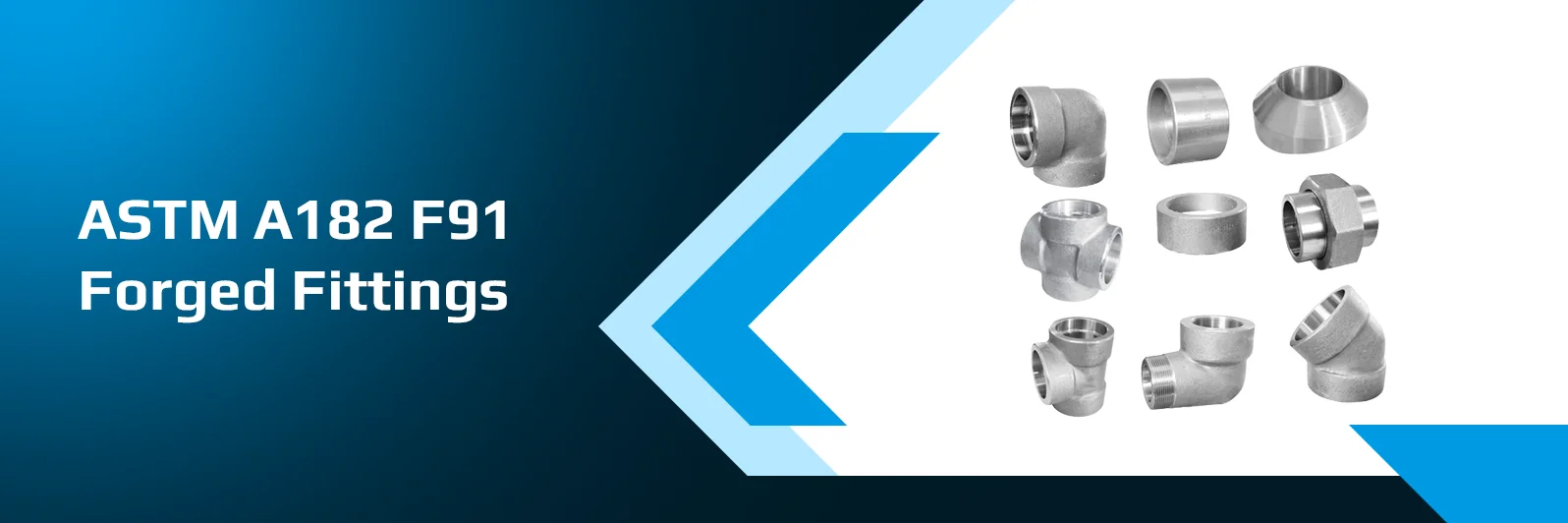
Many P91 piping specifications prohibit socket welds outright. The reason is not the alloy, it is the joint: a socket weld fillet cannot be radiographed the way a butt weld can, and P91 is a grade where an undetected weld defect or a missed post-weld heat treatment does not announce itself until the component has been in creep service for years. Check the piping class before you specify a socket weld F91 fitting. Solitaire Overseas manufactures and exports A182 F91 forged fittings from India for supercritical service, with PMI on every heat and full heat treatment records. Below: where F91 forged is permitted, what PWHT demands at small bore, and the grade data.
Three factors combine, and none of them is about the alloy's strength:
Where socket welds are prohibited, the small bore connection is made by buttweld instead, using the ASTM A234 WP91 (https://www.solitaire-overseas.com/wp91-pipe-fittings-manufacturer-india.html) range, or by a branch outlet fitting with a full penetration weld.
F91 forged fittings remain a real and necessary product, they simply require the specification to permit them:
Separate from the A182 material class, the fitting carries a pressure class that depends on the end type:
| End Type | Available Classes | Correlates To Pipe Schedule |
|---|---|---|
| Socket Weld | Class 3000, 6000, 9000 | 3000 = Sch 80/XS · 6000 = Sch 160 · 9000 = XXS |
| Threaded (NPT) | Class 2000, 3000, 6000 | Threaded runs one class lower at the top end. There is no Class 9000 threaded fitting |
Size range: 1/8 inch to 4 inch NPS. Above 4 inch the line moves to buttweld fittings under ASME B16.9.
| Element | Range |
|---|---|
| Carbon | 0.08 - 0.12% |
| Manganese | 0.30 - 0.60% |
| Silicon | 0.20 - 0.50% |
| Chromium | 8.0 - 9.5% |
| Molybdenum | 0.85 - 1.05% |
| Vanadium | 0.18 - 0.25% |
| Niobium (columbium) | 0.06 - 0.10% |
| Nitrogen | 0.030 - 0.070% |
| Nickel | 0.40% max |
| Aluminium | 0.02% max |
PMI ON EVERY HEAT, AND WHY: Vanadium, niobium and nitrogen form the stable carbonitrides that give F91 its creep strength. A deviation in any of the three can destroy long-term performance while ordinary tensile and hardness testing still passes. On forged fittings this matters more than on large components, because small fittings are easy to mix up in a store and impossible to identify by eye. Insist on heat-specific PMI.
The tempering requirements that make WP91 demanding apply equally to F91, and small sections make them harder rather than easier:
Supplied as couplings, unions, plugs, bushings, street elbows and swage nipples, plus forged elbows and tees.
| Item | Detail |
|---|---|
| Material standard | ASTM A182 / ASME SA182 F91 |
| Dimensional | ASME B16.11 |
| Pressure classes | SW 3000/6000/9000, Threaded 2000/3000/6000 |
| Size range | 1/8 inch to 4 inch NPS |
| Heat treatment | Normalised and tempered. PWHT mandatory |
| Testing | PMI every heat, hardness testing |
| Matching pipe | ASTM A335 P91 |
| Certification | EN 10204 3.1 with heat treatment records. 3.2 with third-party inspection |
Matching pipe: ASTM A335 P91 pipes. Buttweld form: ASTM A234 WP91 fittings.
It depends on the project specification, and many restrict or prohibit them. The concern is that a socket weld fillet cannot be volumetrically examined the way a butt weld can, while P91 is a grade where an undetected defect or an incorrect post-weld heat treatment does not show up until creep service. Check the piping class before specifying a socket weld F91 fitting, and where they are not permitted, make the connection by buttweld or a reinforced branch outlet instead.
Product form. F91 under ASTM A182 is the forged fitting to ASME B16.11, socket weld or threaded, and also covers forged flanges, valve bodies and parts. WP91 under ASTM A234 is the buttweld fitting to ASME B16.9. The modified 9Cr-1Mo-V alloy is the same, with the same creep strength and the same heat treatment demands. See our WP91 fittings (https://www.solitaire-overseas.com/wp91-pipe-fittings-manufacturer-india.html) page.
Yes, regardless of size or wall thickness. Small sections actually make the tempering harder to control, because thin material heats and cools quickly while the acceptable tempering window remains narrow. Hardness testing after PWHT is the practical confirmation that it was done correctly, and it should be specified rather than assumed.
No, despite the similar names. F9 is 9Cr-1Mo used mainly for sulfidation resistance in refining. F91 is modified 9Cr-1Mo with vanadium, niobium and nitrogen additions, engineered for creep strength in supercritical power plant. They share a chromium level but have different purposes, different microstructures and very different fabrication requirements. See our WP9 fittings (https://www.solitaire-overseas.com/wp9-alloy-steel-pipe-fittings-exporter.html) page for the F9 family.
Send your fitting type, size, end type and pressure class, plus confirmation that your piping specification permits socket weld or threaded joints in P91 service, and we will confirm availability, heat treatment, testing and lead time.