+91-9619103479
or
vishal@solitaire-overseas.com
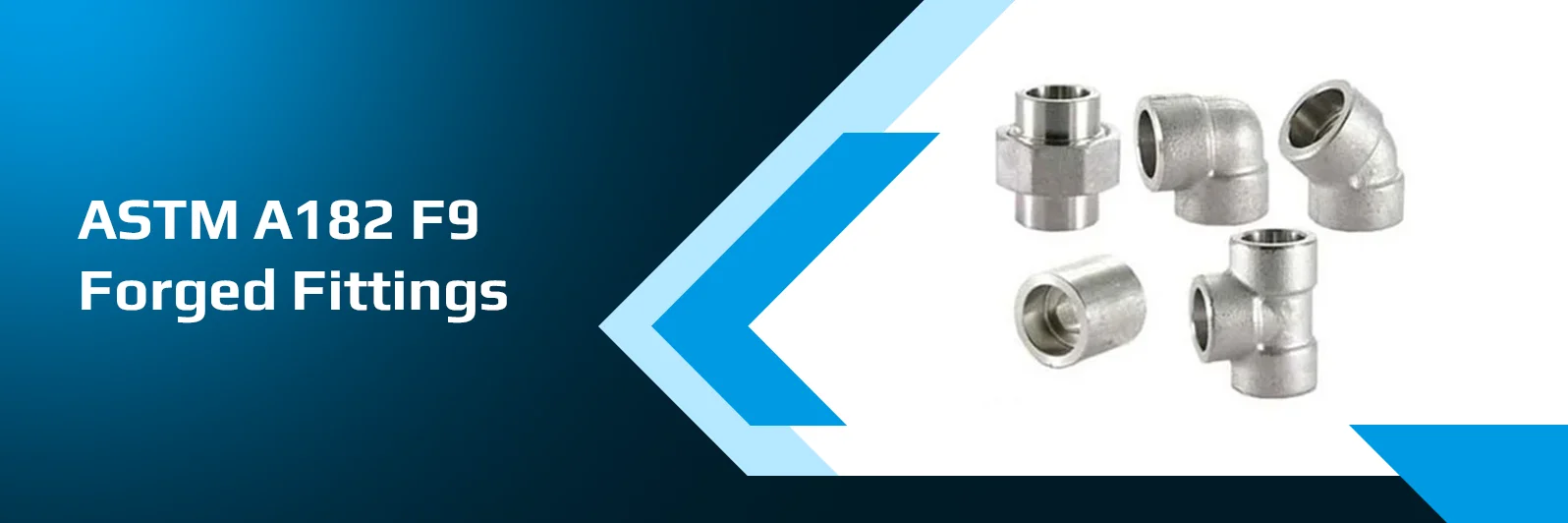
F9 and F91 sit next to each other in the same ASME B16.11 catalogue, differ by one digit, and are not remotely the same material. One resists sulphur in a refinery. The other resists creep in a supercritical boiler. Ordering the wrong one is a mistake that survives inspection because both are nine percent chromium and both look identical in the hand. Solitaire Overseas manufactures and exports A182 F9 forged fittings from India, socket weld and threaded. Below: how to tell them apart, where F9 forged belongs, and grade data.
| F9 | F91 | |
|---|---|---|
| Full name | 9Cr-1Mo | Modified 9Cr-1Mo-V |
| Chromium | 8.0 - 10.0% | 8.0 - 9.5% |
| Key additions | None beyond Cr and Mo | Vanadium, niobium, nitrogen |
| Chosen for | Sulfidation resistance in refining | Creep strength in supercritical power plant |
| Microstructure | Conventional | Tempered martensite, engineered |
| Fabrication | Standard chrome-moly practice | Narrow tempering window, mandated consumables, PMI every heat |
| Substituting one for the other | Loses creep strength | Loses nothing on corrosion but costs far more |
Why PMI matters more on the forged form. A large buttweld fitting is marked and handled individually. Small forged fittings arrive in quantity, get stored in bins, and are indistinguishable by eye. Positive Material Identification before installation is the only reliable defence against a mixed bin, and on a site running both grades it is worth making routine.
The F91 forged range is covered on our ASTM A182 F91 forged fittings page.
| Element | Range |
|---|---|
| Carbon | 0.15% max |
| Manganese | 0.30 - 0.60% |
| Phosphorus | 0.030% max |
| Sulfur | 0.030% max |
| Silicon | 0.50 - 1.00% |
| Chromium | 8.0 - 10.0% |
| Molybdenum | 0.90 - 1.10% |
| Property | Value |
|---|---|
| Tensile strength min | 585 MPa (85 ksi) |
| Yield strength min | 380 MPa (55 ksi) |
| Maximum hardness | 217 HBW |
ASME B16.11 Pressure Classes
| End Type | Available Classes | Correlates To |
|---|---|---|
| Socket Weld | Class 3000, 6000, 9000 | Sch 80/XS, Sch 160, XXS |
| Threaded (NPT) | Class 2000, 3000, 6000 | No Class 9000 threaded fitting exists |
Size range: 1/8 inch to 4 inch NPS. Above 4 inch the line moves to buttweld under ASME B16.9.
Supplied as couplings, unions, plugs, bushings and street elbows, plus forged elbows and tees.
Matching pipe: ASTM A335 P9 pipes. Lower chromium: F5 forged fittings.
F9's chromium is there for sulfidation resistance. That reasoning is set out on our WP9 buttweld fittings page. In the forged form:
No. F9 is 9Cr-1Mo, used mainly for sulfidation resistance in refining. F91 is modified 9Cr-1Mo with vanadium, niobium and nitrogen additions, engineered for creep strength in supercritical power plant. They share a chromium level but nothing else that matters, and they cannot be substituted for one another. Because small forged fittings look identical, PMI before installation is the reliable check. See our F91 forged fittings page.
Product form. F9 under ASTM A182 is the forged fitting to ASME B16.11, socket weld or threaded, 1/8 inch to 4 inch. WP9 under ASTM A234 is the buttweld fitting to ASME B16.9. Same 9Cr-1Mo alloy. See our WP9 fittings page.
ASTM A182 caps hardness at 217 HBW for F9 as for F5. Harder material is more susceptible to environmental cracking in refinery service where sulphide or hydrogen is present, so the cap is a service safeguard rather than a strength requirement.
Send your fitting type, size, end type and pressure class, and confirm whether you need F9 or F91, since the two are frequently confused. We supply both and will flag any ambiguity before quoting.