+91-9619103479
or
vishal@solitaire-overseas.com
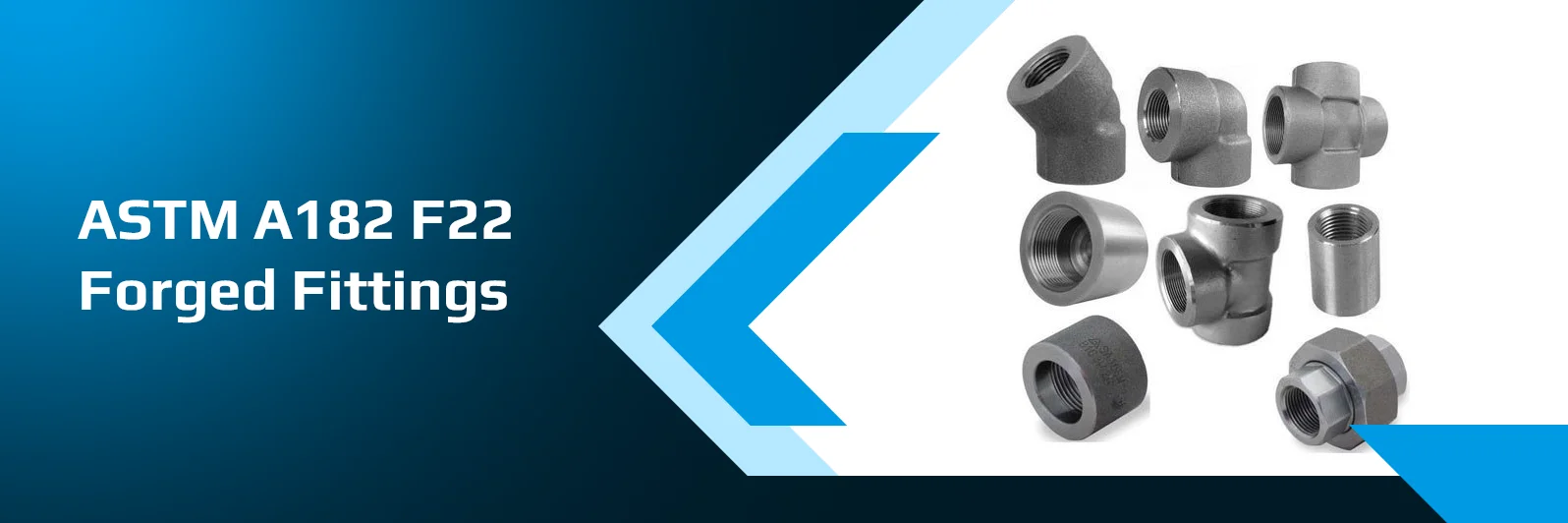
Buttweld fittings run the main steam line. Forged fittings are how anything gets connected to it. Every instrument tapping, drain, vent and sample point on a hot P22 header is a small bore connection, and below 4 inch the fitting is forged F22 to ASME B16.11 rather than buttweld WP22 to B16.9. Same alloy, same hydrogen and creep resistance, different product entirely. Solitaire Overseas manufactures and exports A182 F22 forged fittings from India in Class 1 and Class 3, socket weld and threaded. Below: where forged F22 belongs, the fatigue caution on socket welds, and full grade data.
On a chrome-moly steam or reformer system the two product families divide the work cleanly by size:
| Buttweld WP22 | Forged F22 | |
|---|---|---|
| Standard | ASTM A234, ASME B16.9 | ASTM A182, ASME B16.11 |
| Size | About 2 inch and above | 1/8 inch to 4 inch |
| Job | The main run: elbows, tees, reducers in the line itself | Everything connecting to it: instrument, drain, vent, sample |
| Joint | Full penetration butt weld | Socket weld fillet, or threaded |
| Rating | Matches pipe schedule | ASME B16.11 pressure class 2000 to 9000 |
The alloy behaves identically in both forms, so the hydrogen resistance and creep strength that make 2.25Cr-1Mo the reformer and hot steam grade apply equally. That side of the story is on our ASTM A234 WP22 fittings page. This page is about the forged product.
Socket Welds on Cycling Lines
A socket weld joins the pipe to the fitting with a fillet weld at the socket mouth, and there is a small annular gap at the bottom of the socket by design, left so the pipe can expand without stressing the weld. That geometry creates a stress concentration at the fillet, and in high cycle service it can initiate fatigue cracking.
Why this matters more on F22 than on lower grades. F22 lives on hot lines, and hot lines cycle. Steam systems start, stop and swing load, and each cycle works the joint. Some project specifications restrict socket welds in cyclic or vibrating service for exactly this reason, and prefer buttweld or a socket weld with additional examination. Check the piping class before assuming a socket weld connection is acceptable on a header that cycles.
Separate from the A182 material class, the fitting carries a pressure class that depends on the end type:
| End Type | Available Classes | Correlates To Pipe Schedule |
|---|---|---|
| Socket Weld | Class 3000, 6000, 9000 | 3000 = Sch 80/XS · 6000 = Sch 160 · 9000 = XXS |
| Threaded (NPT) | Class 2000, 3000, 6000 | Threaded runs one class lower at the top end. There is no Class 9000 threaded fitting |
Size range: 1/8 inch to 4 inch NPS. Above 4 inch the line moves to buttweld fittings under ASME B16.9.
| Element | Range |
|---|---|
| Carbon | 0.05 - 0.15% |
| Manganese | 0.30 - 0.60% |
| Phosphorus | 0.040% max |
| Sulfur | 0.040% max |
| Silicon | 0.50% max |
| Chromium | 2.00 - 2.50% |
| Molybdenum | 0.87 - 1.13% |
| Material Class | Tensile min | Yield min |
|---|---|---|
| Class 1 | 415 MPa (60 ksi) | 205 MPa (30 ksi) |
| Class 3 | 515 MPa (75 ksi) | 310 MPa (45 ksi) |
Supplied as couplings, unions, plugs, bushings, street elbows and swage nipples, plus forged elbows and tees.
| Item | Detail |
|---|---|
| Material standard | ASTM A182 / ASME SA182 F22 |
| Dimensional | ASME B16.11 |
| Material classes | Class 1, Class 3 |
| Pressure classes | SW 3000/6000/9000, Threaded 2000/3000/6000 |
| Size range | 1/8 inch to 4 inch NPS |
| PWHT | Mandatory regardless of thickness |
| Matching pipe | ASTM A335 P22 |
| Certification | EN 10204 3.1 with PWHT records |
Matching pipe: ASTM A335 P22 pipes.
Product form. F22 under ASTM A182 is the forged fitting to ASME B16.11, socket weld or threaded, 1/8 inch to 4 inch, used for the small bore connections onto a line. WP22 under ASTM A234 is the buttweld fitting to ASME B16.9, used in the main run from about 2 inch upward. The 2.25Cr-1Mo alloy is identical, so hydrogen and creep resistance are the same. See our WP22 fittings (https://www.solitaire-overseas.com/astm-a234-wp22-alloy-fittings-supplier.html) page.
Yes, and regardless of wall thickness. PWHT is mandatory on 2.25Cr-1Mo whether the component is a large buttweld fitting or a one inch socket weld coupling. Small forged fittings make this easy to overlook because the sections look insignificant, but the requirement does not scale with size and PWHT records should accompany the work.
With caution. The fillet weld at a socket joint carries a stress concentration, and in high cycle service that can initiate fatigue cracking. F22 typically sits on hot lines that start, stop and swing load, so the risk is real rather than theoretical. Some project specifications restrict socket welds in cyclic service, so check the piping class before specifying one on a header that cycles.
Send your fitting type, size, end type, material class and pressure class, plus whether the line cycles, and we will confirm availability, PWHT requirements, certification and lead time.