+91-9619103479
or
vishal@solitaire-overseas.com
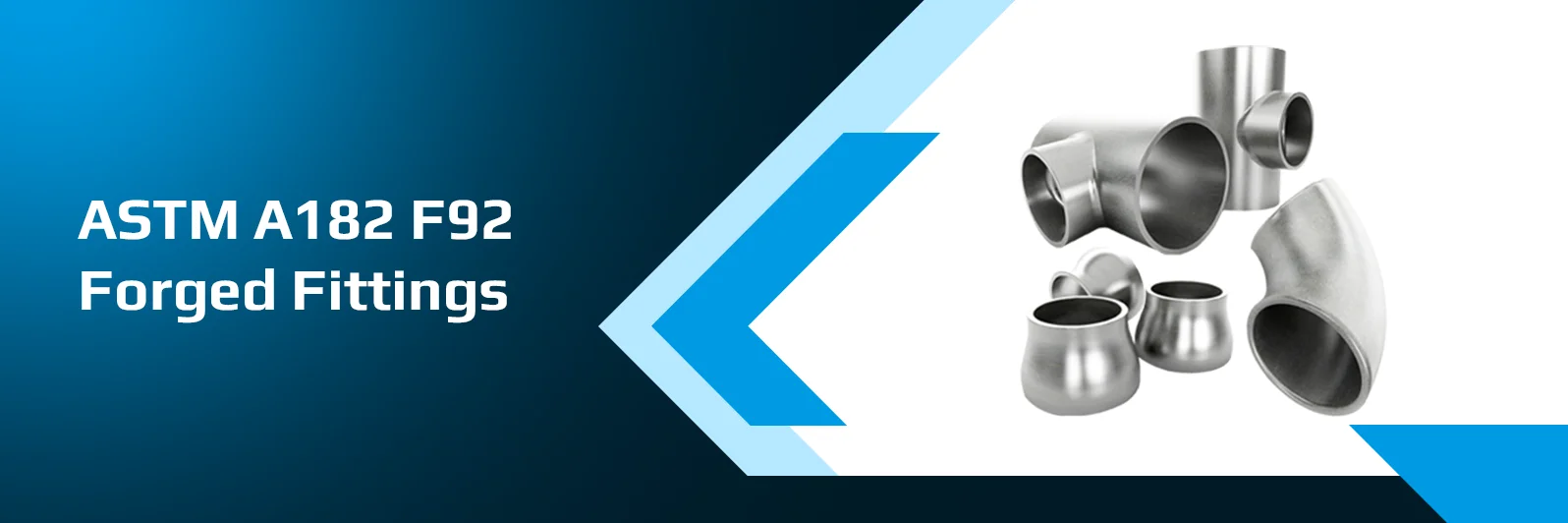
Everything difficult about F91 is more difficult here. F92 adds tungsten and boron to the modified 9Cr chemistry, which raises creep strength by roughly thirty percent and narrows every process window that was already narrow. On a small forged fitting, where thin sections cool fast and post-weld heat treatment is hardest to control, that combination demands a fabricator who has done it before. Solitaire Overseas supplies A182 F92 forged fittings from India for ultra-supercritical service. Below: what F92 adds, and the questions to ask before specifying it at small bore.
Three difficulties stack on top of each other, and each is manageable alone:
F92 keeps F91's modified 9Cr-Mo-V-Nb-N chemistry and adds tungsten, roughly 1.5 to 2.0 percent, with a small controlled boron addition, while reducing molybdenum. The result is around thirty percent more creep strength than Grade 91. The mechanism and the buttweld application are covered on our WP92 buttweld fittings page.
| Element | Range |
|---|---|
| Carbon | 0.07 - 0.13% |
| Chromium | 8.5 - 9.5% |
| Molybdenum | 0.30 - 0.60% |
| Tungsten | 1.50 - 2.00% |
| Vanadium | 0.15 - 0.25% |
| Niobium | 0.04 - 0.09% |
| Nitrogen | 0.030 - 0.070% |
| Boron | 0.001 - 0.006% |
| End Type | Available Classes | Correlates To |
|---|---|---|
| Socket Weld | Class 3000, 6000, 9000 | Sch 80/XS, Sch 160, XXS |
| Threaded (NPT) | Class 2000, 3000, 6000 | No Class 9000 threaded fitting exists |
Size range: 1/8 inch to 4 inch NPS. Above 4 inch the line moves to buttweld under ASME B16.9.
Supplied as couplings,unions, plugs, bushings and street elbows, plus forged elbows and tees.
| Item | Detail |
|---|---|
| Material standard | ASTM A182 / ASME SA182 F92 |
| Dimensional | ASME B16.11 |
| Pressure classes | SW 3000/6000/9000, Threaded 2000/3000/6000 |
| Size range | 1/8 inch to 4 inch NPS |
| Heat treatment | Normalised and tempered. PWHT mandatory |
| Testing | PMI every heat including W and B, hardness testing |
| Matching pipe | ASTM A335 P92 |
| Certification | EN 10204 3.1 with heat treatment records. 3.2 with third-party inspection |
Matching pipe: ASTM A335 P92 pipes. The grade below: F91 forged fittings.
F92 adds tungsten, roughly 1.5 to 2.0 percent, and a small controlled boron addition while reducing molybdenum, raising creep strength by around thirty percent over Grade 91. The cost is tighter process control and more limited sourcing. Where F91 is adequate, F92 adds difficulty without benefit. See our F91 forged fittings page.
It depends on the project specification, and as with P91 many restrict socket welds because the fillet cannot be volumetrically examined while the grade hides heat treatment errors until creep service. Check the piping class before specifying. Where socket welds are not permitted, the connection is made by buttweld using the WP92 range or by a reinforced branch outlet.
Heat-specific PMI covering tungsten and boron as well as the vanadium, niobium and nitrogen additions, full heat treatment records including PWHT, and hardness test results confirming the tempering was correct. EN 10204 3.1 as a minimum, with 3.2 and third-party inspection where the project requires it.