+91-9619103479
or
vishal@solitaire-overseas.com
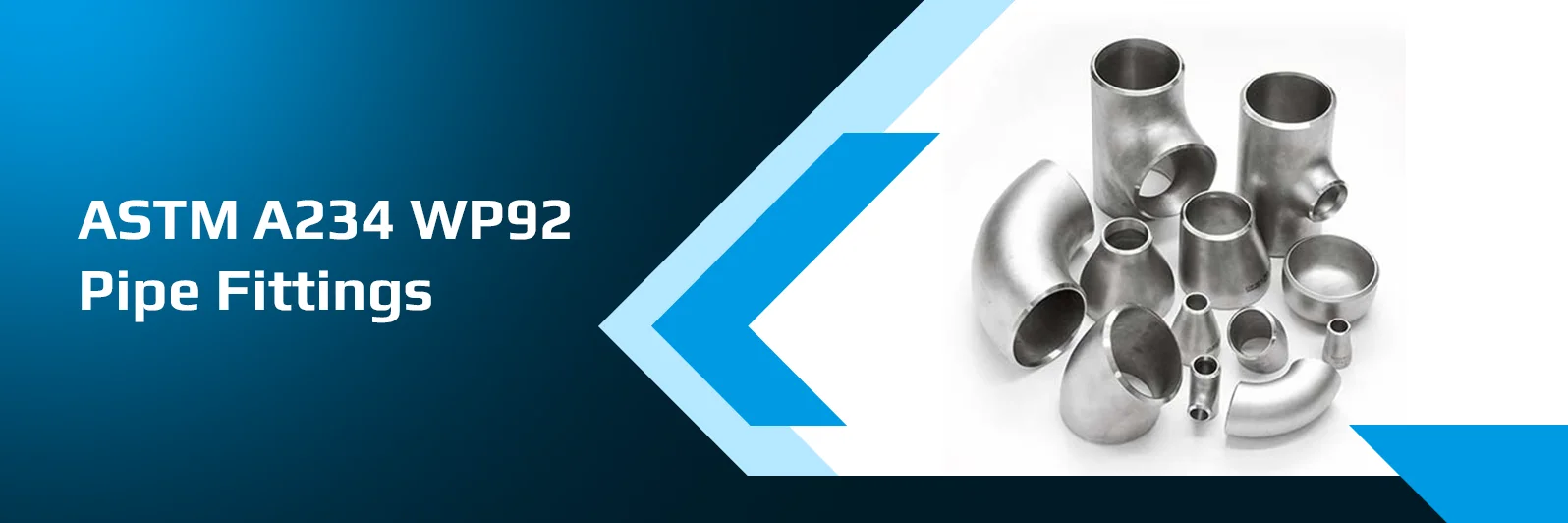
P92 is P91 with tungsten and a trace of boron, and those two additions buy roughly thirty percent more creep strength. That lets the wall come down again on lines that were already thin. The catch is control. Boron is specified in the range of thousandths of a percent, tungsten sits between 1.5 and 2.0, and a grade this finely balanced is unforgiving of a mill that treats it as ordinary chrome-moly. Solitaire Overseas manufactures and exports A234 WP92 buttweld fittings from India for ultra-supercritical service, with PMI on every heat. Below: what tungsten and boron do, and where WP92 is genuinely warranted over WP91.
WP92 keeps the modified 9Cr-1Mo-V-Nb-N chemistry that gives WP91 its creep strength, then adds two things:
| Addition | Typical Range | What It Does |
|---|---|---|
| Tungsten (W) | 1.50 - 2.00% | Solid solution strengthening at temperature, and stabilises the precipitate structure against coarsening over long service |
| Boron (B) | 0.001 - 0.006% | Stabilises grain boundary carbides. Specified in thousandths of a percent, which is why control matters so much |
| Molybdenum | Reduced from WP91 | Partly replaced by tungsten in the strengthening role |
The result is roughly thirty percent more creep strength than Grade 91. On an ultra-supercritical header or main steam line that translates into a further wall reduction, less weight, smaller thermal gradients on start-up and better cycling life, the same chain of benefits that justified moving from P22 to P91, applied one step further.
BORON IS THE HARD PART: A specified range of 0.001 to 0.006 percent leaves very little margin. Boron content outside the band, or lost during processing, changes the grain boundary behaviour the grade depends on. This is the single strongest reason to insist on heat-specific PMI covering boron and tungsten, and to buy WP92 only from a source that can produce those records.
| Situation | Grade | Reason |
|---|---|---|
| Supercritical, around 570 to 600 C | WP91 | Well proven, widely available, established fabrication practice |
| Ultra-supercritical, higher steam conditions | WP92 | The extra creep strength is genuinely needed |
| Very thick WP91 sections that cycle | WP92 | The wall reduction improves thermal fatigue life further |
| Anywhere WP91 is adequate | WP91 | WP92 adds cost, process risk and sourcing difficulty for no benefit |
The WP22 to WP91 economic comparison is covered on our high temperature fittingspage, and the same logic of matching grade to duty applies at this step.
| Element | Range |
|---|---|
| Carbon | 0.07 - 0.13% |
| Manganese | 0.30 - 0.60% |
| Silicon | 0.50% max |
| Chromium | 8.5 - 9.5% |
| Molybdenum | 0.30 - 0.60% |
| Tungsten | 1.50 - 2.00% |
| Vanadium | 0.15 - 0.25% |
| Niobium | 0.04 - 0.09% |
| Nitrogen | 0.030 - 0.070% |
| Boron | 0.001 - 0.006% |
Supplied as elbows, tees, reducers, caps and pipe bends.
| Item | Detail |
|---|---|
| Standard | ASTM A234 / ASME SA234 WP92 |
| Dimensional | ASME B16.9, ASME B16.28 |
| Size range | NPS 1/2 inch to 48 inch |
| Heat treatment | Normalised and tempered. PWHT mandatory |
| Testing | PMI every heat including W and B, hardness, NDE after forming |
| Matching pipe | ASTM A335 P92 |
| Certification | EN 10204 3.1 with heat treatment records. 3.2 with third-party inspection |
Matching pipe: ASTM A335 P92 pipes. The grade below: WP91 fittings.
WP92 adds tungsten, roughly 1.5 to 2.0 percent, and a small controlled boron addition to the modified 9Cr chemistry, while reducing molybdenum. Together those raise creep strength by around thirty percent over Grade 91, allowing thinner walls at the same duty. The cost is tighter process control, since boron is specified in thousandths of a percent, and more limited sourcing.
Boron stabilises the grain boundary carbides that carry creep resistance, and it is specified in a very narrow band of 0.001 to 0.006 percent. Content outside that band, or boron lost during processing, changes the grain boundary behaviour the grade depends on. Heat-specific PMI covering boron and tungsten is the only reliable confirmation.
Where ultra-supercritical steam conditions genuinely demand the extra creep strength, or where WP91 wall thickness has become impractical on a thick cycling component. Where WP91 is adequate, WP92 adds cost, process risk and sourcing difficulty without benefit. It is a step to take when the design requires it, not by default.
Send your fitting type, size, schedule and design conditions, and we will confirm availability, heat treatment and testing regime, certification and lead time. WP92 orders should state the PMI and PWHT documentation required.