+91-9619103479
or
vishal@solitaire-overseas.com
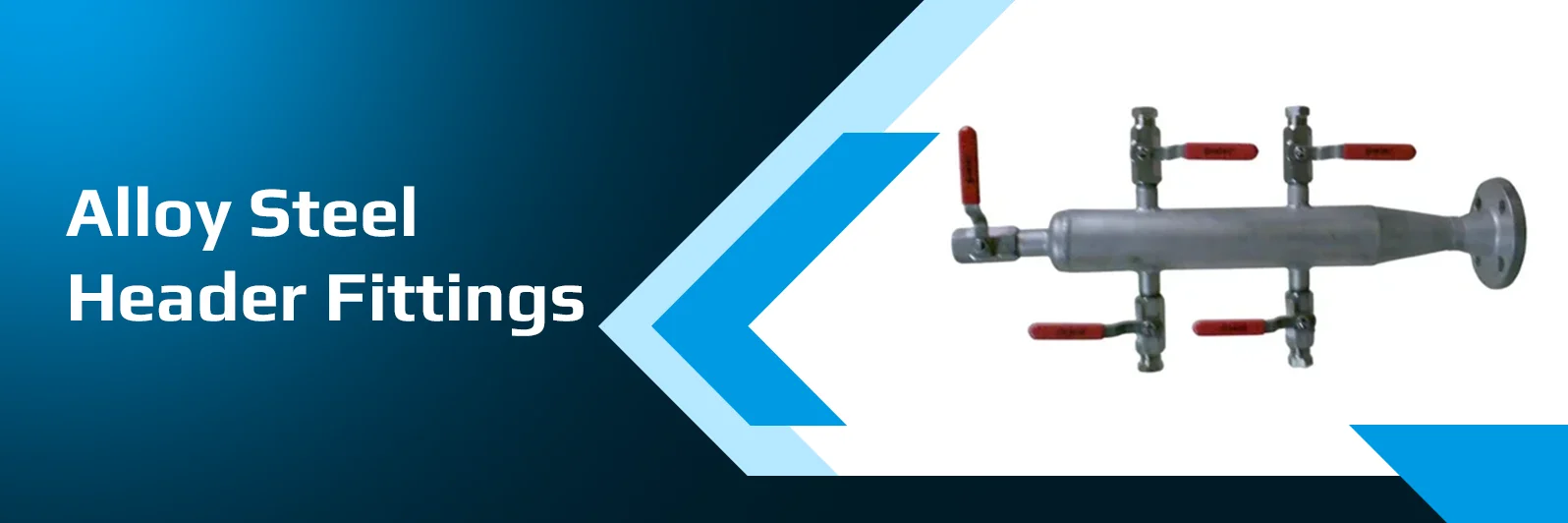
A single water wall header can carry four hundred stub connections. Each one is a branch welded into a thick-wall pressure component, each one has to line up with a tube on a panel drawing, and each one is a potential leak point in a boiler that will run for decades. Header work is not general pipe fitting. It is thick-section, high-integrity fabrication where the heat treatment records matter as much as the steel. Solitaire Overseas supplies alloy steel header fittings from India in P11, P22 and P91, with the certification and PWHT documentation boiler work demands. Below: header types by boiler location, grade selection, and what the codes require.
A header is a thick-walled distribution vessel with a large number of small branch connections. That combination creates problems ordinary piping does not have. Thick sections develop steep temperature gradients through the wall during startup, and repeated gradients cause thermal fatigue cracking. Many closely spaced stubs mean many welds in a highly stressed component, each of which has to be right.
Upgrading a superheater header from P22 to P91 reduces the wall by roughly half to two thirds and the weight by around 60 percent. A thinner wall equilibrates faster, so the thermal gradient during a start is smaller and the thermal fatigue life rises by an order of magnitude. On a cycling plant that is often the deciding argument, not the material cost.
Grade follows position in the boiler, because position determines temperature:
| Header | Position and Service | Typical Grade | Notes |
|---|---|---|---|
| Economizer header | Feedwater, coolest section | Carbon steel | Below the creep range, PWHT often not required by thickness |
| Water wall header | Furnace wall panels, large bore heavy wall | Carbon steel to P11 | Carries one stub per water wall tube, often 100 to 400 stubs per header |
| Intermediate superheater header | Rising steam temperature | P11 | PWHT required above the code thickness threshold. Nozzle forgings in F11 |
| Superheater outlet header | Hottest steam, high pressure | P22, or P91 in supercritical plant | PWHT mandatory on P22 regardless of thickness |
| Reheater header | High temperature reheat steam | P22, or P91 | As above |
| Supercritical SH and RH outlet | Ultra-supercritical service | P91 | PMI on every heat, strict tempering control, hardness testing |
Header assemblies use a specific subset of the fittings range:
P22 is the standard grade for high pressure superheater outlet and reheater headers in conventional subcritical boilers. P91 is used for supercritical and ultra-supercritical service, and increasingly on cycling plant, because its higher strength allows a substantially thinner wall and therefore better thermal fatigue life.
Because it reduces wall thickness by roughly half to two thirds. A thinner wall reaches thermal equilibrium faster during a startup, so the temperature gradient through the section is smaller and the thermal fatigue damage per cycle is lower. Published comparisons put the improvement in thermal fatigue life at a factor of ten or more, which matters far more on a cycling plant than the material price.
On P22 and P91 it is mandatory regardless of wall thickness, and on P91 it must be held within a narrow tempering window with hardness testing afterwards to confirm the microstructure. On P11 it is required once thickness exceeds the code threshold. PWHT records form part of the documentation package on any header order.
On a large furnace panel, commonly between one hundred and four hundred, since there is one stub per water wall tube. Stub spacing and projection length must match the panel fabrication drawing exactly, because each stub meets a specific tube. That alignment requirement is one of the main reasons header work is treated as fabrication rather than fittings supply.
Send your header drawing or specification, including grade, wall thickness, stub arrangement and PWHT requirements, and we will confirm scope, certification and lead time.