+91-9619103479
or
vishal@solitaire-overseas.com
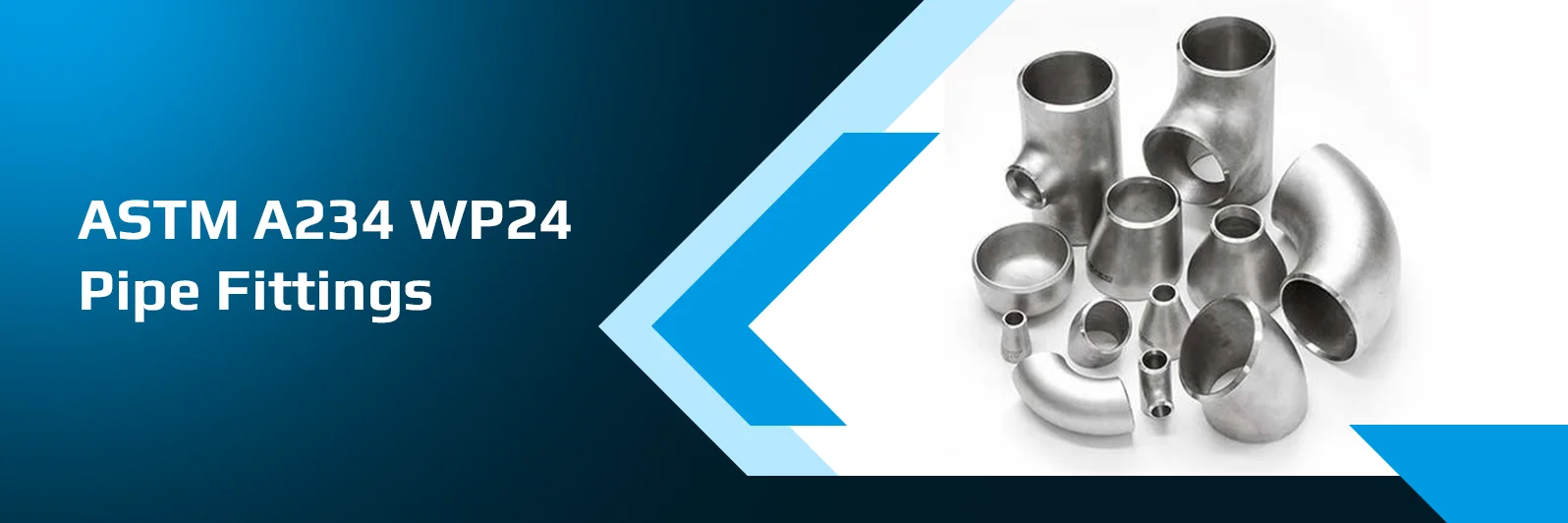
Grade 24 reaches the same place as Grade 23 by a different route. Not tungsten. Vanadium with titanium and a controlled boron addition instead, lifting creep strength above 2.25Cr-1Mo while staying markedly easier to fabricate than Grade 91, which is the whole reason both grades were developed. Boiler service was the target, so buttweld is their natural form. We supply A234 WP24 to order.
Part of our alloy steel fittings range. Forged form: ASTM A182 F24. Closest neighbour: WP23 buttweld fittings.
Grade 24 keeps the 2.25 percent chromium and roughly one percent molybdenum of Grade 22, then adds three things in small quantities:
| Addition | Typical Range | Role |
|---|---|---|
| Vanadium | 0.20 - 0.30% | Forms fine carbides that resist creep, the same mechanism used in Grade 91 |
| Titanium | 0.05 - 0.10% | Works with the vanadium in forming stable precipitates |
| Boron | 0.0015 - 0.0070% | Stabilises grain boundaries. Specified in thousandths of a percent, so control matters |
The contrast with Grade 23. Grade 23 takes the tungsten route and cuts molybdenum right back to 0.05 to 0.30 percent. Grade 24 keeps the molybdenum at Grade 22 levels and adds vanadium, titanium and boron instead. Both land in a similar place on creep strength, and the choice between them is almost always made by the governing specification rather than by comparing the two on merit.
BORON CONTROL, THE SAME POINT AS GRADES 91 AND 92: A boron range of 0.0015 to 0.0070 percent leaves little margin. Heat-specific PMI covering boron and titanium is worth specifying, since these elements carry the creep performance and a deviation will not show up in ordinary tensile testing.
| Element | Range |
|---|---|
| Carbon | 0.05 - 0.10% |
| Manganese | 0.30 - 0.70% |
| Silicon | 0.15 - 0.45% |
| Chromium | 2.20 - 2.60% |
| Molybdenum | 0.90 - 1.10% |
| Vanadium | 0.20 - 0.30% |
| Titanium | 0.05 - 0.10% |
| Boron | 0.0015 - 0.0070% |
| Nitrogen | 0.012% max |
Supplied as buttweld fittings to ASME B16.9 and B16.28, NPS 1/2 inch to 48 inch, in schedules to XXS. Available as elbows, tees, reducers and caps.
Made to order. This grade is not held in stock. Expect a lead time and a minimum quantity, and send the governing specification with your enquiry so availability can be confirmed before you commit. EN 10204 3.1 certification is supplied as standard, with PMI, hardness testing and heat treatment records on request.
WP24 is a vanadium-titanium-boron bearing 2.25Cr grade developed largely for boiler tubes and headers. It sits between P22 and P91, offering higher creep strength than 2.25Cr-1Mo while being less demanding to fabricate than Grade 91. It is normally specified because a boiler licensor or project standard names it.
The chemistry route. WP23 uses a tungsten addition and cuts molybdenum back sharply. WP24 keeps molybdenum at Grade 22 levels and adds vanadium, titanium and a controlled boron addition instead. Both reach a similar creep strength, and the choice is normally dictated by the governing specification.
Boron stabilises the grain boundaries that carry creep resistance, and it is specified in a narrow band of 0.0015 to 0.0070 percent. A deviation will not show up in ordinary tensile testing but can affect long-term creep performance, so heat-specific PMI covering boron and titanium is worth specifying.
No. WP24 is uncommon and made to order. Send the governing specification with your enquiry so availability, lead time and minimum quantity can be confirmed before you commit.
Send your fitting type, size, schedule and the governing specification, and we will confirm whether the grade can be sourced, with lead time and certification.