+91-9619103479
or
vishal@solitaire-overseas.com
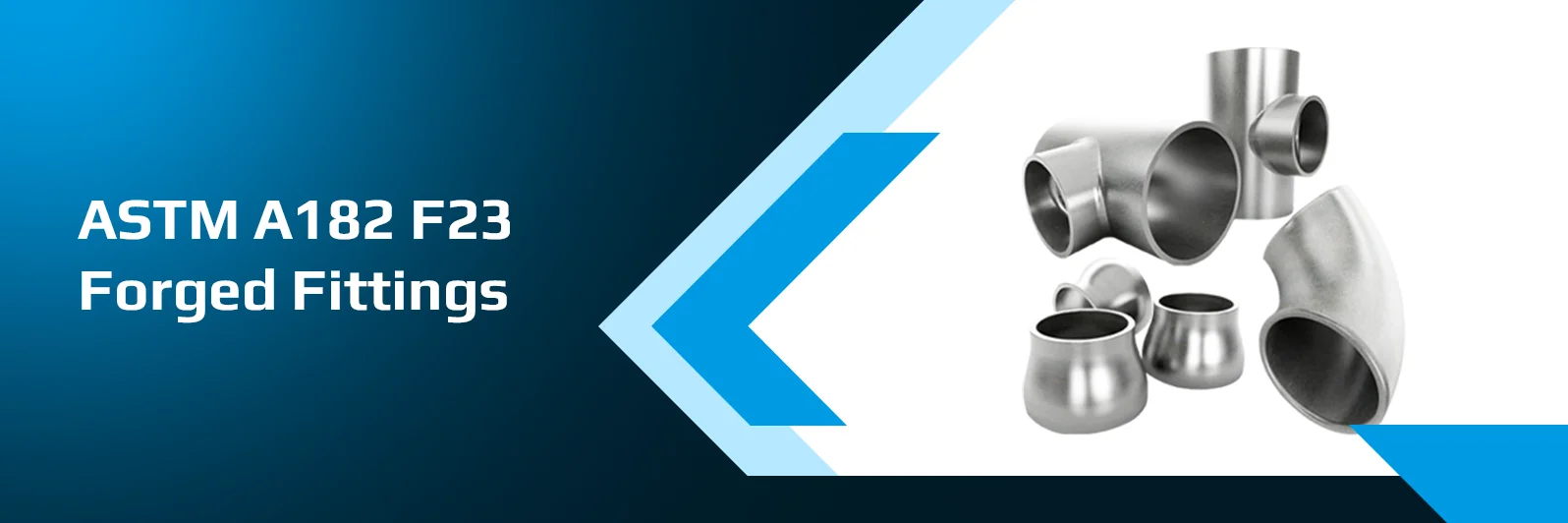
F23 and F24 exist to solve one problem: P22 is not strong enough and P91 is too much trouble. Both sit deliberately between the two, offering more creep strength than 2.25Cr-1Mo without the narrow tempering windows and mandated consumables that make Grade 91 demanding. F23 gets there with tungsten. It is an uncommon grade and we supply it to order rather than from stock.
Part of our alloy steel fittings range. See also F24 forged fittings.
| Element | Range |
|---|---|
| Carbon | 0.04 - 0.10% |
| Manganese | 0.10 - 0.60% |
| Silicon | 0.50% max |
| Chromium | 1.90 - 2.60% |
| Molybdenum | 0.05 - 0.30% |
| Tungsten | 1.45 - 1.75% |
| Vanadium | 0.20 - 0.30% |
| Niobium | 0.02 - 0.08% |
| Boron | 0.0005 - 0.006% |
| Nitrogen | 0.030% max |
Supplied as forged fittings to ASME B16.11, socket weld and threaded, 1/8 inch to 4 inch NPS, in pressure classes 2000 to 9000. Available as couplings, unions, plugs and forged elbows and tees.
Made to order. This grade is not held in stock. Expect a lead time and a minimum quantity, and send the full specification with your enquiry so availability can be confirmed before you commit. EN 10204 3.1 certification is supplied as standard, with PMI and hardness testing on request.
F23 is a tungsten-bearing 2.25Cr grade positioned between P22 and P91. It offers higher creep strength than 2.25Cr-1Mo while avoiding the narrow tempering windows and mandated welding consumables that make Grade 91 demanding to fabricate. It is specified mainly in boiler and superheater service and on uprated plant.
No. F23 is an uncommon grade and is generally made to order rather than held in stock. Expect a lead time and a minimum quantity, and send the full specification with your enquiry so availability can be confirmed before committing.
Both target the same gap between P22 and P91, from different directions. F23 uses a tungsten addition to raise creep strength; F24 uses vanadium with titanium and a boron addition. Both are uncommon and generally made to order.
Send your fitting type, size, end type, pressure class and the governing specification, and we will confirm whether the grade can be sourced, along with lead time and certification.