+91-9619103479
or
vishal@solitaire-overseas.com
Solitaire Overseas has been manufacturing super duplex steel flanges for over two decades, exporting to 50+ countries across oil and gas, desalination,
and petrochemical industries. ISO 9001 certified. All materials shipped with EN 10204 3.1 Mill Test Certificates.
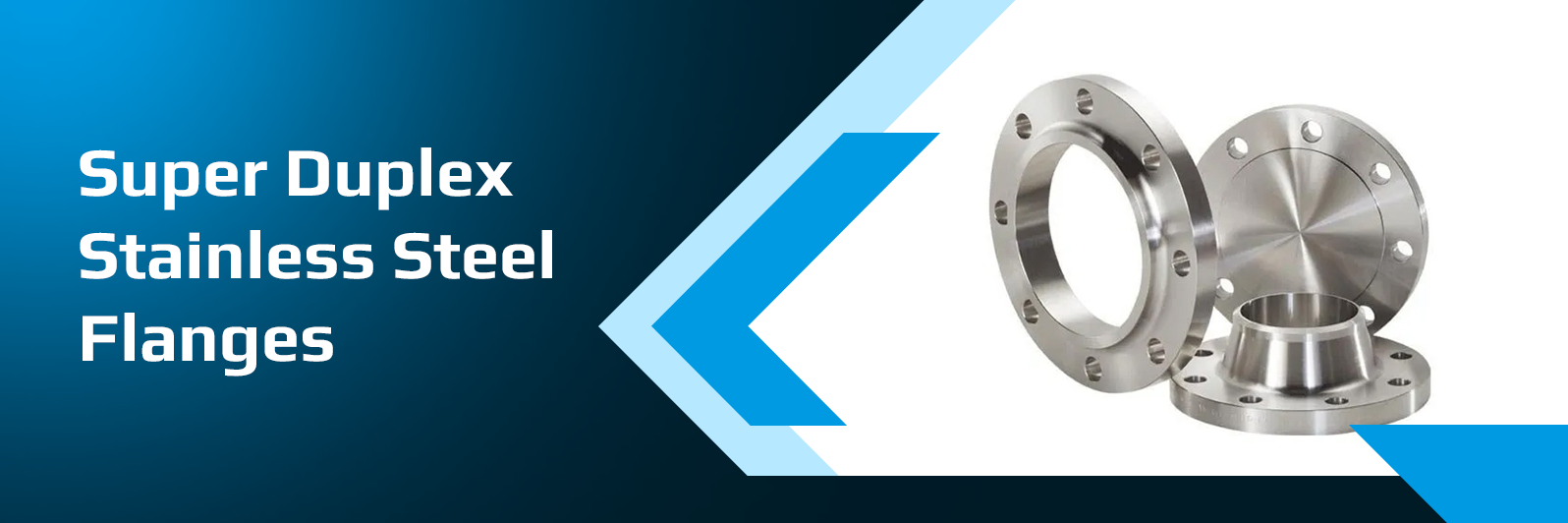
Super Duplex Steel Flanges (ASTM A182 F53 and F55) are high performance, forged pipe flanges designed to operate in chloride heavy and high pressure conditions where the austenitic grades fail. These flanges have a PREN of 40 or higher and offer resistance to pitting, crevice corrosion and stress corrosion cracking operating temperatures between -50 degrees C and +300 degrees C. These flanges consist of three parts that are required, namely, the pipe flange, bolting parts, and gasket. The joints are built with a gasket between two flanges joining the two to provide a good seal.
Super Duplex Steel Flanges need to be solution annealed at temperatures of 1040 to 1120 degrees C with a direct water quench to prevent the formation of sigma-phase and ensure the required 40 to 60 percent ferrite ratio. ASTM A182 Super Duplex Flanges are available in both welded or threaded design, which provides flexibility to piping systems and allows easy dismantling and gaining access to piping system parts.
Super Duplex Stainless Steel Flanges are good at high temperature oxidation. But, just like other duplex stainless steels, they become embrittle even on short-term exposure at temperatures above 300 degrees C. Because the hot strength of super duplex alloys is relatively low, fixturing or support is needed during forging and heat treatment to eliminate distortion. Solution treatment is performed after hot forging in order to regain maximum mechanical properties and corrosion resistance.
Super Duplex Pipe Flanges are offered in a vast array of designs that can be used in a broad application in industry such as Super Duplex Socket Weld Flanges, Super Duplex Lap Joint Flanges, Super Duplex Slip-On Flanges, Super Duplex Blind Flanges, Super Duplex Weld Neck Flanges, Super Duplex Threaded Flanges, and Super Duplex Orifice Flanges. Each of them is developed to meet a bunch of installation and performance requirements.
Enquire Now | Call: +91-9619103479 | Email: vishal@solitaire-overseas.com
Super Duplex stainless steel flanges are not a single material but a group of ultra-high-performance alloys whose Pitting Resistance Equivalent Number (PREN) values exceed 40. The choice of UNS S32750 or UNS S32760 depends on your environment, corrosion exposure, and mechanical requirements.
PREN: 40 to 43
Best For: General offshore, moderate chloride environments, and high-strength applications.
Key Advantage: Cost-effective high performance standard for most marine uses.
PREN: 43 or above (typically 43 to 47)
Best For: Extreme chlorides, acidic media, and sour service applications requiring W and Cu enhancement.
Key Advantage: Maximum corrosion resistance provided by tungsten and copper additions.
| Parameter | Specification |
|---|---|
| Standards | ASTM A182/A182M, ASME B16.5, ASME B16.47 Series A and B, MSS SP-44, EN 1092-1 |
| Additional Standards | DIN 2527/2631 to 2638 (PN6 to PN400), JIS B2220 (5K to 20K), BS 4504 PN6 to PN250 available on request |
| Grades Covered | F53 (UNS S32750), F55 (UNS S32760) |
| Size Range | DN15 (1/2 inch) to DN1200 (48 inch) |
| Pressure Classes | ASME: 150 to 2500 | DIN: PN6 to PN400 | JIS: 5K to 20K |
| Face Types | RF (Raised Face), FF (Flat Face), RTJ (Ring Type Joint) |
| Temperature Range | -50 degrees C to +300 degrees C (-58 degrees F to +572 degrees F) |
| PREN Value | 40 or above (superior pitting resistance) |
| Surface Finish | Pickled and Passivated (standard). Electropolished available on request. |
| Element | S32750 (F53) Typical Range | S32760 (F55) Typical Range | Role |
|---|---|---|---|
| Chromium | 24 to 26% | 24 to 26% | Base corrosion resistance |
| Nickel | 6 to 8% | 6 to 8% | Austenite stabiliser |
| Molybdenum | 3 to 5% | 3 to 4% | Pitting resistance |
| Nitrogen | 0.2 to 0.3% | 0.2 to 0.3% | Strength and pitting resistance |
| Tungsten | Not present | 0.5 to 1.0% (added) | Specific to F55/S32760 only |
| Copper | Not present | 0.5 to 1.0% (added) | Specific to F55/S32760 only |
| Carbon | 0.030% max | 0.030% max | Low carbon prevents sensitisation |
| Manganese | 1.20% max | 1.00% max | Austenite stability |
Note: Composition ranges are typical values. Refer to grade-specific datasheets for exact ASTM A182 minimum and maximum limits.
| Property | UNS S32750 (F53) | UNS S32760 (F55) | Test Standard |
|---|---|---|---|
| Tensile Strength (min) | 795 MPa (115 ksi) | 750 MPa (109 ksi) | ASTM A370 |
| Yield Strength 0.2% (min) | 550 MPa (80 ksi) | 550 MPa (80 ksi) | ASTM A370 |
| Elongation (min) | 15% | 25% | ASTM A370 |
| Hardness (max) | 32 HRC / 310 HB | 32 HRC / 310 HB | ASTM E18 |
| Impact Toughness | 45J at -46 degrees C | 45J at -46 degrees C | ASTM A370 |
| Density | 7.8 g/cm3 | 7.8 g/cm3 | Reference value |
The minimum yield strength of 550 MPa is approximately twice that of 316L stainless steel (minimum 170 MPa), enabling lighter wall construction in piping systems without sacrificing pressure integrity.
These flanges resist pitting in harsh seawater and chloride environments with a PREN above 40. They provide outstanding resistance against stress corrosion cracking (SCC) and crevice corrosion in environments where standard 316L stainless steel fails. The combination of 24 to 26% chromium, 3 to 5% molybdenum, and 0.2 to 0.3% nitrogen creates a multi-mechanism barrier against the most aggressive corrosive media encountered in offshore, chemical, and marine applications.
Super Duplex Steel Flanges offer a minimum yield strength of 550 MPa, approximately twice that of 316L stainless steel (minimum 170 MPa). This allows thinner wall construction, making piping systems significantly lighter without sacrificing pressure integrity. Reduced weight also lowers installation time and structural support costs on offshore platforms and large-diameter pipework.
Although material cost is higher at the outset, Super Duplex delivers lower lifecycle costs through extended service life, reduced maintenance intervals, and minimal unplanned downtime. The ability to specify thinner wall sections further reduces total material volume and fabrication cost, often closing the price gap with austenitic alternatives within the first maintenance cycle.
Super Duplex Steel Flanges operate reliably across the full pH range from acidic to alkaline and maintain structural integrity from -50 degrees C (suitable for many cryogenic applications) to +300 degrees C service temperature. This broad operating envelope makes them suitable for everything from Arctic subsea pipelines to tropical desalination plants in a single standardised material selection.
| Property | UNS S32750 (2507 / F53) | UNS S32760 (Zeron 100 / F55) |
|---|---|---|
| Chromium (%) | 24 to 26 | 24 to 26 |
| Nickel (%) | 6 to 8 | 6 to 8 |
| Molybdenum (%) | 3 to 5 | 3 to 4 |
| Tungsten (%) | Not present | 0.5 to 1.0 (added) |
| Copper (%) | Not present | 0.5 to 1.0 (added) |
| PREN | 40 to 43 | 43 or above (typically 43 to 47) |
| Tensile Strength | 750 to 950 MPa | 750 to 1000 MPa |
| Yield Strength (min) | 550 MPa | 550 MPa |
| Impact Toughness | 45J at -46 degrees C | 45J at -46 degrees C |
| Density | 7.8 g/cm3 | 7.8 g/cm3 |
| Max Service Temp | 300 degrees C | 300 degrees C |
| Best Applications | Offshore platforms, heat exchangers, general marine service | Acidic chloride media, desalination, sour service, reducing acid environments |
Super Duplex Steel Flanges are produced through a controlled multi-stage forging and heat treatment process designed to consistently achieve PREN 40 or above and the required 40 to 60 percent ferrite balance.
High-grade scrap and master alloy are melted in an Electric Arc Furnace (EAF), then refined in an Argon Oxygen Decarburization (AOD) converter to fix the precise Cr, Mo, and N chemistry required for PREN 40 or above. Dissolved gases are removed and final alloy composition is set at this stage.
The conditioned melt is cast and forged to shape under controlled temperature to ensure a uniform dual-phase (ferrite and austenite) microstructure throughout the flange cross-section.
Flanges are solution annealed at 1040 to 1120 degrees C and immediately water quenched to lock in the 40 to 60 percent ferrite balance and prevent sigma-phase formation. This step is mandatory and cannot be substituted with air cooling.
Each flange is precision-machined to ASME B16.5 and B16.47 dimensional tolerances and subjected to ferrite content testing (ASTM E562), corrosion testing (ASTM G48 Method A), and impact testing at -46 degrees C (ASTM A370).
EN 10204 3.1 Mill Test Certificates, PMI (Positive Material Identification) reports, and dimensional inspection reports are issued with every order. EN 10204 3.2 and third-party inspection are available on request.
Related Products from Solitaire Overseas: Super Duplex Steel Pipe Fittings (ASTM A815) | Super Duplex Steel Pipes and Tubes (ASTM A790) | UNS S32615 Products
Super Duplex has higher chromium, molybdenum, and nitrogen content, resulting in a PREN above 40 (compared to 30 to 40 for standard Duplex 2205). This provides approximately 30 to 40 percent better corrosion resistance and higher mechanical strength. Duplex steel flanges (e.g. UNS S31803 and S32205) contain approximately 22% chromium and 3% molybdenum and are suitable for most industrial applications. Super Duplex flanges (e.g. UNS S32750, S32760) are specified for more aggressive environments such as deep-sea applications and high-chloride process streams.
ASTM A182 Grade F51 (UNS S31803 and S32205) is the most commonly specified duplex stainless steel grade for flanges, offering an excellent balance of strength, corrosion resistance, and weldability at competitive cost. Grade F53 (UNS S32750) and F55 (UNS S32760) are specified for more demanding environments.
Yes. Super Duplex maintains sufficient toughness down to -50 degrees C, making it suitable for many LNG and cryogenic service applications. Impact testing at -46 degrees C per ASTM A370 is mandatory to verify suitability for these temperatures.
S32750 is the standard choice for most offshore and marine applications. Choose S32760 primarily when facing highly acidic chloride environments or when tungsten-enhanced resistance to reducing acids (sulfuric, phosphoric) is required for specific chemical processing applications.
We maintain stock of standard sizes (1/2 inch to 8 inch) which can ship immediately. Custom specifications or large diameters typically require 4 to 6 weeks for manufacturing, though express options are available for urgent projects.
Direct connection is generally not recommended due to galvanic corrosion risks (Super Duplex is more noble) and different thermal expansion rates. Use compatible Super Duplex piping or proper isolation kits and transition spools.
Duplex Steel Flanges can be connected to carbon steel piping using appropriate transition fittings or isolation gaskets to prevent galvanic corrosion. The flange bolt holes, facing dimensions, and pressure-temperature ratings must be matched according to the applicable standard (e.g. ANSI B16.5 Class 150 or 300).
Solitaire Overseas provides Material Test Certificates (MTC) per EN 10204 3.1 as standard with all shipments. EN 10204 3.2 certificates, NACE compliance certificates, third-party inspection reports, heat treatment certificates, hydrostatic test certificates, and dimensional inspection reports are available on request.
Yes. Solitaire Overseas manufactures Super Duplex Steel Flanges to custom specifications including non-standard sizes, special face configurations, custom bore dimensions, and project-specific material certifications. Please share your drawings or technical datasheet with our team for a prompt quotation.
Super Duplex flanges should be welded using matching or over-alloyed filler metals. For GTAW/TIG use ER2594 wire; for SMAW use E2594 electrodes. Key procedure controls: interpass temperature below 100 degrees C, heat input 0.5 to 2.5 kJ/mm, and no PWHT required in most cases. If PWHT is specified for stress relief, full solution annealing at 1040 to 1120 degrees C with immediate water quench is mandatory. Solitaire Overseas provides WPS and PQR documentation on request for project qualification.
Pricing depends on size, pressure class, grade (S32750 vs S32760), quantity, and certification requirements. Contact us for a project-specific quotation. Standard sizes (1/2 inch to 8 inch) are available from stock and can be quoted same-day.
Solitaire Overseas maintains ready stock of ASTM A182 F53 and F55 flanges from 1/2 inch to 8 inch for immediate dispatch, with larger sizes available to order in 4 to 6 weeks. Send us your size schedule and we will respond within 24 hours with pricing and availability.
Request a Quote India
India Iran
Iran Thailand
 South Korea
 Turkey
 Morocco
 Costa Rica
 Kazakhstan
 Philippines
 Canada
 Japan
Japan Russia
 United States
 Saudi Arabia
 Kuwait
 Singapore
 Malaysia
 UAE
UAE Germany
 Italy
Italy China
China UK
UK Egypt
Egypt Vietnam
 Oman
Oman Australia
 Qatar
Qatar Portugal
 Nigeria
 Iraq
Iraq Ukraine
 Bangladesh
 Poland
 Romania
 Cyprus
 Angola
 Colombia
 Norway
 Chile
Chile Mexico
 South Africa
 Netherlands
 Brazil
 France
 Jordan
 Spain
Spain Hong Kong
 Indonesia
 Taiwan
 Tobago
 Greece
 Czechia
 Belgium
 Sri Lanka
 Myanmar
 Venezuela