+91-9619103479
or
vishal@solitaire-overseas.com
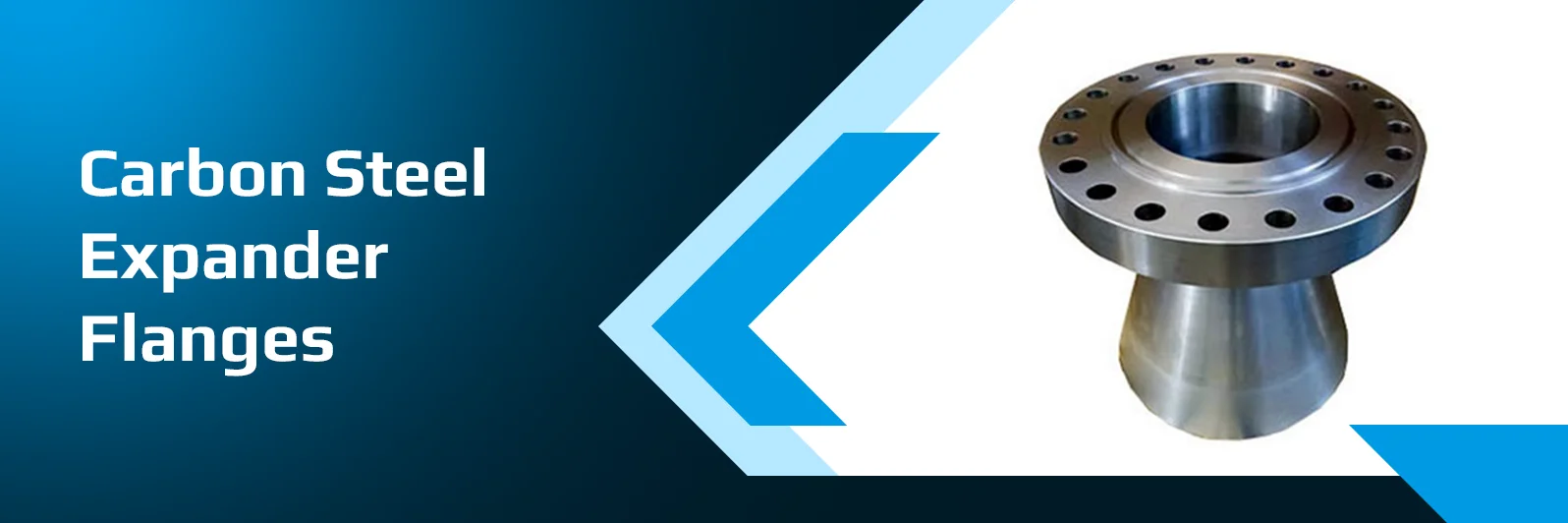
Carbon Steel Expander Flanges are forging pipe fittings that have an expanding hub and a flange connection, thus creating a smaller flanged connection to connect a larger diameter pipe without having to install a separate reducer. They are often used in the discharge lines of pumps, compressor piping, valve connections, and process equipment where space and alignment are constrained. The flanges can be made in a variety of grades, including ASTM A105 and ASTM A350 LF2 Class 1, and can be chosen based on the specific pressure and temperature requirements, depending on the design standards. They are supplied across Class 150 to Class 2500 with flange ends to ASME B16.5 and weld ends prepared to ASME B16.25. Solitaire Overseas is a reliable manufacturer and supplier of carbon steel expander flanges in India, providing certified expander flanges for industrial needs in different parts of the world.
| Parameter | Specification & Manufacturing Details |
|---|---|
|
Product Type |
Forged Carbon Steel Weld Neck Expander Flange |
|
Material Specifications |
ASTM A105 / SA105 (Normalised A105N available); ASTM A350 LF2 Class 1 (Low Temperature); ASTM A694 (Grades F42 to F70); ASTM A516 Gr 70 (Plate-fabricated for custom large diameters) |
|
Flange-End Dimensional Standard |
ASME B16.5 (NPS 1/2 to 24); ASME B16.47 Series A / B (NPS 26 to 60) |
|
Weld-End Preparation |
ASME B16.25 butt-weld bevel (Schedule 40, 80, 160, XXS, or custom ID) |
|
Pressure Ratings |
Class 150, Class 300, Class 600, Class 900, Class 1500, Class 2500 |
|
Facing Options |
Raised Face (RF), Flat Face (FF), Ring Type Joint (RTJ) |
|
Non-Destructive Testing (NDT) |
Ultrasonic Testing (UT), Magnetic Particle Inspection (MPI), Radiographic Testing (RT) on welds |
|
Material Certification |
EN 10204 3.1 Mill Test Certificate (3.2 with TPI on request) |
|
Special Compliance |
NACE MR0175 / ISO 15156, NACE MR0103 sour service compliance on request |
| Grade | Carbon (C) max | Manganese (Mn) | Phosphorus (P) max | Sulfur (S) max | Silicon (Si) | Cu / Ni / Cr / Mo max |
|---|---|---|---|---|---|---|
|
ASTM A105 |
0.35 |
0.60 – 1.05 |
0.035 |
0.040 |
0.10 – 0.35 |
0.40 / 0.40 / 0.30 / 0.12 |
|
ASTM A350 LF2 Cl. 1 |
0.30 |
0.60 – 1.35 |
0.035 |
0.040 |
0.15 – 0.30 |
0.40 / 0.40 / 0.30 / 0.12 |
| Grade | Tensile Strength (MPa) | Yield Strength min (MPa) | Elongation min (%) | Reduction of Area min (%) | Hardness max (HBW) | Impact Test Requirement |
|---|---|---|---|---|---|---|
|
ASTM A105 |
485 min |
250 |
22% |
30% |
187 |
Not mandatory unless specified |
|
ASTM A350 LF2 Cl. 1 |
485 – 655 |
250 |
22% |
30% |
197 |
-46°C: 20 J avg / 16 J min (full size) |
| Expander Size (Flange × Weld End, NPS) | Flange End OD (O) | Bolt Circle (BC) | Number of Bolt Holes (n) | Bolt Hole Dia. | Min Flange Thickness | Weld-End OD (W) |
|---|---|---|---|---|---|---|
|
2" × 3" |
152.4 |
120.7 |
4 |
19.1 |
19.1 |
88.9 |
|
3" × 4" |
190.5 |
152.4 |
4 |
19.1 |
23.9 |
114.3 |
|
4" × 6" |
228.6 |
190.5 |
8 |
19.1 |
23.9 |
168.3 |
|
6" × 8" |
279.4 |
241.3 |
8 |
22.2 |
25.4 |
219.1 |
|
8" × 10" |
342.9 |
298.5 |
8 |
22.2 |
28.6 |
273.1 |
|
10" × 12" |
406.4 |
362.0 |
12 |
25.4 |
30.2 |
323.9 |
|
12" × 14" |
482.6 |
431.8 |
12 |
25.4 |
31.8 |
355.6 |
| Pressure Rating Class | Maximum Working Pressure (psig) | Maximum Working Pressure (bar) | Typical Primary Application |
|---|---|---|---|
|
Class 150 |
285 psig |
19.6 bar |
Utility lines, cooling water, low-pressure process piping |
|
Class 300 |
740 psig |
51.0 bar |
Medium-pressure steam, refinery process loops |
|
Class 600 |
1,480 psig |
102.1 bar |
High-pressure gas pipelines, boiler feed systems |
|
Class 900 |
2,220 psig |
153.2 bar |
High-pressure gas transmission & injection headers |
|
Class 1500 |
3,705 psig |
255.3 bar |
Critical pressure vessel nozzles, high-pressure steam |
|
Class 2500 |
6,170 psig |
425.5 bar |
Extreme-pressure offshore manifold service, HP subsea |
A carbon steel expander flange is a forged weld-neck flange designed with a pipe weld end that is larger than its flanged bolting end. It expands line size directly at an equipment nozzle connection.
An expander flange has a smaller flange end and a larger pipe end (e.g., 4"×6"). A reducing flange is the opposite, featuring a larger flange end and a smaller pipe end (e.g., 6"×4").
Specify the flange bolting end size first, followed by the pipe weld end size (e.g., NPS 4 × 6), and include the pressure class, facing, material grade, and pipe schedule.
Yes. An expander flange replaces both components in a single forging, saving space, reducing assembly weight, and eliminating one circumferential butt weld.
Choose ASTM A105 for standard ambient to elevated temperature service (-29°C to 427°C). Choose ASTM A350 LF2 Class 1 for low-temperature applications down to -46°C (-50°F).
The flanged bolting end follows ASME B16.5 for pressure class, dimensions, facing, and tolerances. Hub length, taper angle, and overall length are engineered per manufacturer standards or customer drawings.