+91-9619103479
or
vishal@solitaire-overseas.com
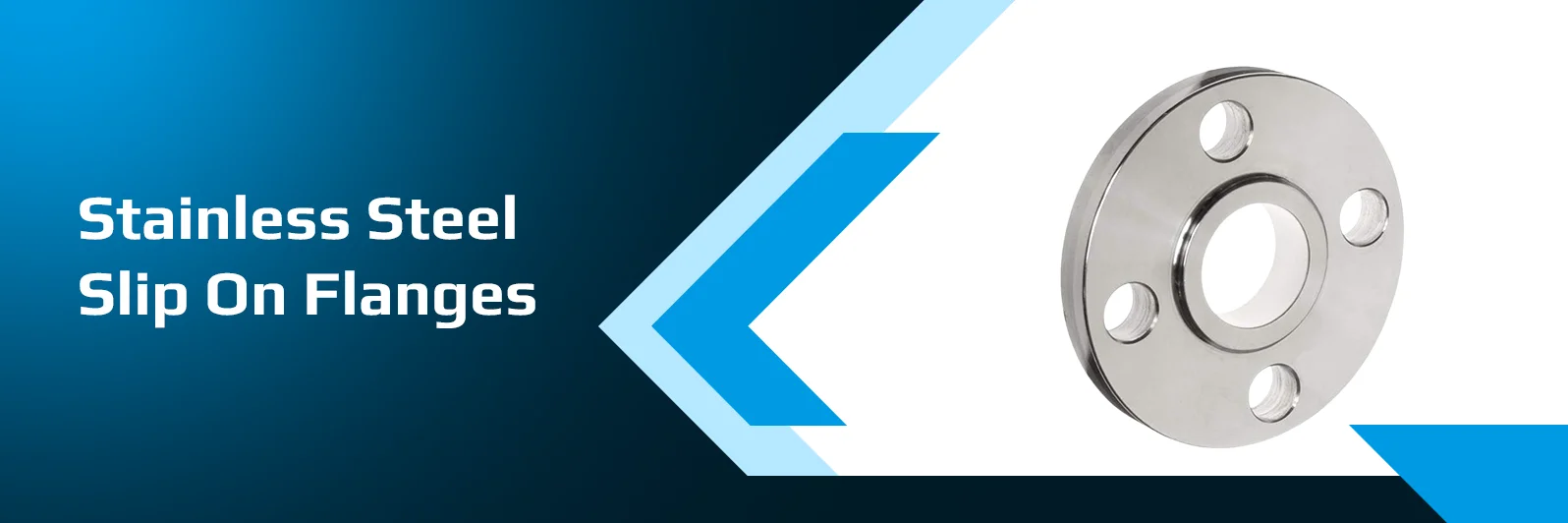
A slip-on flange is cheaper twice over. Cheaper to buy, and cheaper to fit, because the pipe slides in and the cut length does not have to be precise. The trade is fatigue life: two fillet welds carry the load where a weld neck has one butt weld and a tapered hub, so under repeated cycling the slip-on gives out first. That is a trade worth making on a low pressure utility line and a poor one on a hot cycling header. Solitaire Overseas supplies stainless steel slip-on flanges from India.
Part of our stainless steel flanges range. Compare with weld neck flanges.
Both fillet welds sit at the flange itself, right where bending stress is highest, and neither has a tapered hub to spread the load into. Under static pressure that is of no consequence. Under repeated cycling, thermal movement or vibration, it is the reason slip-on flanges have shorter fatigue life than weld neck, and it is why project specifications restrict them above certain classes.
| Service | Slip-On Suitable? | Comment |
|---|---|---|
| Low pressure, static, Class 150 to 300 | Yes | The type's natural home. Cost saving is real and the limitation does not bite |
| Moderate pressure, non-cycling | Usually | Check the piping class |
| Class 600 and above | Often restricted | Many specifications require weld neck at higher classes |
| Cyclic, vibrating or thermally cycling | No | This is exactly where the two fillet welds fail first |
| Erosive or corrosive medium | Prefer weld neck | The pipe end sits inside the flange with a recess, which can trap medium |
| Standard | Coverage |
|---|---|
| ASME B16.5 | NPS 1/2 inch to 24 inch, Class 150 to 2500 |
| ASME B16.47 Series A and B | NPS 26 inch to 60 inch. Series A and B are NOT interchangeable |
| ASTM A182 | Forged stainless material specification |
| ASME B16.20 / B16.21 | Gasket standards for RTJ and flat gaskets |
| Grade | Typical Selection Reason |
|---|---|
| 304 / 304L | General service. The volume grade |
| 316 / 316L | Chloride exposure, marine atmosphere, chemical duty |
| 321 / 347 and H variants | Elevated temperature, stabilized against sensitization |
| 904L, duplex, super duplex | Aggressive chloride or high strength requirement |
Flat face and raised face are the usual options. Slip-on flanges are not normally supplied in ring type joint, since RTJ belongs to the high class service where slip-on is generally not specified anyway.
Construction and load path. A slip-on has no hub; the pipe slides into the flange bore and is fixed by two fillet welds, one inside and one outside. A weld neck has a long tapered hub and joins by a single butt weld at the end of it, away from the flange base. The slip-on is cheaper to buy and quicker to align, but has lower fatigue life, so weld neck is specified where pressure, temperature or cycling matter.
Yes. The internal fillet seals the joint and prevents a crevice at the pipe end, while the external fillet carries most of the structural load. Both are required. Omitting the internal weld to save time leaves a crevice in the bore and a joint that does not meet the standard.
They are made across the standard classes, but in practice they are used at Class 150 and 300, sometimes 600. Many project specifications restrict or prohibit slip-on flanges above certain classes and in cyclic service. Check the piping class rather than assuming availability equals acceptability.
Because the pipe slides into the flange bore, the cut length does not have to be precise and alignment is forgiving. On a fabrication with many joints, that labour saving often exceeds the material saving. The offset is that a slip-on needs two fillet welds where a weld neck needs one butt weld.
Send your size, class, facing and grade. If the line cycles, runs hot, or sits above Class 600, tell us and we will say whether a weld neck is the better specification before quoting.