+91-9619103479
or
vishal@solitaire-overseas.com
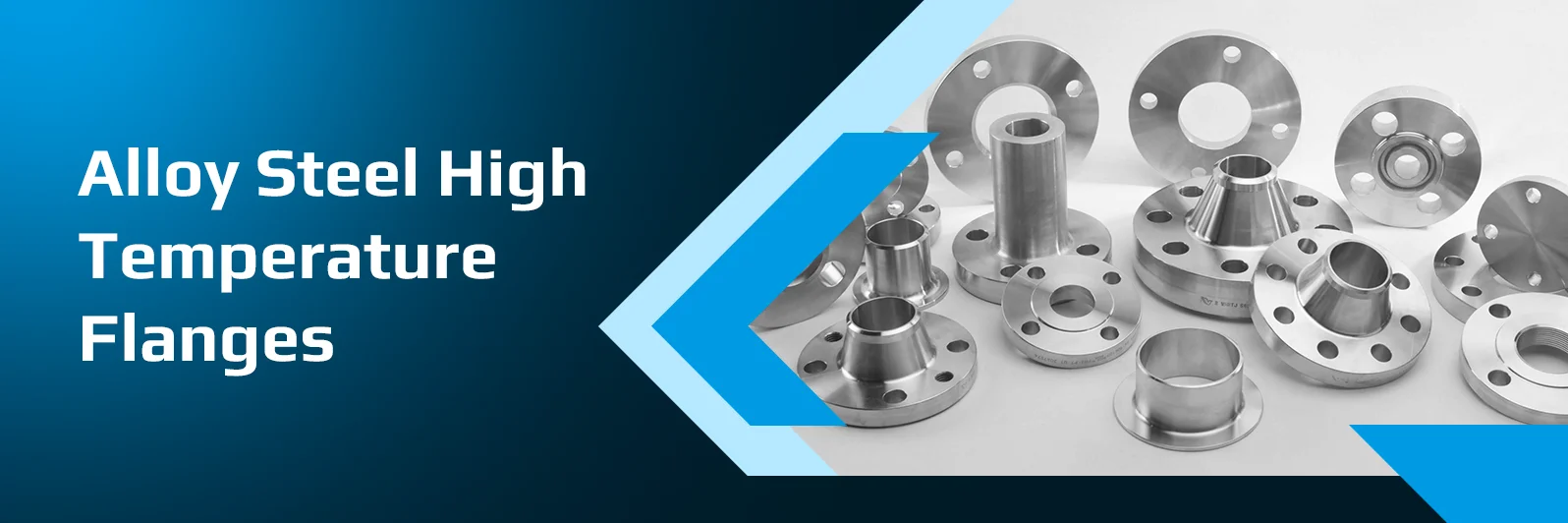
Alloy Steel High Temperature Flanges are forged piping elements with pressure and strength to ensure the stability of the system under high temperature conditions. These flanges are made of chrome-molybdenum alloy steels, which provide resistance to thermal stress, creep and oxidation if the material grade and operating conditions are compatible. Typical grades are ASTM A182 F5, F11, F22 and F91 found in thermal power plants, refinery processing units, boiler lines and high-temperature steam pipe-lines etc. Selecting a product depends on factors such as temperature, pressure class, flange size, heat treatment, and applicable standards, such as ASME B16.5 and ASME B16.47. Alloy steel high temperature flanges are trusted manufacturers and suppliers in India by Solitaire overseas and are used in different industries across the globe.
| Feature / Parameter | Specification / Specification Limits |
|---|---|
|
Manufacturing Standards |
ASME B16.5, ASME B16.47 (Series A & B), EN 1092-1, BS 4504, DIN standards |
|
Material Specifications |
ASTM A182 / ASME SA182 (Forged Alloy Steel Piping Components) |
|
Primary Material Grades |
F1, F5, F9, F11 Class 2, F12 Class 2, F22 Class 3, F91 (P91 pipe-matching) |
|
Size Range |
1/2"NB to 24"NB (ASME B16.5); 26"NB to 60"NB (ASME B16.47) |
|
Pressure Classes |
Class 150, Class 300, Class 600 (For Class 900–2500, see high-pressure range) |
|
Sustained Service Ceiling |
Up to 650°C (1202°F) continuous exposure (grade-dependent) |
|
Heat Treatment Condition |
Normalized and Tempered (N+T) per ASTM A182 requirements |
|
Testing & Inspection |
PMI (100% heat verification), Hardness Survey, UT, MPI, Impact Testing |
|
Certification & Traceability |
EN 10168 / EN 10204 Type 3.1 (Type 3.2 available with TPI on request) |
| ASTM Grade | UNS No. | Carbon (C) | Manganese (Mn) | Phosphorus (P) max | Sulfur (S) max | Silicon (Si) | Chromium (Cr) | Molybdenum (Mo) | Micro-Alloying / Other Elements |
|---|---|---|---|---|---|---|---|---|---|
|
F1 |
K11522 |
0.28 max |
0.60–0.90 |
0.045 |
0.045 |
0.15–0.35 |
0.00 (Dash) |
0.44–0.65 |
— |
|
F11 Class 2 |
K11572 |
0.10–0.20 |
0.30–0.80 |
0.040 |
0.040 |
0.50–1.00 |
1.00–1.50 |
0.44–0.65 |
— |
|
F12 Class 2 |
K11564 |
0.10–0.20 |
0.30–0.80 |
0.040 |
0.040 |
0.10–0.60 |
0.80–1.25 |
0.44–0.65 |
— |
|
F22 Class 3 |
K21590 |
0.05–0.15 |
0.30–0.60 |
0.040 |
0.040 |
0.50 max |
2.00–2.50 |
0.87–1.13 |
— |
|
F5 |
K41545 |
0.15 max |
0.30–0.60 |
0.030 |
0.030 |
0.50 max |
4.00–6.00 |
0.44–0.65 |
Ni: 0.50 max |
|
F9 |
K90941 |
0.15 max |
0.30–0.60 |
0.030 |
0.030 |
0.50–1.00 |
8.00–10.00 |
0.90–1.10 |
Ni: 0.50 max |
|
F91 |
K91560 |
0.08–0.12 |
0.30–0.60 |
0.020 |
0.010 |
0.20–0.50 |
8.00–9.50 |
0.80–1.05 |
V: 0.18–0.25, Nb: 0.06–0.10, N: 0.03–0.07, Ni: 0.40 max |
| ASTM Grade | Tensile Strength, min [MPa (ksi)] | Yield Strength (0.2% offset), min [MPa (ksi)] | Elongation in 2 in. (50 mm), min (%) | Reduction of Area, min (%) | Brinell Hardness Range (HBW) |
|---|---|---|---|---|---|
|
F1 |
485 MPa (70 ksi) |
275 MPa (40 ksi) |
20% |
35% |
143 – 197 |
|
F11 Class 2 |
485 MPa (70 ksi) |
275 MPa (40 ksi) |
20% |
30% |
143 – 207 |
|
F12 Class 2 |
485 MPa (70 ksi) |
275 MPa (40 ksi) |
20% |
30% |
143 – 207 |
|
F22 Class 3 |
515 MPa (75 ksi) |
310 MPa (45 ksi) |
20% |
30% |
156 – 207 |
|
F5 |
485 MPa (70 ksi) |
275 MPa (40 ksi) |
20% |
35% |
143 – 217 |
|
F9 |
585 MPa (85 ksi) |
380 MPa (55 ksi) |
20% |
40% |
179 – 217 |
|
F91 |
585 MPa (85 ksi) |
415 MPa (60 ksi) |
20% |
40% |
190 – 248 |
| Temperature (°C) | Temperature (°F) | Group 1.9 (F11 Cl. 2) [bar / psig] | Group 1.10 (F22 Cl. 3) [bar / psig] | Group 1.13 (F5) [bar / psig] | Group 1.18 (F91) [bar / psig] |
|---|---|---|---|---|---|
|
38°C |
100°F |
103.4 bar / 1500 psig |
103.4 bar / 1500 psig |
103.4 bar / 1500 psig |
103.4 bar / 1500 psig |
|
300°C |
572°F |
88.6 bar / 1285 psig |
90.8 bar / 1317 psig |
84.1 bar / 1220 psig |
99.1 bar / 1437 psig |
|
400°C |
752°F |
81.3 bar / 1179 psig |
83.2 bar / 1207 psig |
73.2 bar / 1062 psig |
90.5 bar / 1313 psig |
|
500°C |
932°F |
55.7 bar / 808 psig |
62.1 bar / 901 psig |
48.0 bar / 696 psig |
76.5 bar / 1110 psig |
|
550°C |
1022°F |
28.5 bar / 413 psig |
38.3 bar / 555 psig |
28.8 bar / 418 psig |
67.7 bar / 982 psig |
|
600°C |
1112°F |
11.2 bar / 162 psig |
18.0 bar / 261 psig |
13.9 bar / 202 psig |
45.3 bar / 657 psig |
|
650°C |
1202°F |
Outside Standard |
Outside Standard |
5.7 bar / 83 psig |
19.8 bar / 287 psig |
Alloy steel high temperature flanges are forged pipe connection components designed to withstand elevated temperatures, pressure, and thermal stress.
They are used in thermal power plants, boilers, refineries, petrochemical plants, and high-temperature steam piping systems.
F11 contains chromium and molybdenum for high-temperature strength, F22 has higher chromium and molybdenum content, and F91 is a 9% chromium-molybdenum alloy designed for demanding high-temperature service.
Yes. Grades such as ASTM A182 F11, F22, and F91 are used in high-pressure steam systems when selected for the specified pressure and temperature conditions.
This page covers Class 150, 300 and 600. For Class 900, 1500 and 2500, see our alloy steel high pressure flanges page
PWHT may be required depending on the material grade, wall thickness, welding procedure, service conditions, and applicable construction code.