+91-9619103479
or
vishal@solitaire-overseas.com
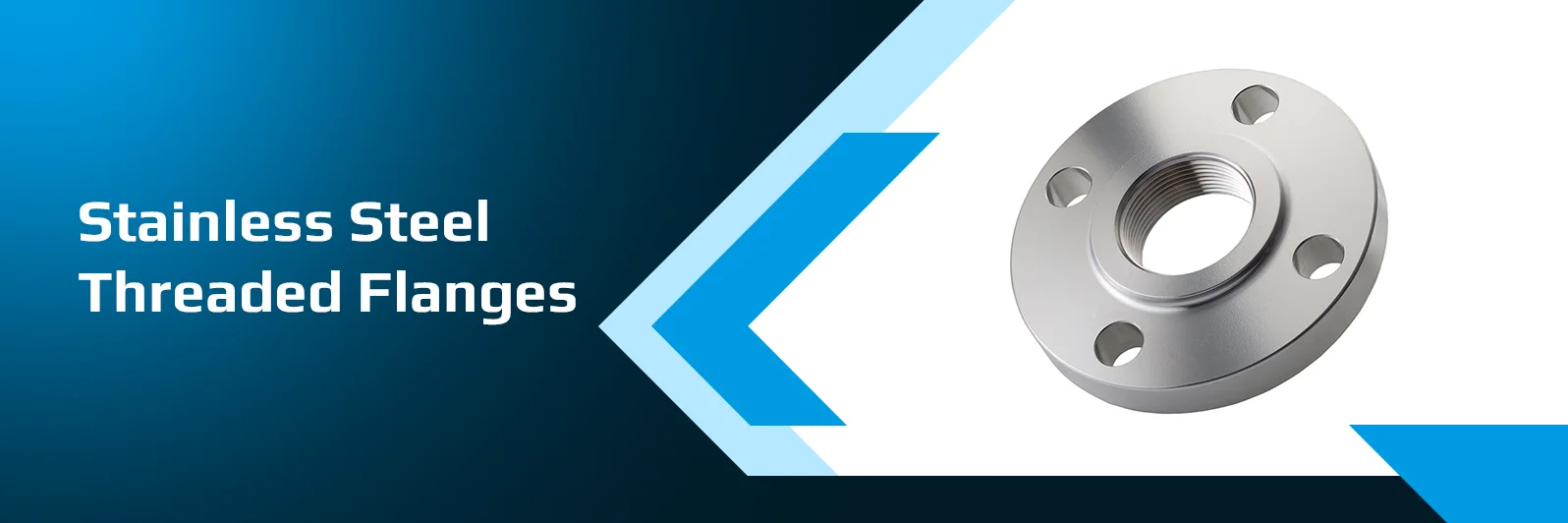
A threaded flange is the answer when welding is not allowed. Not inconvenient, not expensive, actually prohibited: a live plant where a hot work permit cannot be obtained, a hazardous area, a galvanized or lined pipe that welding would destroy. In those situations a threaded flange connects the line with a spanner and nothing else. Solitaire Overseas supplies stainless steel threaded flanges from India, and this page is as much about when not to use one as when to.
Part of our stainless steel flanges range.
Threads loosen under vibration and cycling. Thread sealant and correct make-up help, but they do not change the mechanism: a threaded joint is held by an interference fit that repeated movement works against. This is not a marginal concern, it is the reason threaded flanges are restricted in most process piping specifications.
| Condition | Threaded Suitable? | Comment |
|---|---|---|
| Static, low pressure, small bore | Yes | The type's proper home |
| Hazardous area where hot work is barred | Yes | This is the reason the type exists |
| Vibrating or cyclic service | No | Threads back out over time regardless of sealant |
| High pressure | Restricted | Cutting the thread removes wall. Class capability is limited |
| High temperature | No | Differential expansion works the thread. Sealants also have temperature limits |
| Large bore | No | Not made or used at large sizes |
| Item | Detail |
|---|---|
| Material standard | ASTM A182 forged stainless |
| Dimensional standard | ASME B16.5 |
| Thread standard | ASME B1.20.1 NPT taper thread. BSPT and BSPP on request |
| Typical classes | 150, 300, 600. Higher classes uncommon in this type |
| Size range | Small bore, typically up to about 4 inch |
| Facings | Flat face and raised face |
| Certification | EN 10204 3.1. PMI on request |
| Grade | Typical Selection Reason |
|---|---|
| 304 / 304L | General service. The volume grade |
| 316 / 316L | Chloride exposure, marine atmosphere, chemical duty |
| 321 / 347 and H variants | Elevated temperature, stabilized against sensitization |
| 904L, duplex, super duplex | Aggressive chloride or high strength requirement |
When welding is not permitted or not practical: hazardous areas where a hot work permit cannot be obtained, live plant modifications where shutting down is impractical, and galvanized or lined pipe that welding would damage. It is also used on small bore utility and instrument lines where the duty is modest and speed matters.
No. Threads loosen under vibration and cycling, and thread sealant does not change that. A threaded joint is held by an interference fit that repeated movement works against. Most process piping specifications restrict threaded flanges for this reason, and on a vibrating line a welded joint is the correct choice.
Typically Class 150, 300 and 600. Higher classes are uncommon in this type because cutting the thread removes wall material, which limits pressure capability. Where the design pressure is high, a socket weld or weld neck flange is the appropriate choice.
NPT taper thread to ASME B1.20.1 is the standard. BSPT and BSPP are available on request. State the thread form when ordering, since NPT and BSP are not interchangeable and will not seal against one another.
Send your size, class, thread form, facing and grade. If the line vibrates, cycles or runs hot, tell us and we will say whether a welded type is the better specification before quoting.