+91-9619103479
or
vishal@solitaire-overseas.com
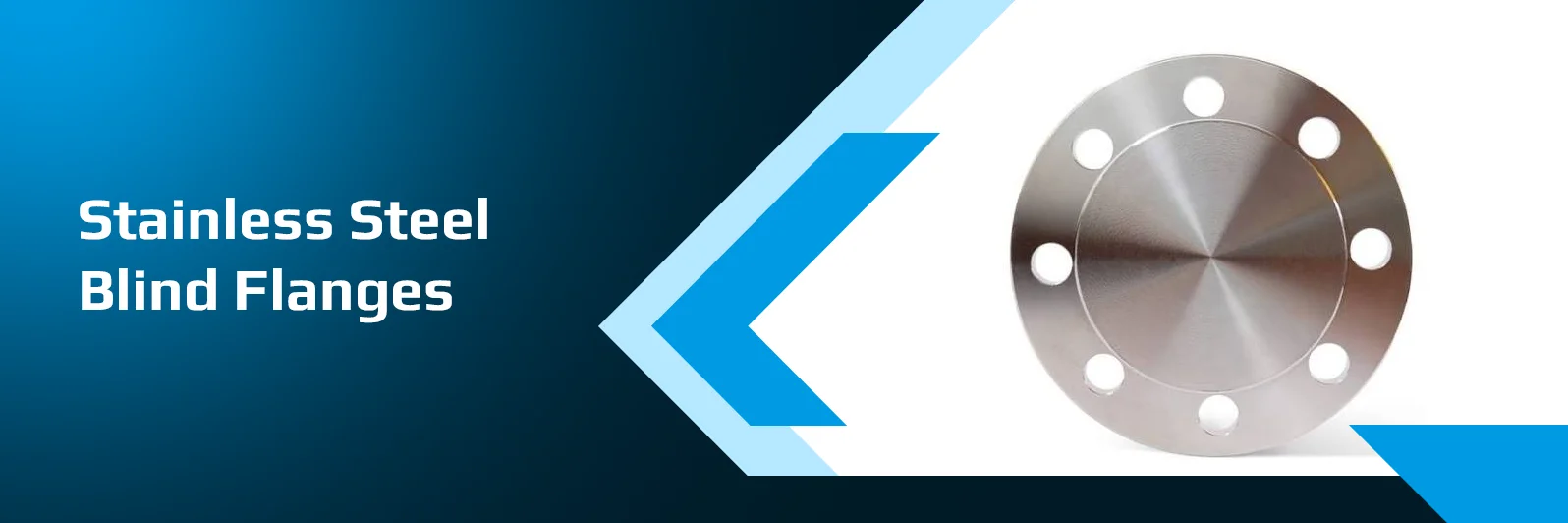
A blind flange is the only flange that connects to nothing. There is no bore, no pipe, no weld, just a solid disc with a bolt pattern, and its job is to close an opening that may one day need to open again. That last part is what separates it from a welded cap, and it is usually why a blind is on the drawing rather than a cap. Solitaire Overseas supplies stainless steel blind flanges from India, Class 150 through 2500.
Part of our stainless steel flanges range.
Both close off an opening. The difference is whether it ever reopens:
| Blind Flange | Welded Cap | |
|---|---|---|
| Joint | Bolted to a mating flange | Welded to the pipe |
| Removal | Undo the bolts | Cut it off |
| Reopening | Routine | Hot work, and a new cap |
| Use when | The opening may be reopened, tested through, or extended later | The closure is permanent |
| Cost in place | Higher, needs a mating flange, gasket and bolting | Lower |
The decision is about the future, not the present. A blind costs more to install because it needs a mating flange, gasket and bolt set. It earns that back the first time someone needs access without a hot work permit. If the drawing shows a blind where a cap would do, the designer is usually anticipating a tie-in, an inspection point or a test connection.
| Standard | Coverage |
|---|---|
| ASME B16.5 | NPS 1/2 inch to 24 inch, Class 150 to 2500 |
| ASME B16.47 Series A and B | NPS 26 inch to 60 inch. Series A and B are NOT interchangeable |
| ASTM A182 | Forged stainless material specification |
| ASME B16.20 / B16.21 | Gasket standards for RTJ and flat gaskets |
Facing. Flat face, raised face and ring type joint, matching whatever the mating flange carries. A blind must match its partner in class, facing and drilling, so specify the mating flange when ordering if there is any doubt.
| Grade | Typical Selection Reason |
|---|---|
| 304 / 304L | General service. The volume grade |
| 316 / 316L | Chloride exposure, marine atmosphere, chemical duty |
| 321 / 347 and H variants | Elevated temperature, stabilized against sensitization |
| 904L, duplex, super duplex | Aggressive chloride or high strength requirement |
BLIND OR SPECTACLE BLIND? Where a line needs to be switched between open and isolated repeatedly, a spectacle blind (a paddle and ring on one piece) is often the better fitting, because the changeover is a rotation rather than a removal and the isolation state is visible from a distance. If Solitaire supplies them, that is a separate page and should be cross-linked from here.
A blind flange is normally thicker than other flange types in the same size and class. The reason is straightforward once stated: every other flange transfers pressure load into the pipe it is welded to, while a blind has to carry the full pressure across an unsupported disc. The bending moment at the centre is carried by thickness alone, so the thickness has to rise, particularly in the larger sizes and higher classes where a blind can become a genuinely heavy item to handle.
Closing an opening that may need to be reopened. Common uses are terminating a line left for a future tie-in, blanking a system for pressure testing, positive isolation during maintenance, and closing spare nozzles on vessels and headers. It is the only flange type with no bore and no pipe connection.
How it is fixed. A blind flange bolts to a mating flange, so it comes off with a spanner. A welded cap is welded to the pipe and has to be cut off to remove. Use a blind where the closure may reopen and a cap where it is permanent. The blind costs more in place because it needs a mating flange, gasket and bolting, and earns that back the first time access is needed without hot work.
Because they carry the pressure load across an unsupported disc. Every other flange type transfers load into the pipe it is welded to, while a blind has to resist the bending moment at its centre by thickness alone. That is why blinds are heavier than other types in the same size and class, and why large bore high class blinds become a handling consideration.
Yes, in class, facing and drilling. A raised face blind pairs with a raised face flange, an RTJ blind with an RTJ flange, and the bolt circle and hole count must match. If there is any doubt, specify the mating flange when ordering rather than the blind alone.
Send your size, class, facing and grade, and if possible the mating flange details so the drilling and facing can be matched exactly.